
By the HMNDP Editorial Team, independent reporting on lawn care, landscaping, water, and the green-industry business.
Last reviewed: June 2026
What an irrigation pump is and what it does
An irrigation pump is a device that moves water from a source (well, pond, lake, tank, or pressurized line) and pressurizes it enough to run sprinkler heads or drip emitters. It supplies two things at once: flow, measured in gallons per minute (GPM), and pressure, measured in pounds per square inch (PSI). Without both, sprinkler heads will not pop up or throw to spec.
Sprinkler heads typically need 30 to 50 PSI at the head and a set GPM per zone. The pump’s job is to deliver that after losses from suction lift, elevation, and pipe friction. Match the pump to the system, not the other way around. For broader system planning, see our irrigation system guide.
Types of irrigation pumps
Irrigation pumps fall into four common types: centrifugal, jet (shallow-well and deep-well), submersible, and booster. The right one depends mostly on how far below the pump the water sits. Centrifugal and shallow jet pumps handle shallow sources, deep-well jet pumps reach moderate depths, and submersibles handle the deepest wells. Booster pumps add pressure to water that is already pressurized.
Centrifugal pumps
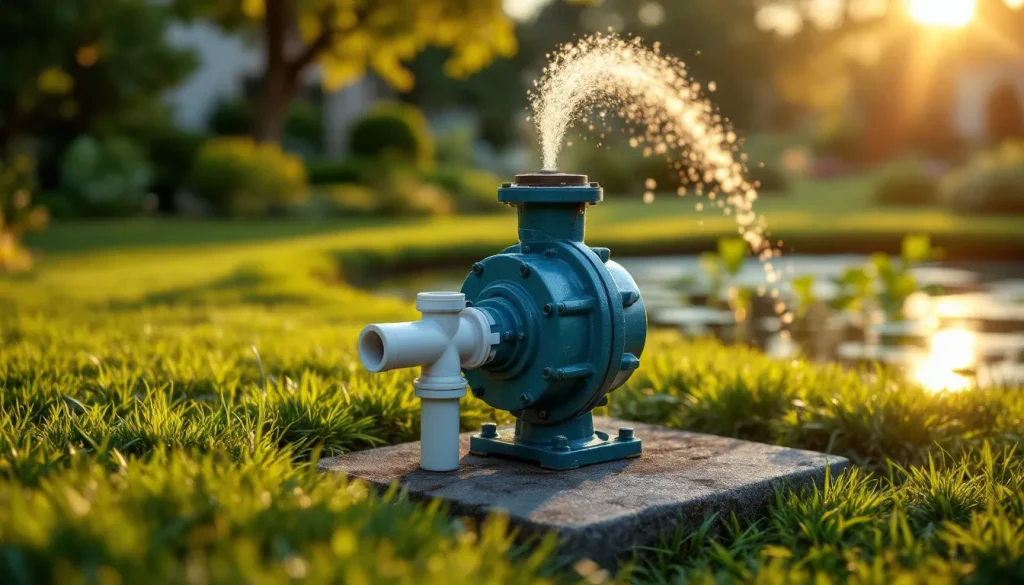
A centrifugal pump is the most common irrigation pump type. A spinning impeller flings water outward to create flow and pressure. It sits above the water and pulls from a shallow source such as a pond, lake, tank, or shallow well. Centrifugal pumps are simple, affordable, and easy to service, which is why they dominate residential sprinkler setups drawing from surface water within about 25 feet of suction lift.
Jet pumps (shallow well vs deep well)
A jet pump uses a jet (venturi) assembly to help lift water. Shallow-well jet pumps work for water within roughly 25 feet of the surface. Deep-well jet pumps use a second pipe and a downhole jet to reach water from about 25 to 110 feet. Jet pumps are self-priming once charged, which makes them forgiving for homeowners who do not want to fuss with priming every cycle.
Submersible pumps
A submersible pump sits underwater inside the well casing and pushes water up rather than sucking it. Because pushing beats pulling, submersibles handle the deepest sources, generally beyond 110 feet. They run quietly and prime themselves since they are always underwater, but servicing one means pulling it out of the well, which raises labor cost.
Booster pumps
A booster pump adds pressure to water that already arrives under some pressure, such as a city water line or a downstream tank. It does not lift water from a dry source. Use a booster when your municipal supply delivers enough volume but not enough PSI to run sprinklers or a long drip run. Boosters pair well with low-pressure drip irrigation systems on city water.
Match the irrigation pump type to your water source depth
Water source depth is the single biggest factor in choosing a pump type. Suction (pulling) is limited by physics to roughly 25 feet, so anything deeper needs a pump that pushes from below. Use the table to match source to pump.
| Water source / depth to water | Recommended pump type | Notes |
|---|---|---|
| Pond, lake, tank, shallow well (under 25 ft) | Centrifugal or shallow-well jet | Sits above water, pulls by suction |
| Well 25 to 110 ft deep | Deep-well jet pump | Two-pipe system with downhole jet |
| Well deeper than 110 ft | Submersible pump | Sits in the well, pushes water up |
| City water or pre-pressurized line (low PSI) | Booster pump | Adds pressure, does not lift |
Sprinkler pump vs irrigation pump: the difference
A sprinkler pump and an irrigation pump are not exact synonyms, though retailers often blur them. “Sprinkler pump” usually means a self-priming centrifugal pump built for high flow at moderate pressure, pulling from a shallow surface source to feed lawn sprinkler zones. “Irrigation pump” is the broader umbrella covering every pump type that feeds any irrigation system, including drip, deep wells, and city-water boosters.
| Aspect | Sprinkler pump | Irrigation pump (general) |
|---|---|---|
| Scope | Subtype, usually centrifugal | All pump types |
| Typical use | Lawn sprinkler zones, shallow source | Sprinkler, drip, wells, boosters |
| Priority | High GPM at moderate PSI | Varies by system and source |
| Source depth | Shallow (under 25 ft) | Shallow to very deep |
Practical takeaway: every sprinkler pump is an irrigation pump, but not every irrigation pump is a sprinkler pump. If you draw from a shallow pond to run pop-up heads, a self-priming sprinkler pump is the specific tool you want.
How to size an irrigation pump
Sizing an irrigation pump means matching two numbers to your system: required flow rate in GPM and Total Dynamic Head (TDH). Add up the GPM of the largest zone that runs at once, calculate TDH from lift, elevation, friction, and required pressure, then pick a pump whose performance curve delivers that GPM at that head with a 10 to 25 percent safety buffer.
Step 1: Find required flow rate (GPM)
Required flow rate is the total GPM your hardest-working zone demands. Add up the flow of every head or emitter that runs simultaneously in your largest zone, since the pump only has to feed one zone at a time on most controllers. A typical rotor head uses 2 to 4 GPM and a spray head 1 to 2 GPM. Five rotors at 3 GPM each equals 15 GPM required.
Step 2: Calculate Total Dynamic Head (TDH)
Total Dynamic Head is the total resistance the pump must overcome, expressed in feet of head. It has four parts: suction lift (vertical distance from water up to the pump), elevation gain (pump up to the highest head), friction loss (resistance inside pipe and fittings), and the required operating pressure converted to feet. Add the four to get TDH.
The key conversion: PSI x 2.31 = feet of head. So 40 PSI at the sprinkler head equals 40 x 2.31, or about 92.4 feet of head. This single conversion lets you fold pressure into the same units as lift and elevation.
Step 3: Account for friction loss
Friction loss is the pressure the system burns off as water rubs against pipe walls and fittings. It rises with flow rate, longer runs, and smaller pipe diameter. As a working estimate, friction loss often adds 10 to 25 percent on top of static head for a residential layout, but charts from pipe makers (rated per 100 feet at a given GPM) give a precise figure. Undersized pipe is a common cause of weak sprinkler performance.
Step 4: Read the pump performance curve
A pump performance curve plots GPM against the head the pump can produce. Find your required GPM on the bottom axis, go up to the curve, and read the head on the side axis. The pump fits if that head meets or exceeds your TDH. Aim to operate near the Best Efficiency Point (BEP), the spot on the curve where the pump runs most efficiently and lasts longest.
Step 5: Add a safety buffer
Add 10 to 25 percent to your calculated TDH before choosing a pump. Real systems lose performance to clogged filters, aging pipe, partly closed valves, and worn impellers. A buffer keeps sprinklers throwing to spec years later. Do not oversize wildly though, since a pump running far left of its curve wastes energy and can shorten its own life.
Worked example: sizing a pump for a real 4-zone lawn
Here is the end-to-end calculation most guides skip. Take a 4-zone residential lawn drawing from a pond, with the busiest zone running five rotor heads. We will compute GPM, TDH, and the recommended horsepower so you can copy the method with your own numbers.
The system:
- Largest zone: 5 rotor heads at 3 GPM each = 15 GPM required
- Suction lift (pond surface up to pump): 10 ft
- Elevation gain (pump up to highest head): 15 ft
- Required head pressure: 45 PSI
- Pipe run to zone: about 200 ft of 1.25-inch pipe
The math:
- Convert required pressure: 45 PSI x 2.31 = 104 ft of head
- Add suction lift: 104 + 10 = 114 ft
- Add elevation gain: 114 + 15 = 129 ft
- Add friction loss (estimate about 15 ft over this run at 15 GPM): 129 + 15 = 144 ft static-plus-friction TDH
- Add a 15 percent safety buffer: 144 x 1.15 = 166 ft design TDH
The result: you need a pump that delivers 15 GPM at roughly 166 feet of head (about 72 PSI of total work). On most manufacturer curves, that lands a 1.5 HP to 2 HP self-priming centrifugal or multi-stage pump. A 1 HP unit would fall short on head at this flow. Plug your own four numbers into the same five steps and the curve tells you the rest.
Irrigation pump horsepower, capacity, and price
Horsepower scales with both flow and head. As a rough residential guide, a 1 HP pump suits small lawns with a handful of heads per zone, 1.5 HP covers mid-size systems, and 2 HP serves larger or higher-pressure layouts. The table pairs typical HP with capacity and 2026 US price bands for the pump unit alone (installation, wiring, and plumbing are extra).
| Horsepower | Typical GPM | Approx. spray/rotor heads per zone | Best for | 2026 price band (pump only) |
|---|---|---|---|---|
| 1 HP | 10 to 20 GPM | 4 to 8 heads | Small lawn, shallow source | $200 to $400 |
| 1.5 HP | 15 to 35 GPM | 6 to 12 heads | Mid-size lawn, moderate head | $300 to $600 |
| 2 HP | 25 to 50 GPM | 10 to 18 heads | Large or high-pressure systems | $450 to $900 |
Prices vary by brand, material (cast iron vs stainless), and retailer. Submersible and deep-well jet pumps typically cost more than equivalent centrifugal units because of the downhole hardware. Treat these as planning ranges, not quotes, since pricing can shift with supply and region.
How to prime, maintain, and winterize an irrigation pump
Most irrigation pumps fail from neglect, not wear. The three habits that keep a pump alive are correct priming, seasonal maintenance, and winterizing before the first hard freeze. Self-priming and submersible pumps skip the manual prime, but every above-ground centrifugal pump needs its case filled with water before the first start.
Priming a centrifugal pump
- Close the discharge valve if equipped.
- Remove the priming plug on top of the pump housing.
- Fill the pump case and suction line completely with water until it overflows.
- Reinstall the plug and start the pump. It should build pressure within a minute.
- If it loses prime, check the foot valve and suction line for air leaks.
Running a centrifugal pump dry even briefly can destroy the mechanical seal, so never start one empty.
Routine maintenance
- Clean the intake screen or foot valve every few weeks during the season.
- Check for leaks at fittings and the shaft seal.
- Listen for cavitation (a gravelly rattle) that signals starved suction.
- Keep the motor vents clear and dry.
- Confirm pressure and flow match your design numbers; a drop signals a clog or worn impeller.
For diagnosing weak zones, low pressure, or short cycling, see our guide to irrigation repair.
Winterizing and freeze protection
- Shut off power at the breaker.
- Close the supply, then open the drain plugs to empty the pump case fully.
- Blow out or drain the suction and discharge lines so no water remains to freeze and crack the housing.
- For above-ground pumps, store removable units indoors or insulate and cover the pump.
- In spring, re-prime before the first start.
Trapped water expanding in a frozen pump body is one of the most common reasons a pump needs replacing, and it is fully preventable. Browse more seasonal how-tos in the HMNDP learn library.
Residential vs commercial irrigation pump considerations
Residential and small-acreage systems usually run one zone at a time on a timer, so a single 1 to 2 HP pump near its Best Efficiency Point covers most lawns and small drip plots. Commercial sites run more zones, longer runs, and higher simultaneous demand, which pushes toward larger horsepower, multi-stage or multiple pumps, variable-frequency drives, and professional hydraulic design.
For homeowners and small-acreage growers, the decision tree is simple: identify your source depth to pick the type, size by GPM and TDH with a buffer, match to a pump curve, and budget by horsepower band. Commercial buyers should add staged pumps and a designer to the same fundamentals.
Frequently Asked Questions
How do I size an irrigation pump for my system?
Size an irrigation pump in two numbers: required flow (GPM) and Total Dynamic Head (TDH). Add the GPM of every head in your largest single zone. Calculate TDH by summing suction lift, elevation gain, friction loss, and required pressure (PSI x 2.31 = feet). Add a 10 to 25 percent buffer, then pick a pump whose performance curve delivers that GPM at that head.
What is the difference between a sprinkler pump and an irrigation pump?
A sprinkler pump is a specific type, usually a self-priming centrifugal pump built for high flow at moderate pressure from a shallow surface source to run lawn sprinklers. An irrigation pump is the broad category covering every pump that feeds any irrigation system, including drip, deep wells, and city-water boosters. Every sprinkler pump is an irrigation pump, but not the reverse.
What size irrigation pump do I need for my lawn (how many sprinkler heads)?
Size by the heads in your busiest zone, not the whole lawn, since most systems run one zone at a time. As a rough guide, 1 HP handles 4 to 8 heads, 1.5 HP handles 6 to 12, and 2 HP handles 10 to 18, assuming moderate head. Confirm with a real GPM and TDH calculation against the pump curve.
What type of irrigation pump is best for my water source (well, pond, or city water)?
Match the type to source depth. For a pond, lake, or shallow well under 25 feet, use a centrifugal or shallow-well jet pump. For wells 25 to 110 feet, use a deep-well jet pump. Beyond 110 feet, use a submersible. For city water that has volume but low PSI, use a booster pump to add pressure.
How much does an irrigation pump cost?
In 2026, residential pump units alone typically run $200 to $400 for 1 HP, $300 to $600 for 1.5 HP, and $450 to $900 for 2 HP. Submersible and deep-well jet pumps cost more because of downhole hardware. Installation, wiring, and plumbing are extra. Prices vary by brand, material, and region, so treat these as planning ranges.
What is Total Dynamic Head (TDH) and how do I calculate it?
Total Dynamic Head is the total resistance a pump must overcome, in feet. Add four parts: suction lift (water up to pump), elevation gain (pump up to highest head), friction loss in pipe and fittings, and required pressure converted with PSI x 2.31 = feet. Sum them, then add a 10 to 25 percent safety buffer before selecting a pump from its performance curve.
How many GPM and PSI does a residential irrigation pump need?
Most residential systems need 10 to 35 GPM for the busiest zone and 30 to 50 PSI at the sprinkler heads. Rotor heads use 2 to 4 GPM each, spray heads 1 to 2 GPM. Add the heads in your largest zone for total GPM. The pump must deliver that flow at enough head to supply the required head pressure plus all losses.
How do I winterize and maintain an irrigation pump?
Before the first freeze, cut power, close the supply, open all drain plugs to empty the pump case, and blow out or drain the lines so no water can freeze and crack the housing. Store or insulate above-ground units. During the season, clean the intake screen, check for leaks, watch for cavitation, and re-prime centrifugal pumps each spring before starting.