
By the HMNDP Editorial Team. Last reviewed: June 2026.
Garden irrigation, decided in one table
Garden irrigation delivers water straight to plant roots on a schedule, which cuts water use 30 to 50 percent versus hand-watering or sprinklers and saves you 20-plus minutes a day in summer. For most home gardens, vegetable beds, and raised beds, a drip system is the best fit. Soaker hoses suit tight rows and tight budgets. Micro-spray covers dense ground cover. In-ground sprinklers fit lawns, not beds.
Pick by layout, not by whichever brand ranks first. The table below maps the four common system types to where each one actually wins.
| System type | Best for | Water efficiency | DIY difficulty | Typical cost (small garden) |
|---|---|---|---|---|
| Drip (tubing + emitters) | Vegetable rows, raised beds, spaced plants, containers | Highest (90%+ to root zone) | Easy to moderate | $40 to $120 kit |
| Soaker hose | Straight rows, hedges, narrow beds under 25 ft | High but uneven over length | Easiest | $15 to $40 |
| Micro-spray / misters | Dense ground cover, seedlings, flower beds | Moderate (some evaporation) | Moderate | $30 to $90 |
| In-ground sprinkler | Lawns and large open turf, not garden beds | Lower (overspray, wind) | Hard (trenching) | $300 to $1,500+ |
For deeper component-level coverage, see our drip irrigation system guide and the broader irrigation system guide.
Drip irrigation systems and kits for gardens
Drip irrigation runs low-pressure water through 1/2-inch mainline tubing, then drips it out through emitters placed at each plant. It is the most water-efficient method for gardens because over 90 percent of the water reaches the root zone with almost no evaporation or runoff. A starter kit covers a small bed; you expand by adding tubing and emitters.
Kits from brands like Rain Bird, DIG, Rachio, and Orbit bundle the mainline, emitters, connectors, a pressure regulator, and a filter into one box. Expect $40 to $120 for a kit that handles roughly 75 to 150 square feet. Emitters come in fixed flow rates, commonly 0.5, 1, and 2 gallons per hour (GPH), so you match output to plant thirst.
- Pressure-compensating emitters deliver the same flow at the start and end of a long run, which matters on beds over 25 feet.
- Drip line (inline tubing) has emitters pre-spaced every 6, 9, or 12 inches, ideal for dense rows of carrots, lettuce, or onions.
- Point-source emitters plug in individually for spaced plants like tomatoes, peppers, and shrubs.
Soaker hoses as a watering method
A soaker hose is a porous rubber hose that weeps water along its entire length, wetting a strip of soil about 12 inches wide. It is the cheapest entry to garden irrigation at $15 to $40 and needs no emitters or assembly. You lay it along a row, connect it to a spigot, and turn it on at low pressure.
The tradeoff is even-ness. Soaker hoses release more water near the faucet end and less at the far end, so runs over 25 feet water unevenly. Limit each hose to 25 feet, or feed it from the middle. Recycled-rubber soaker hoses (often made from old tires) reinforce the eco-friendly, water-saving angle while keeping cost down.
Watering kits and bundles: what “everything you need” really includes
A garden watering kit bundles every part needed to water one zone from a single outdoor faucet, so a beginner avoids guessing at fittings. A complete bundle should include mainline tubing, emitters or drip line, a backflow preventer, a pressure regulator, a filter, a faucet adapter, end caps, and stakes. Many add a timer.
Watch for kits that omit the pressure regulator or filter to hit a lower sticker price. Household water pressure runs 40 to 80 PSI, but drip systems want 25 to 30 PSI, so a missing regulator means blown emitters. The checklist below is what a true all-in-one kit contains.
| Part | Job | In a complete kit? |
|---|---|---|
| Backflow preventer | Stops dirty garden water siphoning into drinking supply | Should be |
| Pressure regulator | Drops 40-80 PSI to 25-30 PSI | Should be |
| Filter (mesh screen) | Keeps grit from clogging emitters | Should be |
| Mainline tubing (1/2 in) | Carries water through the garden | Yes |
| Emitters / drip line | Releases water at each plant | Yes |
| Timer | Automates run times | Sometimes (add $25-$60) |
Coverage for small gardens, flower beds, and rows
Match the method to the planting shape. Spaced plants want point-source drip emitters, continuous rows want drip line or soaker hose, and dense flower beds want micro-spray. A single 1/2-inch mainline can feed roughly 200 feet of tubing and up to about 200 emitters at correct pressure, which covers most home gardens from one faucet.
| Garden shape | Recommended method | Emitter spacing |
|---|---|---|
| Spaced vegetables (tomato, pepper) | Point-source drip, 1-2 GPH each | One per plant |
| Dense rows (lettuce, carrots) | Inline drip line | Every 6-9 in |
| Flower bed (mixed annuals) | Micro-spray or 12-in drip line | 180-360 degree heads |
| Hedge or single row | Soaker hose under 25 ft | Continuous |
Eco-friendly and water-saving positioning
Drip and soaker systems are the water-saving choice because they target roots instead of spraying foliage and walkways. The EPA WaterSense program notes that targeted irrigation can cut outdoor water use significantly versus broadcast sprinklers, and the U.S. EPA estimates outdoor use accounts for about 30 percent of household water nationally, far more in dry climates.
Three habits push savings further: add a timer to stop overwatering, water at dawn to cut evaporation, and pair drip with 2 to 3 inches of mulch to hold soil moisture. A WaterSense-labeled timer with a soil-moisture or rain sensor can trim watering further by skipping cycles after rain.
How to install a garden drip system yourself, step by step
Installing garden drip irrigation is a 1 to 2 hour DIY job that needs no trenching, glue, or special tools beyond scissors or a tubing cutter. You assemble parts at the faucet, run flexible tubing across the surface, punch in emitters at each plant, flush the line, then cap the ends. The order below prevents the two most common mistakes: skipping the regulator and over-tightening fittings.
- Assemble the faucet head. Screw on in this order: backflow preventer, filter, pressure regulator, then faucet adapter. Hand-tighten only.
- Run the mainline. Lay 1/2-inch tubing from the adapter along your beds. Let it sit in the sun 10 minutes first so it relaxes and bends easily.
- Stake it down. Pin tubing every 4 to 6 feet and at every turn with galvanized or plastic stakes.
- Add emitters. Punch a hole with the included tool and press in a 1-GPH emitter at each spaced plant, or splice in inline drip line for dense rows.
- Branch with 1/4-inch tubing. For containers or far plants, run 1/4-inch micro-tubing off the mainline to reach them.
- Flush and cap. Open the water to flush grit, then close the mainline end with a figure-8 end cap or crimp.
- Test and adjust. Run 10 minutes, check every emitter drips, and reposition any that miss the root zone.
For a fuller walkthrough with photos, see our guide on how to install drip irrigation.
Parts glossary: what each component does
Garden drip systems use a small, fixed set of parts. Knowing each one stops you from overbuying or omitting a part that protects the system. These are the seven components nearly every kit and DIY build shares, regardless of brand.
- Mainline tubing (1/2 inch): the backbone that carries water through the garden.
- Micro-tubing (1/4 inch): branches off the mainline to reach containers and outliers.
- Emitters: meter water in fixed GPH (0.5, 1, 2); pressure-compensating types stay even on long runs.
- Pressure regulator: drops home pressure to the 25-30 PSI drip systems need.
- Backflow preventer: a code item in many areas that keeps garden water out of drinking lines.
- Filter: a 150 to 200 mesh screen that blocks the grit that clogs emitters.
- Timer: a battery or hose-thread controller that runs zones on a set schedule.
How much does a garden irrigation system cost?
A DIY garden irrigation system costs $40 to $200 for most home gardens, or roughly $0.50 to $1.50 per square foot for drip components. A soaker-hose setup runs $15 to $40. Buying loose components instead of a kit saves money on gardens over about 200 square feet, where a kit forces you to rebuy tubing anyway. Professional in-ground installs jump to $300 to $1,500-plus because of trenching and labor.
| Setup | Garden size | Parts cost | Notes |
|---|---|---|---|
| Soaker hose | Single 25-ft row | $15-$40 | No timer, manual on/off |
| Drip starter kit | 75-150 sq ft | $40-$120 | All parts in one box |
| Drip from loose components | 200-400 sq ft | $90-$200 | Cheaper per sq ft at scale |
| Add automatic timer | Any | +$25-$60 | Battery hose-thread type |
| Pro in-ground sprinkler | Lawn / large yard | $300-$1,500+ | Trenching plus labor |
Kit vs components math: a $70 kit covering 150 square feet works out near $0.47 per square foot. Loose parts for a 300-square-foot garden, about 200 feet of tubing ($40), 50 emitters ($15), a regulator-filter-backflow head ($25), and fittings ($15), total around $95, or $0.32 per square foot. The kit wins on convenience under 150 square feet; components win on price above it.
Best irrigation for raised garden beds: a configured layout
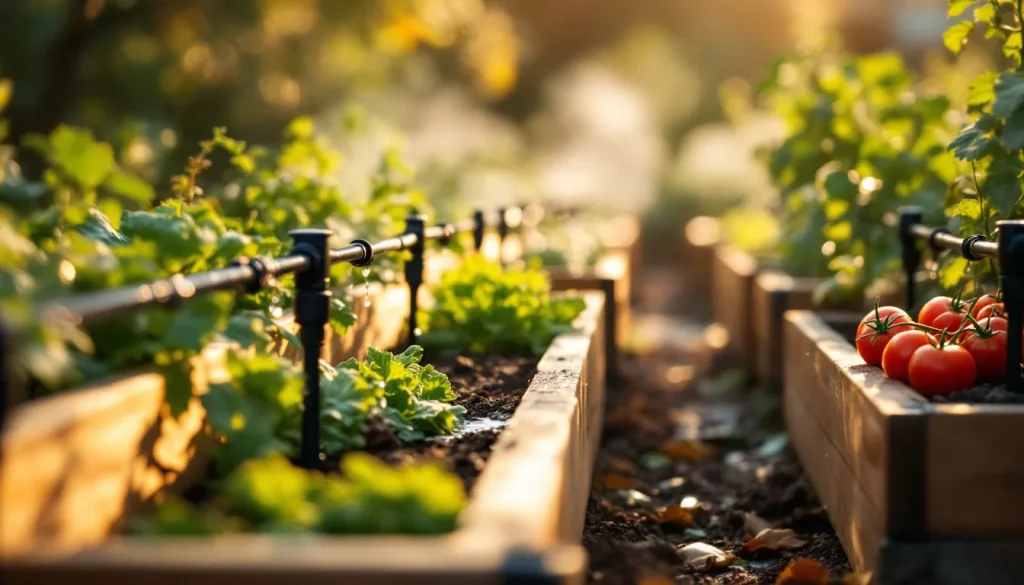
Raised garden beds need their own drip layout, not a generic accessory. The proven setup is a perimeter loop or parallel runs of 1/4-inch drip line fed from a single 1/2-inch manifold, with emitters spaced 6 to 12 inches and one zone per bed. A loop keeps pressure even across the whole bed, so the far corner waters the same as the spigot side.
Build it in four moves: run a 1/2-inch supply line behind the beds, drop a 1/4-inch line into each bed through the wall, lay drip line in a loop or in rows 12 inches apart, and cap each loop. For a typical 4-by-8-foot bed, two parallel runs 12 inches apart with 6-inch emitter spacing water the whole bed evenly. Group beds onto one timer so they all run together.
| Bed size | Layout | Drip line | Emitter spacing |
|---|---|---|---|
| 4 x 4 ft | Single perimeter loop | ~16 ft | 6 in |
| 4 x 8 ft | Two parallel runs, 12 in apart | ~16 ft | 6 in |
| 2 x 8 ft (narrow) | One center run | ~8 ft | 9 in |
How long and how often to run garden irrigation
Run drip irrigation deeply and infrequently: most vegetable gardens want 30 to 60 minutes, two to three times a week, delivering roughly 1 to 1.5 inches of water weekly including rain. Frequency rises in heat and sandy soil and drops in clay or cool weather. Check 2 to 3 inches down with a finger; water when it feels dry, not on a rigid clock.
| Plant / setting | Run time | Frequency (warm season) |
|---|---|---|
| Vegetable beds | 30-60 min | 2-3x per week |
| Raised beds (drain fast) | 20-40 min | 3-4x per week |
| Flower beds / perennials | 30-45 min | 2x per week |
| Seedlings / new transplants | 10-15 min | daily, light |
| Hot, dry climate (90F+) | +50% time | add 1 day |
Browse more seasonal watering and setup walkthroughs in the HMNDP learn library.
Frequently Asked Questions
What is the best irrigation system for a home garden?
Drip irrigation is the best system for most home gardens. It sends over 90 percent of water to plant roots, cuts use 30 to 50 percent versus sprinklers, and installs in 1 to 2 hours with no trenching. Choose a soaker hose for a single tight row on a budget, or micro-spray for dense flower beds. Reserve in-ground sprinklers for lawns.
Drip irrigation vs soaker hose: which is better for a garden?
Drip wins for control and even watering; soaker hose wins for low cost and zero assembly. Drip places emitters at each plant and waters evenly over 100-plus feet with pressure-compensating parts. A soaker hose costs $15 to $40 but waters unevenly past 25 feet, releasing more near the faucet. Pick drip for mixed or large gardens, soaker for one short row.
How much does a garden irrigation system cost to install?
A DIY garden drip system costs $40 to $200 in parts for most home gardens, about $0.50 to $1.50 per square foot. A soaker hose runs $15 to $40, and adding an automatic timer adds $25 to $60. Loose components beat kits on price above 200 square feet. Professional in-ground sprinkler installs cost $300 to $1,500-plus due to trenching and labor.
How do I set up a drip irrigation system in my garden myself?
Assemble the faucet head in order: backflow preventer, filter, pressure regulator, adapter. Run 1/2-inch mainline tubing along your beds, stake it every 4 to 6 feet, then punch in 1-GPH emitters at each plant. Use 1/4-inch micro-tubing for outliers, flush the line, and cap the end. Test for 10 minutes and reposition any emitter that misses the root zone.
What is the best irrigation system for raised garden beds?
The best raised-bed system is drip line in a perimeter loop or parallel runs, fed by one 1/2-inch manifold, with emitters 6 to 12 inches apart and one zone per bed. A 4-by-8-foot bed uses two runs 12 inches apart at 6-inch spacing. A loop keeps pressure even so the far corner waters the same as the near side.
How long and how often should I run garden irrigation?
Run drip 30 to 60 minutes, two to three times a week, aiming for 1 to 1.5 inches of water weekly including rain. Raised beds drain faster, so run 20 to 40 minutes three to four times weekly. New seedlings want short daily watering. Add roughly 50 percent more time in 90F-plus heat or sandy soil; cut back in clay or cool weather.
Do I need a pressure regulator and backflow preventer for garden drip irrigation?
Yes to both. A pressure regulator drops household 40 to 80 PSI down to the 25 to 30 PSI drip systems need, or emitters and fittings blow off. A backflow preventer stops garden water from siphoning into your drinking supply and is required by plumbing code in many areas. Both are inexpensive and included in most complete kits.
Can I put my garden irrigation system on an automatic timer?
Yes. A battery-powered hose-thread timer screws between your faucet and the system for $25 to $60 and runs zones on a set schedule with no wiring. WaterSense-labeled smart timers add rain or soil-moisture sensors that skip cycles after rain, saving more water. Set deep, infrequent cycles and water at dawn to cut evaporation.