
By the HMNDP Editorial Team | Last reviewed: June 2026
What natural fertilizer means (and how it differs from synthetic)
Natural fertilizer is plant food made from once-living material or mined minerals: compost, manure, bone meal, fish emulsion, kelp, and similar inputs. It feeds plants by feeding soil microbes, which release nutrients slowly. Synthetic (chemical) fertilizer is manufactured salt that delivers nutrients to roots fast, in exact ratios, with no soil-life benefit.
The practical split is speed versus staying power. A synthetic 10-10-10 dissolves and reaches roots in days. A natural source like compost releases nitrogen over weeks to months as microbes break it down, which is why “feed the soil, not the plant” is the organic-gardening rule of thumb.
Natural does not automatically mean gentle or low-dose. Blood meal and fresh poultry manure can burn roots as easily as a synthetic if you over-apply. The difference is the form of the nutrient, not a guarantee of safety.
| Trait | Natural / organic fertilizer | Synthetic / chemical fertilizer |
|---|---|---|
| Source | Plant, animal, or mined mineral | Manufactured (often petroleum or mined salts processed into soluble form) |
| Nutrient release | Slow, microbe-driven, weeks to months | Fast, water-soluble, days |
| Typical NPK strength | Low (often 1-1-1 to 6-4-4) | High and precise (10-10-10, 24-0-0) |
| Soil health effect | Builds organic matter, feeds microbes | None, can reduce microbial activity over time |
| Burn risk | Lower for most, real for manure and blood meal | Higher, salt index burns roots if over-applied |
| Cost per pound of N | Higher per unit nutrient | Lower per unit nutrient |
Why use natural fertilizer over synthetic
Use natural fertilizer when you want long-term soil health, slow steady feeding, and lower runoff risk. Compost and manure add organic matter that improves water retention and microbial life, which synthetics do not. The tradeoff: natural sources cost more per unit of actual nitrogen and act slower, so they reward patience over a quick green-up.
Soil health is the strongest case. Organic inputs raise soil organic matter, which improves moisture holding and structure. A 1 percent rise in organic matter can let an acre of soil hold roughly 20,000 more gallons of water, per USDA Natural Resources Conservation Service figures.
The environmental case is runoff. Fast-dissolving synthetic nitrogen leaches into waterways and feeds algae blooms. Slow-release natural nitrogen stays bound in organic matter longer, lowering that loss. For lawn owners near lakes or storm drains, this matters and some states restrict phosphorus lawn fertilizer for this reason.
On cost, be honest: synthetic wins per pound of nutrient. Natural fertilizer wins when the input is free (your own compost or coffee grounds) or when you value the soil-building you get alongside the feeding. Our organic garden fertilizer guide walks through building a feeding plan around these tradeoffs.
NPK explained, and which natural sources supply each nutrient
NPK is the three-number label on every fertilizer: nitrogen (N), phosphorus (P), potassium (K), shown as a percentage by weight. Nitrogen drives leaf and blade growth, phosphorus supports roots and flowers, potassium supports overall vigor and stress resistance. Natural sources are usually strong in one nutrient and weak in the others, so gardeners mix them.
- Nitrogen (leaves, green growth): blood meal, fish emulsion, poultry manure, grass clippings.
- Phosphorus (roots, flowers, fruit): bone meal, rock phosphate, manure.
- Potassium (vigor, disease resistance): kelp/seaweed, greensand, wood ash, banana peels.
- Balanced all-rounder: compost and worm castings (low numbers, broad coverage).
The 11 best natural fertilizer sources, with NPK numbers and dosage
Here are the most useful natural fertilizers ranked by reliability, each with its typical NPK, how fast it works, and a real application rate. NPK values vary by batch and brand, so these are representative ranges from product labels and soil-science references, not guarantees. Always check the bag and your own soil test.
| # | Source | Typical NPK | Release speed | Best for | Application rate |
|---|---|---|---|---|---|
| 1 | Compost | 1-1-1 to 3-2-1 | Slow | Everything, soil building | 1-2 in. layer, or 25-50 lb per 100 sq ft |
| 2 | Worm castings | 1-0-0 to 5-5-3 | Slow-medium | Seedlings, houseplants, beds | 1/4-1/2 in. top dress, or 1 cup per plant |
| 3 | Composted manure (cow) | 0.5-0.5-0.5 to 1-1-1 | Slow | Garden beds, lawns | 20-40 lb per 100 sq ft |
| 4 | Poultry manure (composted) | 3-2-2 to 5-3-2 | Medium | Heavy feeders (corn, squash) | 10-20 lb per 100 sq ft |
| 5 | Blood meal | 12-0-0 to 13-0-0 | Medium-fast | Nitrogen boost, leafy greens | 1-2 lb per 100 sq ft, do not exceed |
| 6 | Bone meal | 3-15-0 to 4-12-0 | Slow | Bulbs, roots, flowers | 2-3 lb per 100 sq ft, or 1 tbsp per hole |
| 7 | Fish emulsion | 4-1-1 to 5-2-2 | Fast | Quick liquid feed, containers | 1-2 tbsp per gallon water, every 2-3 weeks |
| 8 | Kelp/seaweed | 1-0-2 to 1-0-4 | Fast (foliar) | Potassium, micronutrients, stress | Per label, foliar spray every 2-4 weeks |
| 9 | Coffee grounds | ~2-0.3-0.3 | Slow | Compost input, light mulch | Thin layer, or up to 20% of compost |
| 10 | Eggshells | ~1.2% N, mostly calcium | Very slow | Calcium, not real fertilizer | Crushed fine, into compost |
| 11 | Wood ash | 0-1-3 to 0-2-6 (+ lime effect) | Fast | Potassium, raising pH | 10-15 lb per 1,000 sq ft, max once a year |
Homemade natural fertilizer recipes from kitchen scraps
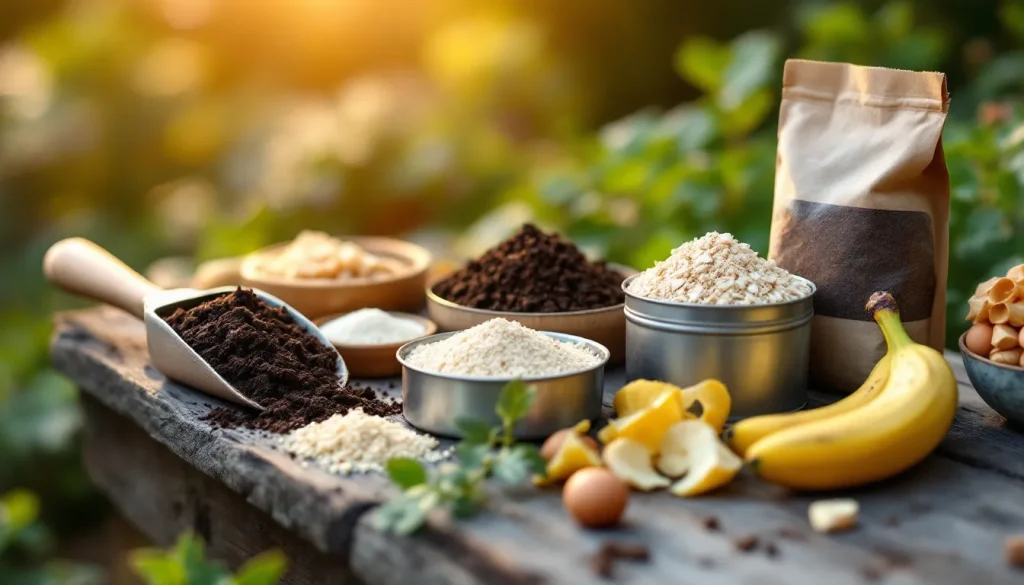
The most useful homemade natural fertilizers are compost, a fish-or-kelp liquid feed diluted in water, and worm castings. Raw kitchen scraps like coffee grounds, eggshells, and banana peels work best routed through a compost pile first, because raw scraps release nutrients too slowly to act as a real fertilizer on their own.
Compost (the highest-value homemade fertilizer)
Compost is decomposed kitchen and yard waste with a balanced low NPK around 1-1-1 plus organic matter. It is the single best thing you can make for free. Mix roughly 2 to 3 parts “browns” (dry leaves, cardboard) to 1 part “greens” (food scraps, grass clippings), keep it damp, and turn it every 1 to 2 weeks. It is ready in 2 to 6 months.
Liquid feed from scraps
Steep finished compost or worm castings in water to make “compost tea,” or buy fish emulsion and dilute 1 to 2 tablespoons per gallon. This delivers a quick, mild nutrient boost to containers and seedlings. Apply every 2 to 3 weeks during the growing season.
The truth about coffee grounds, eggshells, and banana peels
These three are repeated everywhere as instant fertilizer, and the claims are overstated. They contain real nutrients, but in forms and amounts that act slowly and unreliably when applied raw to soil. Treat them as compost inputs, not as a feed your plants can use this week.
- Coffee grounds: about 2 percent nitrogen, but raw grounds tie up nitrogen as they decompose and can compact into a water-repelling crust. Best composted, not piled on soil. They are not strongly acidic once brewed, so the “acid-loving plant” claim is weak.
- Eggshells: roughly 95 percent calcium carbonate, almost no NPK. They take months to years to break down unless ground to powder. Useful for calcium and compost, not a fertilizer.
- Banana peels: good potassium source (the peel is the rich part), but burying a whole peel releases nutrients only as it rots over weeks. Chop and compost them, or dry and grind for faster availability.
How to apply natural fertilizer to garden plants and vegetables
For vegetable gardens, build the soil with 1 to 2 inches of compost worked into the top few inches before planting, then side-dress heavy feeders with a higher-nitrogen source mid-season. Vegetables differ: leafy greens want nitrogen, tomatoes and peppers want lower nitrogen with steady phosphorus and potassium to avoid all-leaf-no-fruit.
A simple plan: compost as the base for all beds, blood meal or composted poultry manure for nitrogen-hungry crops like corn and brassicas, and bone meal worked into the planting hole for root crops, bulbs, and flowering plants. Liquid fish emulsion every 2 to 3 weeks keeps containers fed since pots leach nutrients fast.
Do not over-apply nitrogen to fruiting plants. Excess nitrogen on tomatoes produces lush foliage and few tomatoes. Our organic fertilizer for vegetable gardens guide covers crop-by-crop feeding in more detail.
How to apply natural fertilizer to lawns and grass
For lawns, the goal is steady nitrogen without a burn-and-fade cycle. The cheapest natural option is leaving mulched grass clippings on the lawn, which returns about 25 percent of the nitrogen your grass needs each season. For a measured feed, use a granular organic lawn fertilizer (commonly around 8-1-4 to 10-0-3) at the bag rate.
Apply natural lawn fertilizer 2 to 4 times per growing season, spaced 6 to 8 weeks apart. Cool-season grasses (fescue, Kentucky bluegrass) feed best in early fall and spring; warm-season grasses (Bermuda, zoysia) feed best in late spring through summer. Composted manure or a thin compost top-dressing in spring also works.
Check your state rules before adding phosphorus. Several US states restrict phosphorus lawn fertilizer unless a soil test shows a deficiency, so a 0-phosphorus organic product is often the safe default. For product-level picks, see our roundup of the best fertilizer for grass.
Commercial natural and organic fertilizer brands
If you want consistent NPK numbers without making your own, off-the-shelf organic lines give you a labeled, repeatable product. Down To Earth, Espoma, Dr. Earth, and Jobe’s Organics are widely stocked US brands with single-nutrient and blended options. They cost more per pound of nutrient than synthetics but remove the guesswork of homemade.
| Brand line | Example product | Typical NPK | Common use |
|---|---|---|---|
| Down To Earth | Blood Meal 12-0-0 | 12-0-0 | Nitrogen boost |
| Espoma | Plant-tone | 5-3-3 | All-purpose garden |
| Espoma | Holly-tone | 4-3-4 | Acid-loving plants |
| Dr. Earth | Tomato & Vegetable | 4-6-3 | Fruiting vegetables |
| Jobe’s Organics | All Purpose | 4-4-4 | General feeding |
Homemade vs store-bought: cost, speed, and reliability
Homemade natural fertilizer wins on cost (often free) but loses on predictability: you do not know the NPK and release is slow. Store-bought organic fertilizer wins on labeled, consistent nutrients and faster availability, at a higher price. Most gardeners use both: free compost as the soil base, a bagged organic product to hit specific nutrient targets.
| Factor | Homemade (compost, scraps) | Store-bought organic |
|---|---|---|
| Cost | Free to very low | $10-$25 per bag, higher per lb of nutrient |
| Known NPK | No, varies by batch | Yes, printed on label |
| Release speed | Slow (weeks to months) | Slow to medium, more predictable |
| Reliability | Variable | Consistent batch to batch |
| Soil-building | High (adds organic matter) | Moderate |
| Effort | High (build and turn compost) | Low (open and spread) |
The cheapest natural fertilizer is your own compost plus mulched grass clippings, both free. The cheapest reliable bagged option per pound of nitrogen is usually composted manure or blood meal. See more free and low-cost feeding ideas in the HMNDP Learn library.
Frequently Asked Questions
What is the best natural fertilizer for plants?
Compost is the best all-around natural fertilizer for most plants, because it supplies balanced low-level nutrients (around 1-1-1) plus organic matter that feeds soil microbes. For a nutrient-specific boost, pair compost with blood meal for nitrogen, bone meal for phosphorus, and kelp for potassium. Worm castings are an excellent gentle choice for seedlings and houseplants.
What is a good natural fertilizer for grass?
Mulched grass clippings left on the lawn are the cheapest natural grass fertilizer, returning about 25 percent of seasonal nitrogen for free. For a measured feed, a granular organic lawn fertilizer around 8-1-4 to 10-0-3 applied 2 to 4 times per season works well. Composted manure or a thin spring compost top-dressing also feeds grass effectively.
How do you make homemade fertilizer from kitchen scraps?
The reliable method is composting: mix 2 to 3 parts dry browns (leaves, cardboard) with 1 part greens (food scraps), keep it damp, and turn every 1 to 2 weeks until it is dark and crumbly in 2 to 6 months. You can also steep finished compost in water for a mild liquid feed. Apply raw scraps only through the compost pile, not directly.
Is natural fertilizer better than chemical (synthetic) fertilizer?
It depends on your goal. Natural fertilizer builds soil health, releases slowly, and lowers runoff, which often suits home gardens and lawns. Synthetic fertilizer delivers exact nutrients fast and costs less per pound of nutrient, which can suit a quick deficiency fix. Many gardeners use natural inputs as the base and synthetics only for targeted, time-sensitive corrections.
What are the NPK values of common natural fertilizers?
Common ranges: compost 1-1-1 to 3-2-1, worm castings around 1-0-0 to 5-5-3, blood meal 12-0-0, bone meal 3-15-0 to 4-12-0, fish emulsion 4-1-1 to 5-2-2, kelp 1-0-2 to 1-0-4, composted poultry manure 3-2-2 to 5-3-2, and wood ash 0-1-3 to 0-2-6. Values vary by batch and brand, so check the label.
How often should you apply natural fertilizer?
Compost is applied once or twice a year (spring and fall) as a top-dressing or soil amendment. Liquid feeds like fish emulsion are applied every 2 to 3 weeks during the growing season. Granular organic lawn and garden fertilizers are applied every 6 to 8 weeks, 2 to 4 times per season. Always follow the product label rate.
Do coffee grounds, eggshells, and banana peels actually work as fertilizer?
Partly. Coffee grounds (~2% nitrogen), banana peels (potassium), and eggshells (calcium) contain real nutrients, but in slow, unreliable forms when applied raw to soil. Eggshells take months to break down and have almost no NPK. The honest verdict: compost all three first so microbes convert them, rather than expecting a direct feed your plants can use immediately.
What is the cheapest natural fertilizer?
Homemade compost and mulched grass clippings left on the lawn are the cheapest natural fertilizers, both essentially free from materials you already have. Among bagged products, composted manure offers the lowest cost per pound of nutrient, and blood meal is inexpensive per unit of nitrogen. The catch with free options is the unknown NPK and slower release.