
By the HMNDP Editorial Team
Last reviewed: June 2026
What are soil mites?
Soil mites are microscopic arachnids in the subclass Acari, the same group that contains ticks and spiders. Most are 0.2 to 1 mm long, smaller than a grain of salt. They live in moist, organic-rich soil and feed on fungi, bacteria, algae, and decaying plant matter. The vast majority are harmless decomposers, not pests.
Because they are arachnids, soil mites have eight legs (six in their first larval stage). They are not insects, and they are not related to fleas or bedbugs. A single handful of healthy garden soil can hold dozens to thousands of them.
Scientists have described more than 48,000 mite species, and soil habitats hold a large share of that diversity. In compost and forest litter, mite populations can reach hundreds of thousands per square meter. Their presence is usually a sign that your soil has active biological life, which is what healthy garden soil should have.
What do soil mites look like? Size, color, and how to spot them
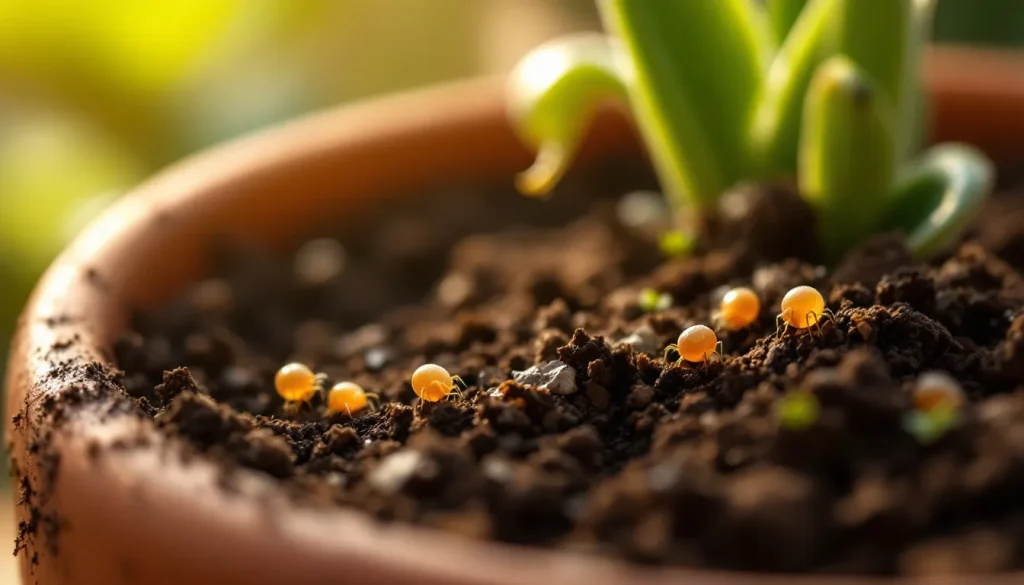
Soil mites look like tiny moving dots, usually white, tan, brown, or reddish, often translucent. Most are 0.2 to 1 mm, so they appear as slow-crawling specks on the soil surface, on pot rims, or under the drainage saucer. You typically need a hand lens (10x) or your phone camera zoom to see legs or body shape clearly.
Spotting tips that separate soil mites from lookalikes:
- Movement: soil mites crawl slowly and steadily. They do not jump and do not fly.
- Shape: rounded, almost spherical or oval body with no visible “waist.” Beetle mites (oribatids) can look like miniature shiny seeds or beetles.
- Location: on the soil surface, in the top inch of potting mix, on the pot rim, or clustered around decaying leaves and algae.
- Quantity: a few dozen scattered specks, not a dense cloud.
If the specks jump when disturbed, they are springtails, not mites. If they fly, they are fungus gnats. If they cluster on stems and leaves above the soil, suspect spider mites or aphids instead.
Soil mites vs the things people confuse them with (ID table)
The single most useful tool for nervous plant owners is a side-by-side comparison, because the specks people panic about are usually one of six things. Soil mites are slow, round, and stay near the soil. Spider mites, fungus gnats, and root aphids actually damage plants; soil mites and springtails almost never do. Use the cues below before treating anything.
| Critter | Size | Color | Movement | Where you see it | Harmful? |
|---|---|---|---|---|---|
| Soil mites | 0.2 to 1 mm | White, tan, brown, translucent | Slow crawl, never jumps or flies | Soil surface, top inch, pot rim | No (mostly beneficial) |
| Springtails | 0.25 to 6 mm | White, gray, sometimes purple | Jumps when disturbed (springs) | Wet soil surface, drainage tray | No (harmless decomposer) |
| Spider mites | 0.3 to 0.5 mm | Pale, red, yellow-green | Slow crawl, fine webbing | Undersides of leaves, not soil | Yes, sucks plant sap |
| Fungus gnat larvae | 3 to 6 mm | Translucent body, black head | Wriggling in wet soil; adults fly | Top 1 to 2 inches of wet soil | Yes, can chew fine roots |
| Root aphids | 1 to 2 mm | White, gray, pear-shaped | Slow, often with white waxy fluff | On roots, around root crown | Yes, sucks root sap |
| Mold (grain) mites | 0.3 to 0.7 mm | Whitish, pale, sometimes “dusty” | Slow crawl, mass movement looks like moving dust | On visible mold, moldy soil or grain | No to plants; can trigger allergies |
Two quick rules. If it is on the leaves with webbing, treat for spider mites. If it is in the soil and round and slow, it is almost certainly a harmless soil mite or springtail, and you can relax.
Are soil mites bad or harmful to plants?
Soil mites are mostly harmless and frequently helpful. The dominant groups eat fungi, bacteria, algae, and dead plant tissue, not living roots, so they rarely damage a healthy plant. They speed decomposition and release nutrients, which improves soil. The exceptions are a few specialized mites (bulb and root mites) that attack already-stressed or rotting tissue.
For 95 percent of houseplant and garden cases, the mites you see are decomposers doing their job. They appear because there is decaying organic matter and moisture to feed on. Removing the food source, not the mites, is the real fix if you want fewer of them.
The rare problem mites belong to the family Acaridae (bulb mites such as Rhizoglyphus) and certain Astigmata. They attack onions, garlic, tulips, lilies, and orchids, but almost always after rot, overwatering, or wounding has already set in. Healthy bulbs in well-drained soil are not their target.
Named soil mite groups: which are harmless and which can cause trouble
Soil mites are not one species but four broad orders, and knowing which is which tells you whether to worry. Oribatid (beetle) mites and Mesostigmata are beneficial. Most Astigmata are harmless scavengers, but the bulb and root mites within this group can damage stressed plants. Prostigmata is mixed. Here is the practical breakdown.
| Group | Common name | Diet / role | Risk to plants |
|---|---|---|---|
| Oribatida | Beetle or armored mites | Eat fungi, decaying matter; key decomposers | None; strongly beneficial |
| Mesostigmata | Predatory mites | Hunt nematodes, fungus gnat larvae, other mites | None; helpful, eat pests |
| Astigmata | Scavenger, mold, bulb mites | Eat mold, decay; some attack bulbs/roots | Mostly none; bulb mites (Rhizoglyphus) harm stressed bulbs |
| Prostigmata | Mixed (includes some plant feeders) | Predators, fungivores, a few sap feeders | Low; most are not pests of soil |
The takeaway: the slow round specks crawling on your potting mix are overwhelmingly Oribatida or harmless Astigmata. The Mesostigmata you cannot see are actively eating fungus gnat larvae for you. Bulb mites only matter if you grow bulbs and they are already rotting.
Their role in decomposition and the soil food web
Soil mites are core members of the soil food web, the network of organisms that recycle nutrients. They shred and digest dead leaves, fungal threads, and organic debris, which speeds decomposition and frees nitrogen, phosphorus, and other nutrients for plant roots. Their droppings become stable soil organic matter. In short, they help build the soil your plants feed on.
Decomposer mites also disperse beneficial fungi and bacteria through the soil on their bodies, spreading the microbes that break down organic matter further. Predatory mites add pest control by eating nematodes and fungus gnat larvae.
This is why composters and soil scientists treat mites as an indicator of a living, functioning system. If you are building soil health, mites are a feature, not a bug. The same logic underlies why we test conditions rather than just kill organisms; see our guide on how to test soil pH to read your soil before reacting.
Why did soil mites suddenly appear in my houseplant?
Soil mites bloom suddenly when conditions favor their food: moisture plus decaying organic matter. The usual triggers are overwatering, recent repotting with rich or compost-heavy mix, decaying leaves or roots, algae or mold on the surface, and warm indoor temperatures. The mite eggs or adults are usually already present in the potting mix and simply multiply when feeding conditions improve.
Common indoor scenarios:
- After overwatering: soggy soil grows fungi and algae, the exact food mites and springtails thrive on.
- After repotting: fresh organic-rich or peat or compost mixes arrive carrying mite eggs and offer fresh decaying matter.
- Decaying debris: dead leaves left on the surface or rotting roots feed a population spike.
They can spread between pots if you reuse contaminated soil, tools, or saucers, but they do not migrate across a room on their own the way flying pests do. Keeping the surface clean and the soil from staying waterlogged keeps numbers low.
Do soil mites bite humans or pets, or infest the house?
No. Soil mites do not bite humans or pets, do not feed on blood, and do not infest homes, furniture, or skin the way dust mites or scabies mites do. They need moist, organic soil to survive and die quickly in dry indoor air. The main human concern is allergies: large numbers of mold or storage mites can trigger sensitivity in some people.
If a soil mite wanders onto your hand or counter, it cannot live or reproduce there. It needs the humidity and food of the soil. Wiping it away or letting it dry out ends it.
People with mold allergies or asthma may react to airborne mite debris from very heavy infestations, especially around moldy soil. If that is a concern, address the underlying moisture and mold and keep affected plants out of bedrooms.
How to get rid of soil mites in potting soil (step by step)
Most soil mites need no treatment, but if numbers bother you or you have allergies, here is the actionable protocol. Work from gentlest to strongest: dry the soil first, remove their food, then escalate to soil replacement or a hydrogen peroxide drench only if needed. Treating the moisture and organic debris solves the problem more durably than killing mites directly.
- Let the soil dry out. Stop watering until the top 2 inches are dry. Mites and their food (fungi, algae) collapse without moisture. This alone resolves most cases in 1 to 2 weeks.
- Remove the food source. Clear dead leaves, fallen debris, and surface mold. Scrape off any algae crust. Less decaying matter means fewer mites.
- Add a dry top layer. Cover the soil with a 0.5 inch layer of dry sand, perlite, or fine gravel. The dry surface discourages surface-dwelling mites and fungus gnats.
- Hydrogen peroxide drench (if needed). Mix 1 part 3 percent hydrogen peroxide with 3 to 4 parts water and drench the soil. It fizzes, kills many surface organisms, then breaks down into water and oxygen. Repeat once after a week if needed.
- Repot with fresh or sterilized soil. For heavy cases, remove the plant, rinse roots, discard old mix, and repot in fresh sterile potting mix. You can sterilize mix by baking it at 180 to 200 F (82 to 93 C) for 30 minutes.
- Introduce predatory mites (optional). For growers, beneficial Mesostigmata such as Stratiolaelaps scimitus (formerly Hypoaspis miles) eat fungus gnat larvae and pest mites without harming plants.
- Fix watering habits. Water only when the top inch is dry, ensure pots drain freely, and empty saucers. Dry, well-drained soil rarely supports mite blooms.
Skip pesticides. Broad miticides are unnecessary for harmless soil mites, can harm beneficial soil life, and are overkill indoors. For outdoor soil pest concerns that genuinely damage turf, see our guide on grub control for lawn, and browse more soil and plant care explainers in the HMNDP Learn library.
Frequently Asked Questions
What are soil mites and where do they come from?
Soil mites are microscopic arachnids (subclass Acari, related to ticks and spiders) that live in moist, organic-rich soil and eat fungi, bacteria, and decaying matter. They come in naturally with potting mix, compost, or garden soil, where their eggs and adults already exist. They multiply when moisture and decaying organic material give them enough food.
What do soil mites look like (size, color, how to spot them)?
Soil mites look like tiny round moving dots, white, tan, brown, or translucent, usually 0.2 to 1 mm. You see them slowly crawling on the soil surface, in the top inch, or on the pot rim. They never jump or fly. A 10x hand lens or phone zoom reveals their rounded eight-legged body shape clearly.
Are soil mites bad or harmful to my plants?
For most plants, soil mites are harmless and even helpful. They eat fungi, algae, and dead plant matter rather than living roots, and they speed decomposition that releases nutrients. The only exceptions are bulb and root mites (family Acaridae) that attack already rotting or stressed bulbs like onions, tulips, and orchids, not healthy plants.
Do soil mites bite humans or pets, or infest the house?
No. Soil mites do not bite people or pets, do not feed on blood, and cannot live or breed indoors away from moist soil. They die quickly in dry air. The only human concern is allergies: heavy populations of mold or storage mites may trigger sensitivity in people with mold allergies or asthma.
How do I get rid of soil mites in potting soil?
Start by letting the top 2 inches of soil dry out and removing dead leaves, debris, and surface mold. Add a dry layer of sand or perlite on top. For stubborn cases, drench with a 1:4 mix of 3 percent hydrogen peroxide and water, or repot in fresh sterilized soil. Fix overwatering to prevent return.
What is the difference between soil mites and spider mites?
Soil mites live in the soil, eat decaying matter, and are harmless. Spider mites live on plant leaves, suck sap, and damage plants. The clearest tell is location and webbing: spider mites cluster on leaf undersides and spin fine webs, while soil mites stay on the soil surface with no webbing. Spider mites need treatment; soil mites usually do not.
How are soil mites different from springtails, fungus gnats, and root aphids?
Springtails jump when disturbed; soil mites crawl slowly and never jump. Fungus gnats fly as adults and have wriggling larvae in wet soil; soil mites do neither. Root aphids are pear-shaped, often with white waxy fluff, and feed on roots, while soil mites are round, slow, and feed on decay. Only fungus gnats and root aphids harm plants.
Why did soil mites suddenly appear in my houseplant?
They bloomed because conditions favored their food. Overwatering, recent repotting with rich or compost-heavy mix, decaying leaves, and surface algae or mold all give mites abundant fungi and organic matter to eat. The mites were usually already in the soil and simply multiplied. Drying the soil and removing debris brings their numbers back down.