
By the HMNDP Editorial Team, independent reporting on lawn care, landscaping, water, and the green-industry business.
Last reviewed: June 2026
Irrigation repair, by symptom: start here
Irrigation repair means diagnosing and fixing the part of an in-ground sprinkler system that failed: a sprinkler head, a buried pipe, a control valve and its solenoid, or the timer (controller). Most single-part fixes cost $5 to $40 in materials and take under an hour. Start with the symptom you can see, then follow it to the cause and the fix below.
An irrigation system has four repairable layers. The controller sends a 24-volt signal. That signal opens a valve grouped into a zone. The valve sends pressurized water through buried pipe. The pipe feeds sprinkler heads that pop up and spray. A failure in any layer shows up as a predictable symptom.
Use this map to jump to your problem.
| What you see | Most likely cause | Typical DIY part cost |
|---|---|---|
| One zone won’t turn on | Solenoid, wiring, or controller output | $15 to $40 (solenoid) |
| Head won’t pop up / sprays sideways | Broken or clogged sprinkler head | $5 to $20 per head |
| Soggy spot, weak spray across a zone | Cracked pipe or fitting leak | $10 to $30 in pipe and fittings |
| Water won’t shut off | Stuck valve diaphragm or debris | $15 to $35 (diaphragm/valve) |
| Whole system dead, no display | Controller power, fuse, or transformer | $0 to $50 (fuse to new timer) |
Repairing or replacing a broken sprinkler head
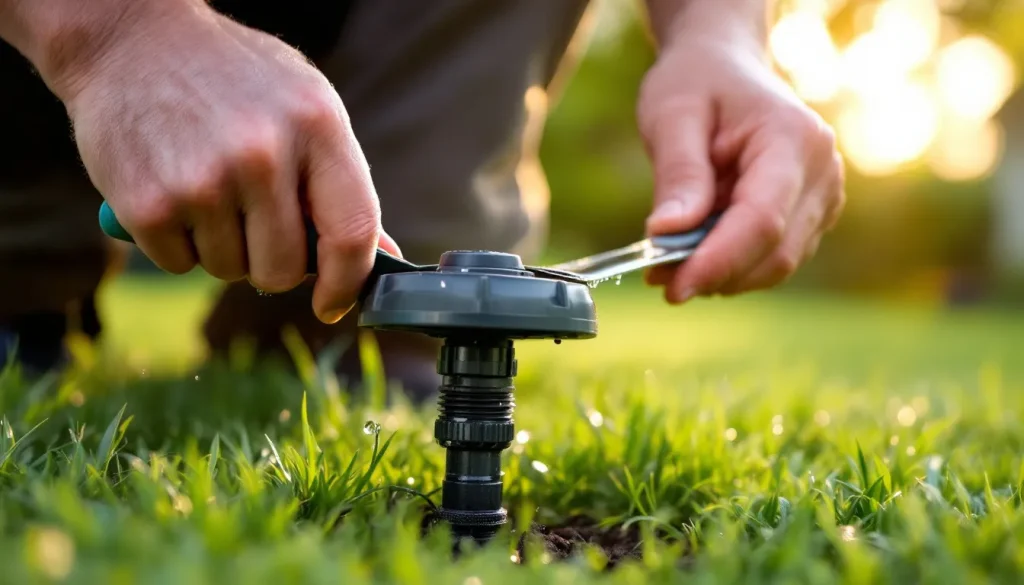
A broken sprinkler head is the most common and cheapest irrigation repair. Replacement heads run $5 to $20 at Home Depot, Lowe’s, or Ewing Irrigation, and the job takes 15 to 20 minutes with no special tools. Replace rather than repair: matching the new head’s spray pattern and nozzle to the old one matters more than the brand.
If the head will not pop up, first run the zone and watch. A head that stays down with water bubbling around it is usually cracked at the riser or jammed with grit. A head that pops up but sprays a thin geyser has lost its nozzle.
- Run the zone, then turn it off at the controller so the head is depressurized.
- Dig a small ring around the head with a trowel, keeping the sod intact.
- Unscrew the head counterclockwise from the riser (the threaded fitting below it). Hold the riser so it does not twist loose underground.
- Note the brand, body height (4 inch is standard for lawns, 6 or 12 inch for beds), and nozzle radius printed on top.
- Screw the matching new head on hand-tight, run the zone, and adjust the spray arc with the small slot on top.
Match popular bodies: Rain Bird 1800, Hunter Pro-Spray, and Toro 570Z are interchangeable on standard half-inch risers. Clogged nozzles often just need rinsing, which costs nothing.
Fixing leaks in irrigation pipe and plumbing
A pipe leak shows up as a chronically soggy spot, a sinkhole, or one zone losing pressure to every head at once. Repairing a cracked lateral line costs $10 to $30 in materials: a coupling, a length of poly or PVC pipe, and primer plus cement for PVC. The hard part is digging, not the fix.
Two pipe types are common in residential systems. Flexible black poly pipe uses barbed or clamp fittings and no glue. White PVC uses primer and solvent cement that cure in minutes.
- Shut off the system at the main irrigation valve and run the affected zone to drain pressure.
- Expose the wet section and cut out the cracked piece with a hacksaw or PVC cutter.
- For PVC: clean the ends, prime them purple, add a slip coupling with cement, and let it cure 30 minutes before pressurizing.
- For poly: slide a barbed coupling into both ends and clamp with stainless gear clamps.
- Run the zone and watch the joint before backfilling.
Stop and call a pro if the leak is on the mainline (the always-pressurized pipe before the valves) or near the backflow preventer. A mainline break floods fast, and backflow work is regulated in many states.
Sprinkler valve repair
A sprinkler valve repair fixes the part that opens and closes water to a zone. The two failure points are the solenoid (the black cylinder with two wires, $15 to $40) and the rubber diaphragm inside the valve body ($10 to $25 in a rebuild kit). Both are screw-out parts you can replace in 20 to 30 minutes without digging up the valve.
A clicking or humming solenoid that never opens the valve usually needs replacing. Unscrew it counterclockwise (water off first), connect the two wires to the field wires with waterproof connectors like 3M DBR/Y-2, and screw the new one in.
If the valve weeps or will not fully close, the diaphragm is likely torn or holding grit. Shut off water, unscrew the valve bonnet (the top), lift out the diaphragm and spring, rinse or replace, and reassemble. Match the valve brand: Rain Bird, Hunter, and Irritrol diaphragms are not interchangeable.
Diagnostics: why a zone won’t turn on
When one zone is dead but others run, the fault is in three places: the controller output, the field wiring, or the solenoid. Work from cheapest to hardest. A dead zone almost never means the pipe; pipe problems reduce pressure, they do not kill a zone outright. This is the diagnostic step the sales-pitch pages skip entirely.
Follow this order so you spend money only where the fault is.
- Confirm the controller fires. Manually start the dead zone. If neighboring zones run fine, the controller has power, so the common 24-volt circuit is intact.
- Swap the wire. At the controller, move the dead zone’s wire to a working zone’s terminal and start that zone number. If the dead valve now opens, the controller terminal failed. If it still does not, the fault is downstream in the wire or solenoid.
- Test the solenoid. A multimeter across the solenoid leads should read roughly 20 to 60 ohms. Open circuit (infinite) means a bad solenoid or cut wire. Near zero means a short.
- Bypass to confirm. Twisting the solenoid a quarter turn manually opens many valves. If water flows, the valve and pipe are fine and the problem is electrical.
A $12 multimeter from any hardware store turns a guessing game into a 10-minute test. For systems with many zones and wiring you cannot trace, a wire-tracking tool or a pro with a Pro48k locator saves hours.
Water won’t shut off, or one zone has low pressure
If water keeps running after the controller stops, a valve is stuck open, usually from debris under the diaphragm or a manual bleed screw left open. If one zone has low pressure but turns on, suspect too many heads on the line, a partial pipe leak, or a half-closed valve. Both are usually $0 to $25 fixes.
For water that won’t shut off, first turn the controller fully off. If water still runs, open and close the valve’s bleed screw and flow-control to flush grit. If it keeps running, rebuild the diaphragm as covered in the valve section above.
For low pressure in one zone, count the heads: spray heads need roughly 30 PSI, and overloading a zone starves the far heads. Check the valve’s flow-control screw is fully open, look for a soft wet patch signaling a leak, and clean clogged nozzles. If every zone is weak, the problem is upstream at the meter, main shutoff, or backflow device.
Controller (timer) won’t run
A dead controller with a blank display almost always points to lost power, not a failed program. Check the outlet, the transformer plug, and the controller’s fuse before assuming the timer is dead. A replacement residential controller (Rain Bird, Hunter, Orbit) costs $40 to $150; many faults are a $0 reset or a tripped GFCI outlet.
- Confirm the outlet has power and is not on a tripped GFCI breaker.
- Check the small fuse on the controller board and replace if blown.
- Test the transformer output with a multimeter (should read about 24 to 28 volts AC).
- If the display works but no zone runs, the common wire or transformer is the suspect.
Smart controllers add Wi-Fi and weather-based scheduling. Adoption is rising fast: see our 2026 smart irrigation adoption report for where the market is heading and whether an upgrade pays off.
Irrigation repair cost: DIY vs hiring a pro
DIY irrigation repair for a single part typically costs $5 to $40 in materials. Hiring a licensed irrigator runs $75 to $150 for a service call plus $50 to $100 per hour, so a head swap a pro bills at $75 to $150 often costs you under $20 to do yourself. The cutoff is not difficulty, it is risk: electrical mains, the pressurized mainline, and backflow devices are where DIY stops.
| Repair | DIY material cost | Typical pro cost | DIY-friendly? |
|---|---|---|---|
| Replace sprinkler head | $5 to $20 | $75 to $150 | Yes |
| Replace solenoid | $15 to $40 | $100 to $200 | Yes |
| Rebuild valve diaphragm | $10 to $25 | $100 to $225 | Yes |
| Repair lateral pipe leak | $10 to $30 | $125 to $300 | Usually |
| Replace controller | $40 to $150 | $150 to $350 | Yes (low-voltage) |
| Mainline break | Not advised | $200 to $700+ | No, call a pro |
| Backflow repair / test | Often regulated | $100 to $300 | No, often licensed only |
Call a licensed irrigator (the Irrigation Association lists certified technicians) when the repair involves the pressurized mainline, 120-volt wiring, the backflow preventer, or annual backflow testing, which many municipalities require by law. The same logic we use for lawn repair service versus DIY applies here: do the cheap, low-risk fixes yourself and pay a pro for water-pressure and code-related work.
Residential vs commercial irrigation repair
Residential and commercial irrigation repair use the same parts and logic, but scale and code differ. A home system has 4 to 12 zones on half-inch and three-quarter-inch pipe. Commercial sites run dozens of zones, two-wire decoder systems, larger valves, and stricter backflow and water-use rules, which is why commercial work is almost always handled by licensed contractors.
For DIY homeowners, the practical takeaway is that residential repairs in this guide use standard, off-the-shelf parts. Commercial decoder controllers and master-valve setups need brand-specific diagnostics and are outside DIY territory.
Tools, parts, and where to buy
Basic sprinkler repair needs a short, cheap kit: a trowel, channel-lock pliers, a hacksaw or PVC cutter, PVC primer and cement, waterproof wire connectors, and a $12 multimeter. Parts (heads, solenoids, couplings) are stocked at Home Depot, Lowe’s, Ace Hardware, and irrigation specialists like Ewing and SiteOne. Bring the old part in to match brand and size.
- Heads: Rain Bird 1800, Hunter Pro-Spray, Toro 570Z, $5 to $20.
- Valve parts: brand-matched solenoids and diaphragm rebuild kits, $10 to $40.
- Pipe and fittings: poly or PVC by the foot plus couplings, $10 to $30.
- Connectors: 3M DBR/Y-2 waterproof wire nuts for any buried splice.
For new low-water zones or expanding beds rather than repairing, our guide on how to install drip irrigation walks through parts and layout. For more lawn and water how-tos, browse the HMNDP Learn hub.
General maintenance to prevent the next repair
Most irrigation repairs trace back to skipped maintenance. Three habits prevent the majority of failures: clean nozzles each spring, check and adjust head alignment monthly during the watering season, and winterize before the first hard freeze. A spring start-up and fall blowout cost little and prevent cracked pipe and frozen valves.
- Spring start-up: open the main slowly, walk each zone, clean nozzles, and straighten tilted heads.
- Mid-season: watch a full cycle monthly for dry arcs, geysers, and soggy spots.
- Fall winterizing: in freeze-prone regions, drain or blow out lines with compressed air to prevent burst pipe and split valves.
Catching a tilted head or weeping valve early turns a future $300 pro call into a five-minute adjustment.
Frequently Asked Questions
How do I fix a sprinkler head that won’t pop up or is broken?
Turn off the zone, dig a small ring around the head, and unscrew it counterclockwise from the riser. Match a replacement head by brand, body height (usually 4 inch for lawns), and nozzle radius, then hand-tighten the new one on. Replacement heads cost $5 to $20. A head that bubbles but won’t rise is often just clogged and only needs rinsing.
Why won’t my sprinkler zone turn on?
When one zone is dead but others run, the fault is electrical, not the pipe. Manually start the zone to confirm the controller fires, then move the dead zone’s wire to a working terminal to test the controller output. If that fails, check the solenoid with a multimeter; 20 to 60 ohms is healthy, and an open reading means a bad solenoid or cut wire.
How much does irrigation repair cost?
A single-part DIY repair costs $5 to $40 in materials: heads $5 to $20, solenoids $15 to $40, pipe fixes $10 to $30. Hiring a licensed irrigator typically runs a $75 to $150 service call plus $50 to $100 per hour. Mainline breaks ($200 to $700-plus) and backflow work cost more and usually require a pro by code.
How do I repair a leaking sprinkler valve?
Shut off the water first. If the valve weeps or won’t close, unscrew the bonnet (top), lift out the rubber diaphragm and spring, then rinse out grit or install a brand-matched rebuild kit ($10 to $25). If the valve never opens, replace the solenoid ($15 to $40) by unscrewing it and reconnecting the two wires with waterproof connectors.
Can I repair my irrigation system myself, or should I hire a pro?
DIY the cheap, low-risk fixes: heads, solenoids, diaphragms, lateral pipe, and low-voltage controllers, all $5 to $40 in parts. Hire a licensed irrigator when the job involves the pressurized mainline, 120-volt wiring, or the backflow preventer, including annual backflow testing that many cities require by law. The cutoff is risk and code, not difficulty.
How do I find and fix a leak in an irrigation line?
Look for a chronically soggy spot, a sinkhole, or one zone where every head loses pressure at once. Shut off the system, expose the wet section, and cut out the cracked piece. For PVC, prime and cement a slip coupling; for poly pipe, slide in a barbed coupling and clamp it. Materials cost $10 to $30. Call a pro for mainline leaks.
Why does one zone have low water pressure?
Low pressure in one zone usually means too many heads on the line, a partial pipe leak, clogged nozzles, or a half-closed valve flow-control screw. Spray heads need about 30 PSI. Check the flow-control is fully open, clean nozzles, and look for wet patches signaling a leak. If every zone is weak, the problem is upstream at the meter, main, or backflow device.
What tools and parts do I need for basic sprinkler repair?
A starter kit is cheap: a trowel, channel-lock pliers, a hacksaw or PVC cutter, PVC primer and cement, 3M waterproof wire connectors, and a $12 multimeter. Keep spare heads, a brand-matched solenoid, and a few couplings on hand. Buy parts at Home Depot, Lowe’s, Ace Hardware, or irrigation specialists Ewing and SiteOne, and bring the old part to match it.