
By the HMNDP Editorial Team, independent reporting on lawn care, landscaping, soil, and the green industry.
Last reviewed: June 2026
What are soil horizons?
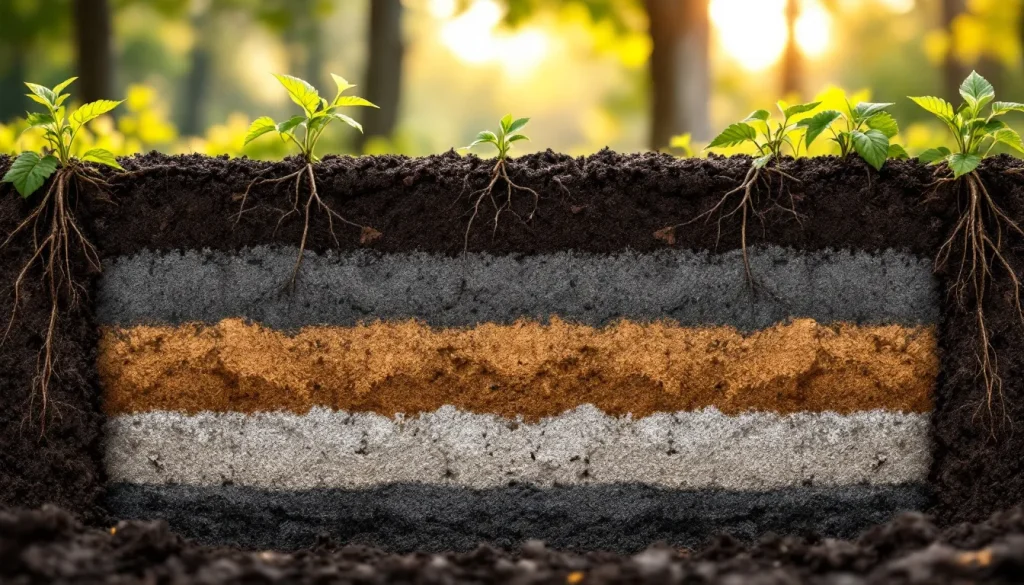
Soil horizons are distinct layers of soil that run roughly parallel to the ground surface, each with its own physical, chemical, and biological characteristics that set it apart from the layers above and below it. The U.S. Department of Agriculture (USDA) defines six master horizons, labeled with capital letters from top to bottom: O, A, E, B, C, and R.
Most soils show three major mineral horizons (A, B, and C). Many also carry an organic O layer on top, and some carry an E layer (a leached zone) and an R layer (bedrock) at depth.
The horizons differ from each other in color, texture, structure, organic matter, and chemistry. A clay-rich subsoil sits below a dark, crumbly topsoil, which sits below a layer of leaf litter. Those differences are what let a scientist or student draw lines between one horizon and the next.
Stacked together, the horizons form a soil profile. Reading that profile from top to bottom is how soil scientists, gardeners, and students classify and understand any patch of ground.
Soil horizons in order from top to bottom
The soil horizons in order from top to bottom are O, A, E, B, C, and R. The O horizon is surface organic litter, A is topsoil, E is a leached light-colored layer, B is subsoil where material accumulates, C is weathered parent material, and R is solid bedrock. Not every soil has all six; A, B, and C are the most common.
The table below is the at-a-glance reference the encyclopedia entries and PDFs leave out. Depths are typical ranges and vary widely by location, climate, and soil type.
| Horizon | Name | Typical depth | Color clue | One-line function |
|---|---|---|---|---|
| O | Organic / litter | 0 to 5 cm (often absent on tilled land) | Dark brown to black | Decomposing leaves, needles, and humus on the surface |
| A | Topsoil | ~5 to 25 cm | Dark gray-brown | Mineral soil mixed with organic matter; most root and biological activity |
| E | Eluviation (leached) | Variable, when present | Pale gray, ash-like | Zone stripped of clay, iron, and organic matter by downward water |
| B | Subsoil | ~25 to 100 cm | Reddish, yellowish, or rich brown | Zone of accumulation (illuviation) where clay, iron, and minerals collect |
| C | Substratum / parent material | ~100 cm and below | Matches local rock or sediment | Weathered parent material, least altered by soil-forming processes |
| R | Bedrock | Below all horizons | Solid rock | Continuous hard rock (granite, limestone, sandstone) under the soil |
The O horizon: surface organic layer
The O horizon is the organic layer that sits on top of the mineral soil, made of decomposing plant litter such as leaves, needles, twigs, and humus. It forms where organic material piles up faster than it breaks down, which is why forests have a thick O horizon and tilled farm fields often have none at all.
The O horizon is dark, spongy, and rich in carbon. In a pine forest you can pull back the top inch and see needles in stages of decay, from whole at the surface to crumbly black humus underneath.
This layer feeds the soil below it. As earthworms, fungi, and bacteria process the litter, nutrients move down into the A horizon.
The A horizon: topsoil
The A horizon is the topsoil: the surface mineral layer where weathered rock particles mix with organic matter from above. It is usually the darkest mineral horizon because of that organic content, and it holds the most roots, earthworms, microbes, and biological activity of any layer.
The A horizon is the layer gardeners care about most. It is where seeds germinate, where most plant roots feed, and where soil structure (the crumbly aggregates that hold water and air) is best developed.
On cropland and lawns, the upper part of the A horizon is often labeled Ap, where the lowercase “p” means plowing or other disturbance has mixed it. If you are planning a planting bed or estimating fill, our guide on how much soil you need walks through measuring topsoil depth and volume.
The E horizon: the leached layer most guides skip
The E horizon is a pale, leached layer that sits between the A and B horizons in some soils. The “E” stands for eluviation, the process of stripping material out. Downward-moving water carries clay, iron, aluminum, and organic compounds out of this zone and deposits them lower in the profile, leaving behind light-colored, resistant sand and silt particles.
Most quick definitions omit the E horizon entirely, but it is one of the six USDA master horizons. It shows up clearly in heavily weathered, sandy, high-rainfall soils.
The classic example is a Spodosol under conifer forest in the northeastern United States or Canada. There you can see a striking ash-gray E horizon sitting directly on a dark reddish-brown B horizon, a contrast so sharp it looks painted.
When an E horizon is present, the typical top-to-bottom order becomes O, A, E, B, C, R rather than the simpler O, A, B, C.
The B horizon: subsoil and zone of accumulation
The B horizon is the subsoil, the zone of accumulation where material leached from above settles and builds up. This downward deposition is called illuviation. Clay, iron oxides, carbonates, and other minerals collect here, which often makes the B horizon denser, more clay-rich, and more strongly colored (red, yellow, or rich brown) than the layers around it.
The B horizon has fewer roots and less organic matter than the topsoil, but it does important work. It stores water and nutrients that deeper roots can reach, and its clay accumulation controls how fast water drains.
Soil scientists add lowercase suffixes to mark what accumulated. Bt means a buildup of silicate clay (the “t” is from the German Ton, meaning clay). Bk means an accumulation of carbonates, common in dry climates. Bw marks a weathered or color-developed B with little accumulation.
The C horizon: weathered parent material
The C horizon is the substratum: weathered or loose parent material that has been altered very little by soil-forming processes. It lies below the active A and B horizons and lacks the structure, biology, and accumulation features of the layers above it.
The C horizon is the raw material the soil above was made from. It can be broken-up rock, glacial till, river sediment, volcanic ash, or windblown loess, depending on the site.
Because it sits outside the main root zone and shows little weathering, the C horizon is the bridge between living soil and the geology beneath it.
The R horizon: bedrock
The R horizon is continuous, hard bedrock beneath the soil, such as granite, basalt, limestone, or sandstone. Unlike the loose material of the C horizon, the R horizon is solid rock that cannot be dug with a hand spade and roots cannot penetrate except along cracks.
The R horizon is the floor of the soil profile. In thin mountain or shield soils, bedrock can sit just centimeters below the surface, while in deep valley soils it may be many meters down or absent from any reasonable pit.
Over very long timescales, the R horizon is the ultimate source of new mineral material as it weathers upward into a C horizon and eventually into true soil.
Soil horizon vs soil profile vs pedon
A soil horizon is a single layer. A soil profile is the full vertical sequence of all the horizons at one spot, from the surface down to bedrock. A pedon is the three-dimensional body of soil, the smallest unit large enough to show all of a soil’s horizons, that a profile is exposed from.
Think of it as three scales of the same thing. The horizon is one slice. The profile is the stack of slices you see on the exposed face of a pit. The pedon is the small block of earth, often about one square meter at the surface, that the pit cuts into.
Soil scientists describe and sample a pedon, draw its profile, and name each horizon to classify the soil. That workflow is the foundation of soil surveys run by agencies like the USDA Natural Resources Conservation Service (NRCS).
How soil horizons form
Soil horizons form as five soil-forming factors drive four soil-forming processes over time, sorting material into distinct layers. None of the top results explain this, yet “how soil horizons form” is one of the most common follow-up searches. The short version: weathering breaks down rock, water moves material up and down, life adds organic matter, and the layers slowly differentiate.
The five soil-forming factors (CLORPT)
Soil scientists summarize the controls on soil formation with the acronym CLORPT: Climate, Organisms, Relief, Parent material, and Time. Hans Jenny formalized these five factors in 1941, and they remain the standard framework taught today.
- Climate (CL): rainfall and temperature drive weathering and how fast water moves material through the profile.
- Organisms (O): plants, animals, fungi, and microbes add organic matter and mix the soil.
- Relief (R): slope and landscape position control erosion, drainage, and how much water soaks in.
- Parent material (P): the rock or sediment the soil develops from sets its starting texture and minerals.
- Time (T): horizons sharpen over hundreds to thousands of years; young soils have few horizons.
The four soil-forming processes
Within those factors, four processes build the horizons. Each one moves or changes material in a way that makes one layer different from the next.
- Additions: material enters the soil, such as leaf litter forming the O horizon or windblown dust landing on the surface.
- Losses: material leaves, such as nutrients washing out the bottom of the profile or topsoil eroding away.
- Translocation: material moves within the profile, the engine behind the E and B horizons (see eluviation and illuviation below).
- Transformation: material changes in place, such as iron rusting to give a B horizon its red color, or fresh litter decaying into humus.
Healthy horizon development depends on water and air moving freely through the soil. On compacted lawns, that movement stalls, which is part of why aerating a lawn can help restore the conditions soils need.
Eluviation vs illuviation
Eluviation is the removal of fine material (clay, iron, organic matter) out of an upper layer by downward-moving water. Illuviation is the deposition of that same material into a lower layer. They are two ends of one journey: water strips the E horizon (eluviation) and dumps the cargo into the B horizon (illuviation).
| Term | What happens | Direction | Horizon affected |
|---|---|---|---|
| Eluviation | Clay, iron, and organics are washed out | Material leaves the layer | E horizon (becomes pale) |
| Illuviation | That material is deposited and builds up | Material enters the layer | B horizon (becomes enriched) |
A memory aid: Eluviation = Exit (and the E horizon), while illuviation means material moves in. The pale E horizon and the enriched B horizon in a forest Spodosol are the visible result of these two processes working together.
Reading horizon notation: the suffix code
Horizon names combine a capital master letter with lowercase suffixes that describe what happened in that layer. The capital letter (O, A, E, B, C, R) names the master horizon; the lowercase letters add detail. Decoding these turns a cryptic label like “Btk” into a readable description.
| Suffix | Meaning | Example |
|---|---|---|
| p | Plowed or otherwise disturbed | Ap (plowed topsoil) |
| t | Accumulation of silicate clay | Bt (clay-enriched subsoil) |
| k | Accumulation of carbonates | Bk (lime buildup in dry soils) |
| w | Weathered, color or structure developed | Bw |
| h | Accumulation of organic matter | Bh (in Spodosols) |
| g | Strong gleying (waterlogged, gray) | Bg, Cg |
Transition horizons get two capital letters when one layer has properties of two masters. An AB horizon is more like A but grades toward B; an EB horizon blends the leached E with the subsoil B. The first letter names the dominant character.
This notation is set by the USDA in the Soil Survey Manual and parallels the World Reference Base (WRB) system used internationally. For students, the key point is that “master horizon” is the capital letter, and a named soil “layer” in a survey is that letter plus its suffixes.
A real-world example: a forest soil profile
A typical temperate-forest soil profile reads, from top to bottom: O, A, E, B, C, and sometimes R. This is the kind of profile a student might sketch from a roadcut or a dug pit, and it shows every major horizon in one place.
- O (0 to 4 cm): a mat of leaves and needles in stages of decay.
- A (4 to 15 cm): dark, crumbly topsoil full of fine roots and worms.
- E (15 to 25 cm): a pale gray, sandy leached band where clay and iron have been stripped out.
- B (25 to 80 cm): reddish-brown subsoil where that clay and iron accumulated (a Bt or Bh horizon).
- C (80 to 130 cm): lighter, structureless weathered parent material.
- R (below 130 cm): solid bedrock, where present.
Agricultural soils often look simpler. A plowed field may show only Ap over Bt over C, with the O and E horizons missing because tillage mixes the surface and erosion removes leached layers. The horizons present tell you the history of the site.
Knowing which horizon you are working in also guides soil testing. Sampling the A horizon (the root zone) is standard practice, and our guide on how to test soil pH covers where and how to pull a representative sample. For more soil and lawn-science explainers, see the HMNDP learn hub.
Frequently Asked Questions
What are the soil horizons in order from top to bottom?
From top to bottom, the soil horizons are O, A, E, B, C, and R. O is surface organic litter, A is topsoil, E is a leached pale layer, B is subsoil where material accumulates, C is weathered parent material, and R is bedrock. Not every soil has all six; the A, B, and C horizons are the most common, while O and E appear in specific conditions.
What are the O, A, B, and C horizons, and where do E and R fit?
O is the organic surface litter, A is mineral topsoil rich in organic matter, B is the subsoil where leached material accumulates, and C is barely altered parent material. The E horizon, a pale leached layer, fits between A and B in some soils. The R horizon, solid bedrock, sits at the very bottom beneath the C horizon.
What is the difference between a soil horizon and a soil profile?
A soil horizon is a single layer of soil with distinct characteristics. A soil profile is the entire vertical sequence of horizons at one location, from the surface down to bedrock. In short, the profile is the full stack and each horizon is one layer within it. Scientists expose a profile by digging a pit into a pedon, the soil body being studied.
How do soil horizons form?
Soil horizons form as five factors (climate, organisms, relief, parent material, and time, abbreviated CLORPT) drive four processes: additions, losses, translocation, and transformation. Weathering breaks down rock, organisms add organic matter, and water moves clay and minerals up and down the profile. Over hundreds to thousands of years, these processes sort material into the distinct layers we call horizons.
What is the E horizon and why do some soils have one?
The E horizon is a pale, leached layer between the A and B horizons, where downward water has stripped out clay, iron, and organic matter. “E” stands for eluviation, meaning removal. Soils develop an E horizon under high rainfall, sandy texture, and acidic forest conditions, such as the Spodosols found under conifers in the northeastern United States and Canada.
What is an example of soil horizons in a real soil profile?
A temperate-forest profile is a clear example: an O horizon of leaf litter at the surface, a dark A topsoil, a pale gray E leached layer, a reddish-brown B subsoil where clay and iron accumulate, a weathered C parent material, and bedrock R below. A plowed farm field is simpler, often just Ap topsoil over a Bt subsoil over C.
Which soil horizon is the topsoil and which is best for growing plants?
The A horizon is the topsoil and the best layer for growing plants. It holds the most organic matter, the most biological activity, and the bulk of plant roots. On cultivated land it is labeled Ap because plowing mixes it. The O horizon above feeds it with decomposing litter, but the A horizon is where germination and root feeding mainly occur.
What is the difference between eluviation and illuviation in soil horizons?
Eluviation is the washing out of clay, iron, and organic matter from an upper layer by downward water, which creates the pale E horizon. Illuviation is the deposition of that same material into a lower layer, which enriches the B horizon. They are two stages of one process: material exits the E horizon (eluviation) and accumulates in the B horizon (illuviation).