
How to Overseed a Lawn: Thicken a Thin Lawn, Step by Step
How to overseed a lawn comes down to one idea: you spread new grass seed over an existing thin lawn to thicken it without tearing everything out and starting over. The full process is: mow low (1 to 1.5 inches) and bag the clippings, dethatch or core aerate to open the soil, rake off debris, spread seed at the overseed rate for your grass species (which is roughly half the new-lawn rate), work the seed into the top quarter inch of soil, apply a starter fertilizer, and keep the top quarter inch moist with light watering two to three times a day until germination. Timing is the part most homeowners get wrong, so this guide gives a species-by-species seed rate table and a soil-temperature window table drawn from university turf programs.
This page covers the complete overseed of a thin but living lawn. If you have a brand new yard with no grass at all, that is a different job covered in our guide to repairing bare spots and renovating dead patches. If you only want to know how fast seed sprouts, see the germination timeline in our seasonal grass schedule.
When is the best time to overseed a lawn?
The best time to overseed depends on whether your lawn is cool-season or warm-season grass. For cool-season lawns (Kentucky bluegrass, tall fescue, perennial ryegrass, fine fescue), late summer to early fall is the strongest window, when soil holds heat for germination but air temperatures and weed pressure are dropping. The University of Nebraska-Lincoln turf program recommends August 15 to September 15 for eastern Nebraska and August 15 to September 5 for the drier west, with air temperatures around 60 to 75 degrees Fahrenheit.
Fall wins because cool-season seedlings get two to three months of growth before winter stress, and weed competition from crabgrass and other summer annuals has already collapsed. Spring is the backup window, but spring overseeding fights germinating weeds and a short runway before summer heat.
Warm-season lawns run on a different clock. Bermuda, zoysia, and St. Augustine are typically overseeded in late spring once soil temperatures climb past about 65 degrees Fahrenheit. The exception is the southern winter overseed: across the Sun Belt, dormant Bermuda is overseeded with perennial ryegrass in fall to keep a green lawn through winter, then transitions back to Bermuda in spring. The Alabama Cooperative Extension System describes this dormant-Bermuda overseed as standard practice on southern fields and lawns.
Soil-temperature windows by grass type
Soil temperature, not calendar date, is the real trigger. Purdue University turfgrass science lists optimum germination ranges that explain why ryegrass establishes fast and Kentucky bluegrass lags. Use these to time your overseed to your own region rather than a generic date.
| Grass species | Optimum soil temp for germination | Typical days to sprout | Best overseed season |
|---|---|---|---|
| Perennial ryegrass | 68 to 86°F (Purdue) | 5 to 10 days | Late summer to fall (cool-season); fall winter-overseed on dormant Bermuda |
| Tall fescue | 68 to 86°F (Purdue) | 7 to 14 days | Late summer to early fall |
| Kentucky bluegrass | 59 to 86°F (Purdue) | 14 to 30 days | Late summer (too slow for short spring windows) |
| Fine fescue | 59 to 77°F (Purdue, red fescue) | 7 to 14 days | Late summer to early fall, shade lawns |
| Bermuda (warm-season base) | Above ~65°F soil | 14 to 21 days | Late spring for seeded Bermuda |
For cool-season lawns, the practical reading is to overseed when daytime soil temperatures sit between roughly 50 and 65 degrees Fahrenheit in fall, which is when extension programs report the most reliable establishment. In shaded lawns, fine fescue tolerates the lower end of that range, which is why it shows up in most shade mixes.
How much seed do you need to overseed?
Overseeding uses about half the seed rate of a brand new lawn, because you are filling in around existing plants rather than covering bare soil. Using the full new-lawn rate crowds the seedlings, which produces weak, disease-prone grass. The rate also varies by species: tall fescue has large seeds and weak spreading, so it needs more weight, while Kentucky bluegrass has tiny seeds and spreads by rhizomes, so it needs far less.
The rates below are overseed rates per 1,000 square feet, drawn from university extension guidance. Measure your lawn first so you buy the right amount; our walkthrough on measuring lawn square footage shows how to do it in a few minutes.
| Grass species | Overseed rate (per 1,000 sq ft) | Source | Notes |
|---|---|---|---|
| Kentucky bluegrass | 2 lbs | University of Nebraska-Lincoln | Slow to establish; spreads by rhizomes |
| Tall fescue | 3 to 4 lbs | University of Nebraska-Lincoln | Large seed, bunch-type, needs more weight |
| Perennial ryegrass (cool-season overseed) | 5 to 8 lbs | Multiple extension and seed sources | Fast germination, good for quick fill |
| Perennial ryegrass (winter overseed on dormant Bermuda) | 8 to 12 lbs | Alabama Cooperative Extension System | Higher rate for full winter color |
Always cross-check the bag. Reputable seed labels list a separate overseeding rate that is lower than the new-lawn rate, and that label rate reflects the specific cultivar blend and purity in that bag.
The step-by-step overseeding process
Overseeding is a fixed sequence: mow low, open the soil, seed at the right rate, feed, and water. Each step exists to put seed in direct contact with soil and keep it moist, the two things that decide whether seed germinates. Skip seed-to-soil contact and most of your seed never sprouts.
- Mow low and bag clippings. Cut the existing lawn to 1 to 1.5 inches and collect the clippings. Short grass lets seed reach the soil instead of hanging up in the canopy.
- Dethatch or aerate. If thatch is thicker than about half an inch, dethatch it. Then core aerate, which the University of Nebraska-Lincoln recommends before seeding to reduce compaction and create channels for seed, water, and roots.
- Rake off debris. Rake up dead grass, thatch pulls, and aeration cores once they dry. This clears the last barrier between seed and soil and loosens the surface.
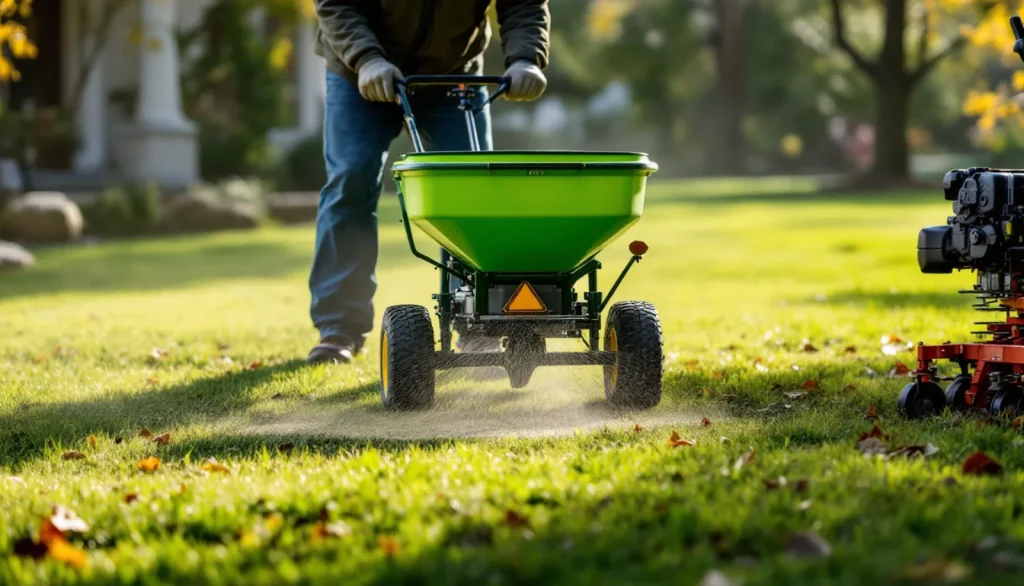
- Spread the seed. Set a broadcast or drop spreader to the overseed rate for your species (see the table above). Apply half the seed walking north-south, then the other half walking east-west for even coverage.
- Work in for seed-to-soil contact. Lightly rake the seed into the top quarter inch of soil, or drag a mat. A slit seeder does this in one pass and tends to give the best contact and germination on thin, compacted lawns.
- Apply starter fertilizer. Spread a phosphorus-containing starter fertilizer over the seeded area to support root and shoot development. Match the rate on the bag.
- Water lightly and often. Water immediately after seeding, then keep the top quarter inch moist with short applications two to three times a day for the first week, easing off as seedlings establish. Morning watering reduces disease risk.
- Hold off on mowing. Do not mow until the new grass reaches about 3 to 4 inches, then mow high on the first cut and never remove more than one-third of the blade.
Broadcast spreader vs slit seeder: which gives better results?
A broadcast or drop spreader is cheaper and fine for most home overseeds, but a slit seeder cuts shallow grooves and drops seed directly into the soil, which improves seed-to-soil contact and germination on thin or compacted lawns. The trade-off is cost and effort: slit seeders rent for roughly $70 to $100 a day, while a broadcast spreader you may already own.
| Method | Seed-to-soil contact | Best for | Cost |
|---|---|---|---|
| Broadcast or drop spreader + rake | Moderate (depends on raking and aeration) | Lightly thinning lawns, smaller yards | Spreader owned or about $30 to $60 |
| Slit seeder (verticut + drop) | High, seed placed in soil grooves | Thin, compacted, or larger lawns | About $70 to $100 per day rental |
Should you aerate before overseeding?
Core aeration before overseeding is recommended for most lawns because it relieves compaction and opens channels that hold seed and move water to the root zone. The University of Nebraska-Lincoln lists aeration as a pre-seeding step that improves establishment. Aerate first, then seed, so the seed can settle into the open holes.
On compacted soil, clay, or high-traffic lawns, aeration matters more, because compacted soil blocks the seed-to-soil contact that germination depends on. If your soil is loose and recently worked, a light dethatch and rake may be enough. Aeration is most useful when paired with overseeding, since the open holes give incoming seed a protected place to germinate.
How to care for an overseeded lawn
The first three weeks decide the outcome. Keep the seedbed consistently moist with light, frequent watering, hold off on mowing until the new grass is 3 to 4 inches tall, and stay off the lawn while seedlings are fragile. Do not apply most pre-emergent weed control, because it stops grass seed from germinating along with the weeds.
Once the lawn is established and you have mowed two or three times, shift to deep, infrequent watering to push roots down, and move into a normal feeding schedule. Our year-round grass maintenance schedule lays out the feeding and mowing calendar for cool-season and warm-season lawns after establishment.
If thin spots persist after a full overseed, the cause is often soil pH, shade, drainage, or pests rather than seed rate. Diagnose before reseeding using our lawn problem diagnosis guide, since dumping more seed on an unfixed problem wastes money.
Common overseeding mistakes that waste seed
Most failed overseeds fail for the same handful of reasons, and almost all of them trace back to seed-to-soil contact or moisture. Knowing the common errors lets you fix the process before you spend on seed again.
- Wrong timing. Seeding a cool-season lawn in late spring puts tender seedlings into summer heat and weed pressure. Wait for the late-summer to early-fall window when soil sits around 50 to 65 degrees Fahrenheit.
- Using the full new-lawn rate. Doubling the seed crowds seedlings into weak, disease-prone grass. Overseed at roughly half the new-lawn rate, or the overseed rate printed on the bag.
- No seed-to-soil contact. Seed broadcast onto an unraked, unaerated canopy mostly dries out or feeds the birds. Aerate or rake the seed into the top quarter inch.
- Letting the seedbed dry out. A single missed day during germination can kill a batch of sprouting seed. Keep the top quarter inch moist with short, frequent watering.
- Applying pre-emergent herbicide. Most pre-emergents stop grass seed from germinating. Skip them on the overseeded area for the season unless the product is specifically labeled as seeding-safe.
How much does overseeding cost?
DIY overseeding is mostly the price of seed plus a starter fertilizer, while hiring a pro adds labor and equipment. Seed itself runs roughly 1 to 15 cents per square foot depending on species and quality, so a 5,000-square-foot lawn might cost $50 to several hundred dollars in seed alone for premium tall fescue or ryegrass blends.
Renting equipment changes the math. A slit seeder rents for about $70 to $100 a day and a core aerator runs in a similar range, so a thorough DIY overseed of a typical lawn lands in the low hundreds of dollars all in. Professional overseeding services average around $1,000 for a full-lawn job including aeration, according to industry pricing reporting, though the figure scales with lawn size and region. For benchmarks across services, see our 2026 lawn care cost guide.
Last reviewed: June 2026
HMNDP Editorial Team, reviewed by HMNDP turf and horticulture editors.
Frequently asked questions
When is the best time to overseed a lawn?
For cool-season lawns (Kentucky bluegrass, tall fescue, ryegrass, fine fescue), late summer to early fall is best, when soil sits around 50 to 65 degrees Fahrenheit and weed pressure drops. The University of Nebraska-Lincoln recommends mid-August to mid-September. Warm-season lawns like Bermuda are overseeded in late spring, or with ryegrass in fall for winter color.
How much grass seed do I need to overseed?
Overseeding uses about half the new-lawn rate. Per 1,000 square feet, the University of Nebraska-Lincoln lists roughly 2 pounds for Kentucky bluegrass and 3 to 4 pounds for tall fescue. Perennial ryegrass runs about 5 to 8 pounds for cool-season overseed, and 8 to 12 pounds for winter overseed on dormant Bermuda per Alabama Cooperative Extension.
Can you just sprinkle grass seed on the lawn?
You can, but most of it will not germinate. Seed needs direct contact with soil and steady moisture to sprout. Broadcasting seed onto an uncut, unaerated lawn leaves it sitting in the canopy where it dries out or gets eaten by birds. Mow low, aerate or rake the seed into the top quarter inch, then keep it moist.
Should you aerate before overseeding?
Yes, for most lawns. Core aeration relieves compaction and creates channels that hold seed and move water to the root zone, which improves germination. The University of Nebraska-Lincoln lists aeration as a pre-seeding step. Aerate first, then seed, so seed settles into the open holes. It matters most on clay or high-traffic lawns.
How long after overseeding before you can mow?
Wait until the new grass reaches about 3 to 4 inches tall, which is usually two to four weeks depending on species and soil temperature. Mow high on the first cut and never remove more than one-third of the blade. Mowing too early uproots fragile seedlings before their roots have anchored.
Do you put down seed or fertilizer first when overseeding?
Spread the seed first, work it into the top quarter inch of soil for contact, then apply a starter fertilizer over the seeded area. Starter fertilizers contain phosphorus to support root and shoot development in new seedlings. Water immediately after both go down, and keep the seedbed moist through germination.
How fast does overseeded grass grow?
It depends on species and soil temperature. Per Purdue University turf science, perennial ryegrass germinates in 5 to 10 days, tall fescue in 7 to 14 days, and Kentucky bluegrass in 14 to 30 days. Warmer soil within each species’ optimum range speeds sprouting, which is why fall overseeding into warm soil establishes faster than early spring.