
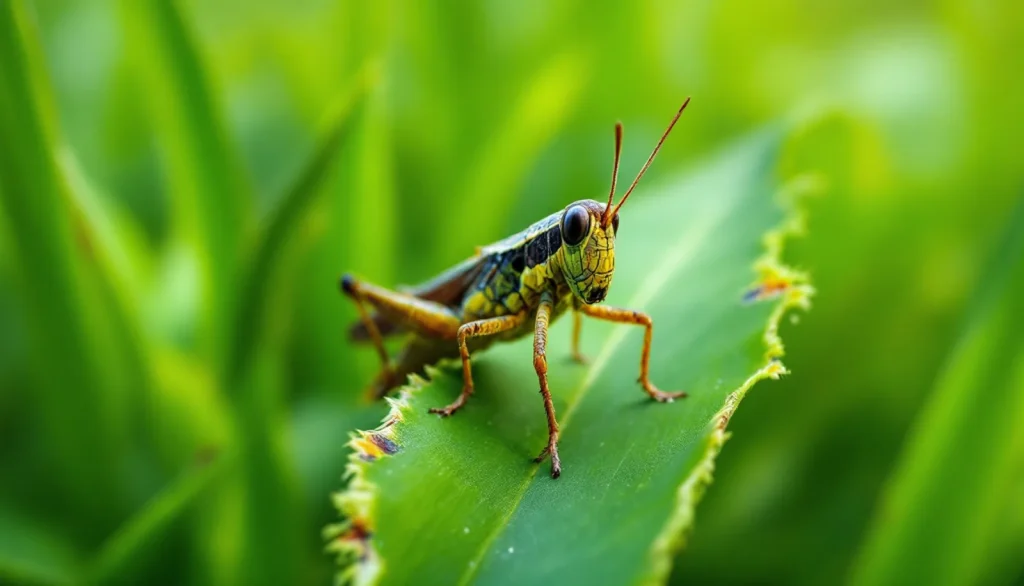
Do Grasshoppers Eat Grass? Lawn Damage and Control
Yes, grasshoppers eat grass, but most pest species prefer broadleaf plants over established lawn turf, so serious lawn damage is uncommon outside of outbreak years. Grasshoppers are chewing herbivores with strong mandibles that strip leaf tissue from grass blades, weeds, vegetables, and ornamentals. On a dense, well-watered home lawn the typical handful of grasshoppers does almost nothing visible. Real turf injury shows up when large numbers migrate in from nearby dry, weedy, or rural ground during a hot, dry season.
This guide separates what grasshoppers actually do to a lawn from the garden damage that most articles lump together, then gives the species, the damage signs, the threshold for action, and the control options ranked by when they work.
Do grasshoppers eat grass, or do they prefer other plants?
Grasshoppers eat grass, but the pest species that reach damaging numbers usually favor broadleaf plants first. According to Colorado State University Extension and the University of Nebraska-Lincoln, the migratory grasshopper feeds readily on broadleaves and switches to grasses and cereals as a secondary choice, while the differential and two-striped grasshoppers (the two species behind most home-landscape complaints) hit vegetables and ornamentals harder than turf. A few grass-specialist species exist, such as the clearwinged grasshopper (Camnula pellucida), which restricts feeding to grasses, but it is a rangeland and pasture problem, not a typical suburban lawn pest.
This is why a thick, weed-free lawn is one of the better grasshopper deterrents you have. CSU Extension notes that reducing weedy, abandoned ground and keeping a dense grass cover with few broadleaf plants lowers how attractive a property is to egg-laying females.
What does grasshopper damage to a lawn look like?
Grasshopper feeding leaves ragged, irregularly chewed grass blades rather than the clean, sheared cut you get from a mower or the round dead patches you get from disease. Look for notched and torn blade edges, chewed-down tips, and, in heavy feeding, thinned or bald spots where blades have been eaten back near the crown. You may also see grasshoppers themselves and small dark fecal pellets (frass) on blades and hardscape.
Damage usually starts at the lawn edge nearest the source, often the side facing a field, ditch, alley, or weedy lot, and works inward. That edge-first pattern is a useful tell. If the brown or thin area is spreading from a single side rather than appearing as scattered circular patches, insects are more likely than disease. Use our brown patches diagnosis guide to rule out fungal and drought causes before you assume grasshoppers.
| Sign | Grasshopper feeding | More likely another cause |
|---|---|---|
| Blade edges | Ragged, notched, chewed irregularly | Clean sheared tips: dull mower blade |
| Pattern | Starts at edge near weedy or open ground, moves inward | Scattered round patches: disease, drought, pet urine |
| Timing | Hot, dry mid to late summer | Spring or wet spells: fungal disease |
| Insect present | Visible grasshoppers, dark frass pellets | No insects, no frass |
When are grasshoppers actually a threat to your lawn?
Grasshoppers become a lawn threat only when they build to outbreak numbers, which happens in hot, dry summers and on properties next to undisturbed breeding ground. Texas A&M AgriLife Extension notes that the worst infestations occur near farmland, rural communities, farmsteads, and urban-fringe areas where grasshoppers have large, weedy breeding grounds. A typical interior city lawn with no adjacent open land rarely sees damaging populations.
There is no published economic threshold for home lawns the way there is for crops, so the practical trigger is visible, spreading damage plus heavy adult numbers, not the sight of a few hoppers. Most extension offices agree that a handful of grasshoppers on a residential lawn needs no treatment at all. Action makes sense when feeding is clearly thinning the turf and large numbers are present, usually a migration from drying vegetation nearby.
The grasshopper life cycle and why timing decides control
Most pest grasshoppers produce one generation per year, overwinter as eggs in the soil, and hatch in mid to late spring, which means the easy window to control them is short and early. Newly hatched nymphs pass through five or six stages (instars) before reaching the winged adult stage in mid to late summer. Texas A&M reports nymph-to-adult development takes roughly 40 to 60 days or more, with adults appearing around mid-July in much of the state.
The reason timing matters: small early-instar nymphs are far easier to kill and have not yet spread out. Once grasshoppers reach the mobile, voracious adult stage, Colorado State University Extension states that control methods become much less effective and reinfestation from surrounding land is constant. Treat young, treat the breeding ground, or accept that adult control on your lawn alone is a losing battle.
- Scout in mid to late spring for newly hatched nymphs in weedy edges, ditches, and field margins near the lawn, not just in the turf itself.
- Target nymphs while they are small, under about 1/2 inch, in the 1st to 3rd instar, before they develop wings and disperse.
- Treat the source ground (weedy borders, fence lines, vacant edges) where they hatch and stage, since that is where numbers build.
- Protect prized garden plants with barriers if hoppers are already adult and migrating.
- Reduce next year’s pressure by clearing weedy harborage and keeping turf dense through fall.
How to control grasshoppers on a lawn
Effective grasshopper control combines reducing weedy breeding ground, treating young nymphs early, and reserving insecticides for genuine outbreaks. Because adults reinvade from surrounding land, no single spray gives lasting control on its own. The options below are ordered roughly from least to most aggressive, with the active ingredients and timing extension entomologists cite.
| Method | Best used when | Notes from extension sources |
|---|---|---|
| Cultural: dense turf, mow weeds, clear weedy edges | Year-round, prevention | Removes broadleaf food and egg-laying habitat; first line of defense (CSU) |
| Nosema locustae bait (NoLo Bait, Semaspore) | Early, on 1st to 2nd instar nymphs (1/4 to 1/2 inch) | Slow-acting microbial bait; only works on young nymphs; keep refrigerated and check expiration (CSU) |
| Barriers: metal window screening, geotextile/row cover | Protecting specific garden plants from adults | Grasshoppers chew through fabric; use metal screening for sensitive plants (Montana State) |
| Insecticide: bifenthrin, lambda-cyhalothrin | Active outbreak, fastest knockdown | Fastest knockdown and longest residual of common products (Texas A&M) |
| Insecticide: permethrin, cyfluthrin, carbaryl (Sevin) | Active outbreak, shorter residual | Effective but shorter-lived; carbaryl and permethrin allowed on some food crops with preharvest intervals (CSU) |
For organic-leaning programs, Nosema locustae bait and products based on neem (azadirachtin) or pyrethrins are the common extension-listed choices, with the caveat that the microbial bait only works on young nymphs and acts slowly. A Reduced Agent and Area Treatment approach, where insecticide covers only part of the breeding area, has proven effective against rangeland populations and limits the chemical you put down.
Whatever product you choose, read the label for lawn and turf clearance, follow the rate, and time it to nymphs. If grasshopper pressure ties into a wider thin or stressed lawn, our grass care fundamentals and seasonal maintenance schedule cover the density and vigor that make turf far less inviting in the first place.
Natural enemies and prevention that lower next year’s pressure
Birds, robber flies, blister beetles, parasitic flies, and naturally occurring fungal diseases all suppress grasshopper numbers, and a healthy yard keeps these allies around. Colorado State University Extension lists horned larks, kestrels, and several predatory and parasitic insects among the natural controls that reduce populations between outbreaks. Broad-spectrum spraying every season can knock these enemies back, which is another reason to treat only when damage is real.
The most durable prevention is habitat management you do in late summer and fall: mow and clear weedy borders where females lay eggs, keep turf thick so broadleaf weeds do not invade, and avoid leaving bare, dry, undisturbed soil at the lawn edge. Reducing egg-laying ground this year is what lowers the hatch next spring.
Last reviewed: June 2026
HMNDP Editorial Team, reviewed by HMNDP turf and horticulture editors.
Frequently asked questions
Do grasshoppers eat grass?
Yes, grasshoppers eat grass, but most pest species prefer broadleaf plants, vegetables, and weeds over established lawn turf. They are chewing herbivores with strong mandibles that strip leaf tissue. On a dense, healthy home lawn a few grasshoppers cause little visible harm. Real turf damage usually happens only in outbreak years when large numbers migrate in from dry, weedy ground nearby.
What does grasshopper damage to a lawn look like?
Grasshopper feeding leaves ragged, notched, irregularly chewed grass blades rather than the clean cut of a mower or the round dead spots of disease. In heavy feeding you see thinned or bald areas near the lawn edge facing a field, ditch, or weedy lot, plus visible grasshoppers and small dark frass pellets on blades and hardscape.
When are grasshoppers a threat to my lawn?
Grasshoppers threaten lawns only at outbreak numbers, which build in hot, dry summers and near rural, farm, or weedy urban-fringe ground. Texas A&M Extension notes worst infestations occur near farmland and undisturbed breeding areas. A typical interior city lawn rarely sees damaging populations. Treat only when feeding clearly thins turf and large adult numbers are present, not for a few hoppers.
How do I get rid of grasshoppers in my lawn?
Combine cultural control with early treatment: keep turf dense, mow and clear weedy edges where eggs are laid, and target young nymphs under half an inch in spring. Nosema locustae bait (NoLo Bait) works on early instars. For outbreaks, extension sources cite bifenthrin and lambda-cyhalothrin for fastest knockdown, or permethrin, cyfluthrin, and carbaryl for shorter residual control.
What is the best time to control grasshoppers?
The best window is mid to late spring, when nymphs are newly hatched, small (under about half an inch), in the 1st to 3rd instar, and have not yet spread. Most pest grasshoppers have one generation per year and overwinter as eggs. Colorado State University Extension notes control gets much less effective once they reach the mobile adult stage in mid to late summer.
Which grasshoppers damage lawns the most?
The differential (Melanoplus differentialis) and two-striped (Melanoplus bivittatus) grasshoppers cause most home-landscape complaints, though they favor gardens and ornamentals over turf. Migratory and redlegged grasshoppers also feed widely. True grass specialists like the clearwinged grasshopper (Camnula pellucida) are mainly rangeland and pasture pests, not typical suburban lawn problems.
Will a thick lawn keep grasshoppers away?
A dense, weed-free lawn is one of the better grasshopper deterrents. Colorado State University Extension notes that reducing weedy, abandoned ground and keeping a thick grass cover with few broadleaf plants makes a property less attractive to egg-laying females. Because pest grasshoppers prefer broadleaf plants, removing weeds and bare, dry edges lowers both feeding pressure and next year’s hatch.