
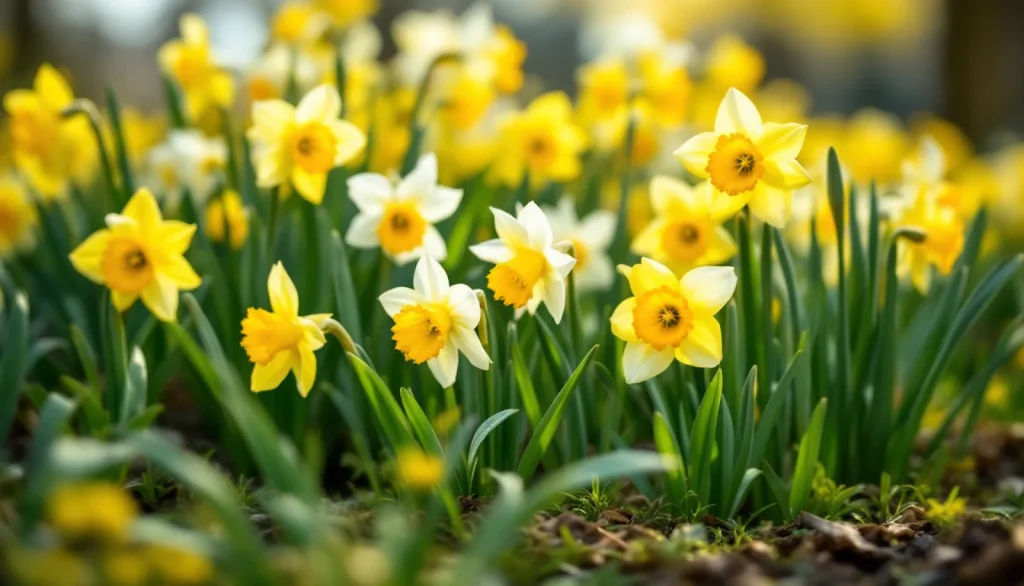
Narcissus Flowers: Types, Planting, and Care
Narcissus flowers are spring-blooming perennial bulbs in the genus Narcissus (family Amaryllidaceae), the same group commonly sold as daffodils, jonquils, and paperwhites. Every daffodil is a narcissus, but not every narcissus is the trumpet-shaped daffodil most people picture. The Royal Horticultural Society sorts all cultivated narcissi into 13 horticultural divisions by flower form, and choosing the right division for your zone, bloom window, and garden use is what separates a one-season pot from a clump that comes back for decades. This guide gives you the division-by-use comparison, US planting specs by zone, and the toxicity facts in one place.
Are narcissus and daffodil the same flower?
Yes and no. Narcissus is the botanical genus name; daffodil is the common name most often applied to the large trumpet types (Division 1). All daffodils are narcissus, but the genus also includes jonquils, tazettas, poeticus, and paperwhites that look nothing like the classic trumpet. Use either word and you will not be wrong, though “narcissus” is the precise term.
The visible differences sit in the corona, the cup or trumpet at the flower’s center. A Division 1 trumpet daffodil has a corona as long as or longer than its petals (technically the perianth segments). A poeticus narcissus has a corona shorter than one-fifth the petal length, a flat colored disc rather than a trumpet. Jonquils carry several small fragrant flowers per stem; the classic daffodil carries one large flower per stem.
The genus is native to meadows and woodland of southern Europe and North Africa, with the center of diversity in the western Mediterranean, per the Wikipedia genus entry and Cornell Botanic Gardens. Plants range from dwarf species near 5 to 8 cm tall (N. asturiensis) up to N. tazetta at roughly 80 cm.
The 13 narcissus divisions and what each is good for
The RHS classification splits narcissi into 13 divisions based on flower form, mainly the ratio of corona length to petal length. Most narcissus bulbs sold in the US come from Divisions 1 (Trumpet), 2 (Large-cupped), and 8 (Tazetta), per the List of Narcissus horticultural divisions. The table below maps each division to its form, a real cultivar, and the garden job it does best.
| Division | Defining form | Named cultivar | Best garden use |
|---|---|---|---|
| 1. Trumpet | Corona as long as or longer than the petals; one flower per stem | ‘American Dream’ | Bold borders, the classic daffodil look |
| 2. Large-cupped | Corona more than one-third but less than the petal length | ‘Ice Follies’, ‘Pacific Rim’ | Reliable mass plantings, naturalizing |
| 3. Small-cupped | Corona not more than one-third the petal length | ‘Emerald Light’ | Refined beds, later-season color |
| 4. Double | Doubled petals or corona or both | ‘Rose Garden’ | Cut-flower beds, peony-like blooms |
| 5. Triandrus | Two or more nodding flowers per stem; reflexed petals | ‘Akepa’ | Containers, rock gardens |
| 6. Cyclamineus | One flower per stem; strongly swept-back petals | ‘Tete-a-Tete’ (miniature) | Early color, pots, edging |
| 7. Jonquilla | One to five (rarely eight) fragrant flowers per stem | ‘Wendover’ | Fragrance, warm-region gardens |
| 8. Tazetta | Three to twenty fragrant flowers per stout stem | ‘Falconet’, paperwhites | Indoor forcing, mild-winter gardens |
| 9. Poeticus | Corona a flat disc under one-fifth the petal length; fragrant | ‘Lemon Cooler’ | Late season, meadow naturalizing |
| 10. Bulbocodium | Tiny petals dominated by a large corona (hoop-petticoat) | ‘Cornish Cream’ | Rock gardens, specialist beds |
| 11. Split-cupped | Corona split for at least one-third its length | ‘Trigonometry’ | Showy modern beds |
| 12. Other | Cultivars fitting no other division; many inter-division hybrids | ‘Mesa Verde’ | Collector and novelty plantings |
| 13. Species and wild | True species and wild hybrids | N. rupicola subsp. watieri | Naturalizing, native-style gardens |
Bloom timing tracks loosely with division and cultivar. Garden-center listings and the Penn State Extension daffodil guide describe early, mid, and late cultivars that, planted together, stretch narcissus color across roughly six to eight weeks. Cyclamineus types like ‘Tete-a-Tete’ open early; poeticus types finish the season.
How to plant narcissus bulbs
Plant narcissus bulbs in fall, pointed end up, at a depth of two to three times the bulb’s height, once soil has cooled to about 55 to 60 degrees Fahrenheit. Penn State Extension recommends covering the bulb with soil twice the bulb’s height; Floret and several retailers go slightly deeper in light soils. Space larger bulbs 4 to 6 inches apart, smaller and miniature bulbs 3 to 4 inches apart, and they need good drainage in at least partial sun.
- Wait until fall soil cools to 55 to 60 degrees, roughly September in cold climates and as late as November in warm ones, per van Engelen and White Flower Farm.
- Pick a spot with at least partial sun. Penn State Extension warns that heavy shade produces “blind” plants that grow leaves but no flowers.
- Loosen soil 6 to 8 inches deep and mix in a little bulb fertilizer and compost (Floret). Avoid spots with standing water, which rots bulbs.
- Set bulbs pointed end up, covered by soil two to three times the bulb’s height. A 1.5-inch bulb sits under about 4 to 5 inches of soil.
- Space large bulbs 4 to 6 inches apart, miniatures 3 to 4 inches. Plant in clumps of 10 to 20 for visual impact rather than single rows.
- Water in once, then leave them. Bulbs need a cold winter chill period to flower the following spring.
If you are unsure how many bulbs a bed needs, our walkthrough on how to measure square footage uses the same area math you can apply to a planting bed, and our drip irrigation install guide covers watering beds without overwetting bulbs.
Do narcissus come back every year?
Yes. Narcissus are reliably perennial in USDA zones 3 through 8 (Penn State Extension) and naturalize well, multiplying within two to three years (Floret). The one rule that keeps them returning: do not cut the foliage until it has turned brown and died back, because the leaves keep feeding the bulb for next year’s bloom.
Cutting green leaves early, or braiding and tying them for tidiness, starves the bulb and weakens or eliminates the next year’s flowers. Let foliage yellow and collapse on its own, usually four to six weeks after bloom, then remove it. A light bulb fertilizer at planting and again as shoots emerge supports return bloom; established clumps rarely need more.
If a clump stops flowering despite good care, it is usually too crowded or too shaded. Lift and divide congested clumps after the foliage dies back, or move them to brighter ground. Narcissus that fail in heavy clay often just need the better-drained, sunnier conditions covered in our guide to growing in shade and tough spots.
Are narcissus poisonous to pets and deer?
Yes, narcissus are toxic to dogs, cats, and horses, and that same toxicity makes them deer and rodent resistant. The ASPCA lists narcissus as toxic, with lycorine and other alkaloids as the toxic principle; the bulb is the most poisonous part. Signs of ingestion include vomiting, drooling, and diarrhea, with large doses causing tremors, low blood pressure, and cardiac arrhythmia.
The upside for gardeners is real. The same lycorine alkaloid means deer, rabbits, and voles leave narcissus alone, per Chicago Botanic Garden and White Flower Farm. That makes them one of the few spring bulbs you can plant in deer country without fencing or repellent, unlike tulips. If a pet ingests any part, the ASPCA Animal Poison Control line is (888) 426-4435.
Keep bulbs out of reach during fall planting, when curious dogs are most likely to dig and chew them. Cut narcissus in a vase also leak a sap that shortens the life of other flowers, so condition the stems separately for a few hours before mixing arrangements (Floret).
What do narcissus flowers symbolize?
Narcissus symbolize rebirth, renewal, and the return of spring, since they are among the first flowers to bloom after winter alongside crocuses. In China, narcissus (especially N. tazetta) represent prosperity and good fortune when forced to bloom for Chinese New Year, a tradition recorded as far back as the 7th century CE per Cornell Botanic Gardens. The flower is the birth flower of March.
Color carries meaning too. Yellow narcissus are linked to happiness, friendship, and new beginnings; white narcissus to purity and sincerity, per A-Z Animals and Petal Republic. Cut narcissus typically hold their bloom for one to two weeks depending on light and water.
Narcissus quick-reference specs
Use this as a planting cheat sheet. Numbers are drawn from Penn State Extension, Floret, van Engelen, White Flower Farm, and the ASPCA, listed in the sources below.
| Spec | Detail |
|---|---|
| Hardiness | USDA zones 3 to 8 (perennial); tazettas and paperwhites tolerate warmer zones or are forced indoors |
| Plant when | Fall, soil cooled to 55 to 60 degrees F |
| Planting depth | 2 to 3 times bulb height (a 1.5-inch bulb under 4 to 5 inches of soil) |
| Spacing | 4 to 6 inches (large bulbs); 3 to 4 inches (miniatures) |
| Light | Full to partial sun; heavy shade causes blind, flowerless plants |
| Bloom time | Early spring, roughly March to early May by cultivar |
| Height range | About 5 to 8 cm (dwarf species) up to 80 cm (tazetta) |
| Toxicity | Toxic to dogs, cats, horses (lycorine); bulb most toxic |
| Deer and rodent | Resistant, due to the same alkaloid |
| Foliage rule | Leave leaves until brown; do not cut green |
For the broader spring garden, our lawn and garden learn hub collects fertilizer, soil, and seasonal-care guides, and the year-round maintenance schedule shows where bulb care fits in the spring calendar.
Last reviewed: June 2026
HMNDP Editorial Team, reviewed by HMNDP turf and horticulture editors.
Frequently asked questions
Are narcissus and daffodils the same flower?
Narcissus is the botanical genus name; daffodil is the common name usually applied to the large trumpet types (Division 1). Every daffodil is a narcissus, but the genus also covers jonquils, tazettas, poeticus, and paperwhites that look nothing like a trumpet daffodil. Either name is acceptable, though narcissus is the precise term.
How deep should you plant narcissus bulbs?
Plant narcissus bulbs at a depth of two to three times the bulb’s height, pointed end up, per Penn State Extension and Floret. A 1.5-inch bulb sits under about 4 to 5 inches of soil. Space large bulbs 4 to 6 inches apart and miniatures 3 to 4 inches apart, in well-drained soil with at least partial sun.
When do narcissus flowers bloom?
Narcissus bloom in early spring, roughly March to early May depending on cultivar and climate. They are among the first flowers to appear after winter, alongside crocuses. Planting early cultivars like the cyclamineus ‘Tete-a-Tete’ with later poeticus types stretches narcissus color across about six to eight weeks.
Do narcissus come back every year?
Yes. Narcissus are reliably perennial in USDA zones 3 through 8 and naturalize, multiplying within two to three years. The key rule is to leave the foliage until it turns brown and dies back, because the leaves feed the bulb for the next year’s bloom. Cutting green leaves early weakens or eliminates future flowers.
Are narcissus poisonous to dogs and cats?
Yes. The ASPCA lists narcissus as toxic to dogs, cats, and horses, with lycorine and other alkaloids as the toxic principle. The bulb is the most poisonous part. Signs include vomiting, drooling, and diarrhea; large doses can cause tremors and cardiac arrhythmia. Call the ASPCA Animal Poison Control at (888) 426-4435 if ingested.
Are narcissus deer resistant?
Yes. The same lycorine alkaloid that makes narcissus toxic to pets also makes them deer, rabbit, and vole resistant, per Chicago Botanic Garden and White Flower Farm. This makes narcissus one of the few spring bulbs you can plant in deer country without fencing or repellent, unlike tulips, which deer readily eat.
How many narcissus divisions are there?
The Royal Horticultural Society sorts cultivated narcissus into 13 horticultural divisions, based mainly on the ratio of corona length to petal length. Division 1 is Trumpet, Division 2 Large-cupped, and Division 8 Tazetta, which together cover most bulbs sold in the US. Other divisions include jonquilla, poeticus, double, and species types.
What do narcissus flowers symbolize?
Narcissus symbolize rebirth, renewal, and the return of spring, since they bloom among the first flowers after winter. In China, narcissus represent prosperity and good fortune when forced for Chinese New Year. Yellow narcissus signal happiness and friendship; white narcissus stand for purity and sincerity. The flower is the March birth flower.