
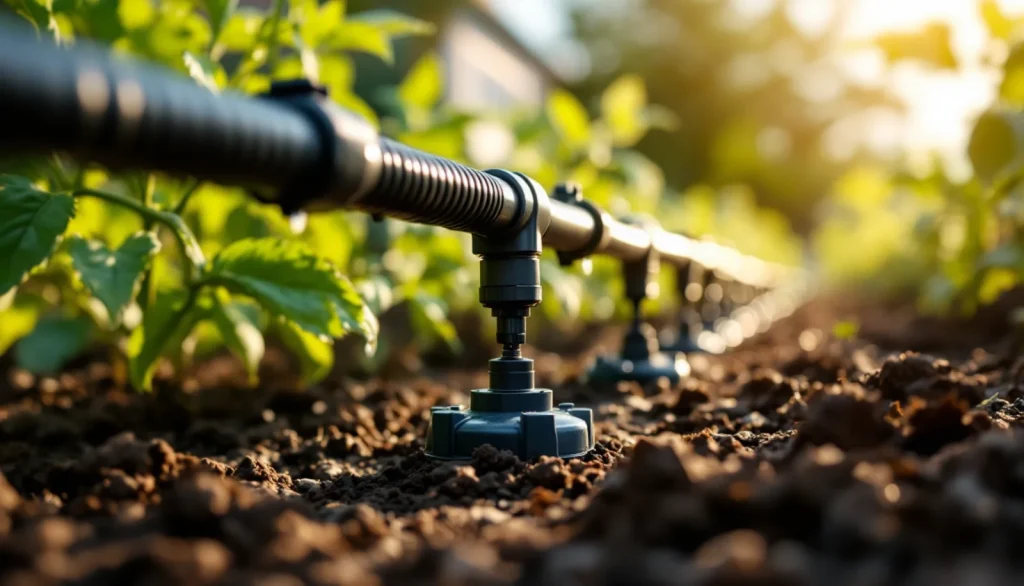
To install drip irrigation in a garden or foundation bed you need three things: a layout plan, the right parts kit, and about 3-5 hours for a typical 200-400 sq ft bed. A complete DIY system runs $80-180 in materials and uses 30-50% less water than equivalent sprinkler coverage. The install is genuinely simple once you understand the four parts that make up every drip system.
The short version
- Materials: backflow preventer, pressure regulator, filter, tubing, emitters, end caps
- Tap into an existing hose bib or a dedicated valve from your irrigation manifold
- Lay 1/2-inch mainline tubing around the bed perimeter
- Punch holes for 1/4-inch feeder lines or in-line emitters
- Plan 0.5-2 gallons per hour per plant depending on size and species
- Cost: $80-180 for a complete 200-400 sq ft bed install in 2026
What every drip system needs
Every drip irrigation system has four functional parts. Skip any one of them and the system fails within a season.
Backflow prevention. Required by code in most municipalities. A simple vacuum breaker (RPZ) at the hose bib or main connection prevents contaminated water from siphoning back into the potable water supply. Cost: $8-25 for a hose-bib RPZ, $40-90 for an inline RPZ.
Pressure regulator. Drip systems run at 25-30 PSI. Most municipal water comes in at 45-80 PSI. Without a pressure regulator, your emitters spray instead of drip, and the tubing develops leaks at every fitting within a season. The standard 25 PSI regulator runs $8-15.
Filter. Y-filter or T-filter at 150 or 200 mesh. Removes sediment and minerals from your water supply before they clog the emitters. Cost: $10-20. Clean monthly during growing season.
Tubing, emitters, fittings. 1/2-inch black polyethylene mainline tubing as the trunk. 1/4-inch black tubing as feeder branches. Pressure-compensating emitters at 0.5, 1, or 2 gallons per hour depending on plant water demand. End caps. T-fittings. Punches. The materials kit for a 200 sq ft bed runs $50-100.
Layout planning
Sketch your bed before you buy anything. Note plant locations and rough mature canopy size. Group plants by water demand: vegetables need 1-2 gallons per hour per plant; perennials run 0.5-1 GPH; established shrubs 1-2 GPH; new trees 2-4 GPH.
Mainline routing: run the 1/2-inch trunk around the perimeter of the bed about 8-12 inches inside the bed edge. Cap the end. Branch off the mainline at each plant location with a 1/4-inch feeder line plus emitter, or punch in-line emitters directly into the mainline if plants are close together.
Maximum mainline run: 200 linear feet per zone for 1/2-inch tubing at 30 PSI. Beyond that, pressure drops below the regulator output and emitters at the end of the run deliver less water than at the start.
Materials list for a typical 200 sq ft bed
| Part | Quantity | Cost (2026) |
|---|---|---|
| 1/2-inch poly mainline, 100 ft | 1 roll | $22-32 |
| 1/4-inch feeder tubing, 50 ft | 1 roll | $8-14 |
| 1 GPH pressure-comp emitters | 20-30 ct | $12-22 |
| 2 GPH pressure-comp emitters | 10-15 ct | $8-15 |
| 1/4-inch T-fittings | 10 ct | $4-8 |
| 1/2-inch end caps | 2 ct | $3-5 |
| Hole punch tool | 1 | $5-12 |
| 25 PSI pressure regulator | 1 | $8-15 |
| 200-mesh Y-filter | 1 | $12-18 |
| Vacuum breaker (RPZ) | 1 | $8-25 |
| Hose-bib timer (optional but recommended) | 1 | $25-65 |
| Total | $115-231 |
Buy from a pro-tier source. SiteOne, Ewing, and Drip Depot stock pro-grade Rain Bird, Hunter, and DIG components at 20-40% below big-box pricing.
Install steps
Step 1: Assemble the head. At the water source, screw on the RPZ, then the timer (if using), then the filter, then the pressure regulator. The order matters: filter before regulator, regulator before tubing.
Step 2: Lay the mainline. Unroll the 1/2-inch tubing along the bed perimeter. If it is stiff from being coiled, lay it in the sun for an hour first. Curve it gently around bed corners; tight 90-degree bends kink the tubing.
Step 3: Punch and install emitters or feeder branches. At each plant, use the hole punch to make a 1/4-inch hole in the mainline. Insert an emitter directly (for in-line installation) or insert a 1/4-inch T-fitting and run a feeder line to the plant. Place the emitter at the dripline of the plant, not directly at the stem.
Step 4: Cap the end. Squeeze the figure-8 end cap or insert a hose clamp at the terminal end of the mainline.
Step 5: Charge the system. Turn on the water at low pressure. Walk the system. Check for spray (regulator failure), wet spots at fittings (loose fitting), or dry emitters (clogged or wrong direction). Tighten and re-punch as needed.
Step 6: Mulch over the tubing. 2-3 inches of bark mulch hides the tubing, protects it from UV degradation (untreated black poly degrades over 3-5 years in full sun), and improves moisture retention.
Common mistakes
Forgetting the pressure regulator. Most common. System works for 2 weeks then starts leaking at every fitting. Fix: install a regulator.
Tubing kinks at corners. Tight 90-degree bends pinch the flow. Use an elbow fitting or curve the tubing wide.
Wrong emitter sizing. 2 GPH emitter on a small annual is overwatering. 0.5 GPH on a tomato plant is underwatering. Match emitter to plant.
UV degradation of exposed tubing. Black poly in full sun lasts 3-5 years. Bury under mulch.
Ignoring filter maintenance. Filter clogs slowly, emitter flow drops, plants slowly die. Clean filter monthly during growing season.
Runtime and water budgeting
For 1 GPH emitters at established plants: run the system 30-60 minutes per zone, 2-3 times per week in summer, 1-2 times per week in spring and fall. Total weekly water use for a 200 sq ft bed with 20 emitters: 20 plants × 1 GPH × 0.75 hour × 2 sessions = 30 gallons per week.
Compared to a typical pop-up sprinkler covering the same bed (5,500 gallons per acre-inch per week target), drip uses 60-70% less water and delivers it directly to the root zone where the plant can use it.
When a pro install makes sense
Three situations warrant calling an irrigation contractor. Tying into your existing irrigation system requires opening up the manifold and adding a valve, plus running wire to the controller. Most homeowners do not enjoy this. Beds larger than 1,000 sq ft need multi-zone planning and pressure calculations beyond hose-bib drip kits. Hardscape integration (drip under pavers, retaining walls) requires forethought during the hardscape build.
Pro install pricing in 2026 runs $400-1,200 for a typical 4-bed yard with controller integration. See our landscapers directory for irrigation specialists in your city.
Bottom line
Drip irrigation is the highest-ROI water project most homeowners will do. Materials run $115-231 for a typical bed. Install takes 3-5 hours. Water savings pay back the install within 2 seasons in most metros. Buy from a pro-tier source like SiteOne or Drip Depot, not big-box. Install pressure regulator and filter or it fails.