
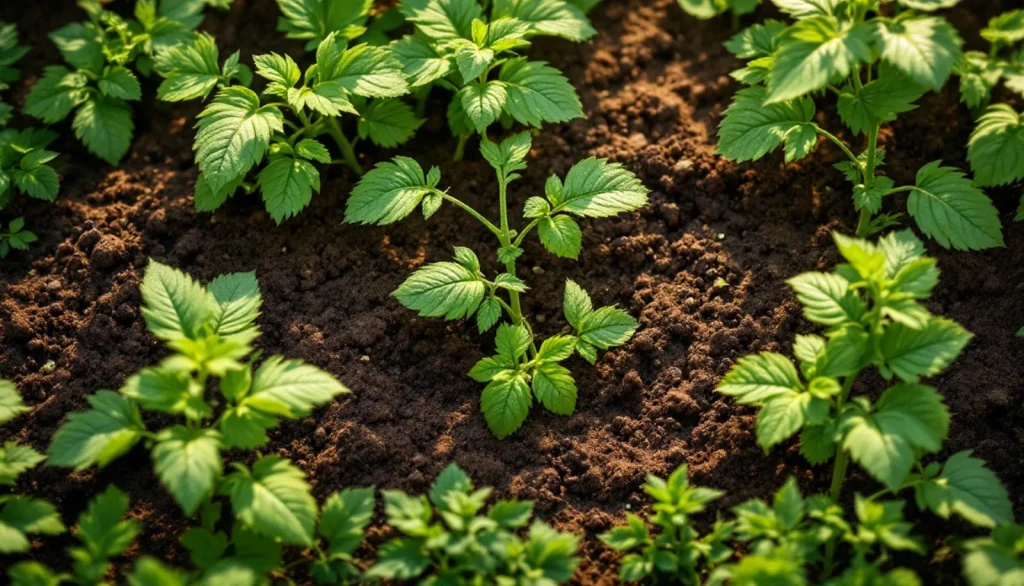
Vegetable garden fertilizer is not one product. Tomatoes want a different NPK than lettuce, peppers want phosphorus at flowering but nitrogen at transplant, and brassicas want consistent nitrogen all season while root vegetables want almost no nitrogen at all. This guide walks through what to feed each major vegetable crop, when to apply it, and what the math actually says about cost per square foot. Real 2026 products, real application rates, and real worked examples for a typical 100 sq ft backyard bed.
The short version
- Tomatoes, peppers, eggplant: 5-10-10 or 3-4-6 at transplant, then switch to higher potassium (2-3-6) at flowering. Phosphorus drives flower and fruit set.
- Leafy greens (lettuce, spinach, chard, kale): 10-5-5 or higher nitrogen ratio. Continuous nitrogen drives leaf growth.
- Root vegetables (carrots, beets, radishes, parsnips): low-nitrogen blend (3-10-10). High nitrogen produces hairy roots and bushy tops with small roots.
- Brassicas (broccoli, cauliflower, cabbage, Brussels sprouts): balanced 10-10-10 at transplant plus a mid-season nitrogen side-dress.
- Best 2026 products: Espoma Tomato-tone 3-4-6 ($14 for 4 lbs), Dr. Earth Home Grown 4-6-3 ($22 for 4 lbs), Jobe’s Organics Vegetable & Tomato 2-5-3 ($13 for 4 lbs), Miracle-Gro Performance Organics 9-4-5 ($14 for 2.5 lbs).
- Annual cost for a typical 100 sq ft vegetable bed: $50 to $90 in fertilizer plus a one-time $30 to $60 in soil-test and pH amendment.
Why one fertilizer cannot do every crop
The temptation in any backyard vegetable garden is to buy one bag of 10-10-10, broadcast it across the whole bed, and call it done. This produces an acceptable garden, but it leaves yield on the table for almost every crop and actively hurts a few of them. The reason is that each crop has different nutritional priorities tied to what it produces.
A leafy green like lettuce is harvested as leaf tissue. Nitrogen drives leaf tissue. A fruiting crop like tomato is harvested as fruit, and fruit development is gated by phosphorus and potassium more than nitrogen. A root crop like carrots is harvested as root tissue, and excess nitrogen pushes the plant to make leaves at the expense of the root. The same 10-10-10 bag is too low in nitrogen for lettuce, too high in nitrogen for carrots, and roughly correct for tomatoes only at transplant time. Switching products by crop is what separates a good garden from a great one.
For the underlying chemistry of NPK and what each number does, the NPK fertilizer guide covers the basics. The short version: nitrogen drives leaf growth, phosphorus drives flower and root development, potassium drives stress tolerance and fruit quality.
NPK ratios by crop type (the table that actually matters)
| Crop category | Best NPK at transplant | Best NPK at flowering / midseason | Application rate |
|---|---|---|---|
| Tomatoes, peppers, eggplant | 5-10-10 or 3-4-6 | 2-3-6 plus calcium | 1 cup per plant at transplant, side-dress at first fruit set |
| Cucumbers, squash, zucchini, melons | 5-10-10 | 5-10-10 every 3 weeks | 1 cup per hill at planting, 1/2 cup side-dress monthly |
| Lettuce, spinach, chard, kale, mustard | 10-5-5 or higher N | 10-5-5 every 2 to 3 weeks | 1 lb per 25 sq ft, broadcast and scratched in |
| Carrots, beets, parsnips, turnips, radishes | 3-10-10 or 4-6-3 | None needed in 60 to 80 day cycle | 1 lb per 25 sq ft worked into bed before sowing |
| Broccoli, cauliflower, cabbage, Brussels sprouts | 10-10-10 | Blood meal or 21-0-0 mid-season | 1 cup per transplant, side-dress at 4 weeks |
| Onions, garlic, leeks | 10-20-10 at planting | 21-0-0 every 3 weeks until bulbing | 1 lb per 25 sq ft pre-plant, side-dress until bulbing |
| Beans, peas (legumes) | 5-10-10 light or skip | None (legumes fix their own N) | Inoculant + light P/K only |
| Corn | 10-10-10 at planting | 21-0-0 at knee-high, again at tasseling | 2 lb per 25 sq ft pre-plant plus side-dressings |
Two takeaways. First, the “tomato fertilizer” category that dominates retail shelves (Tomato-tone, Burpee Big Boy, Dr. Earth Premium Gold Bag) is correctly formulated for fruiting crops and works for tomatoes, peppers, eggplant, cucumbers, squash, and melons interchangeably. Second, root vegetables need fundamentally different inputs than fruiting crops. Using “tomato fertilizer” on carrots produces beautiful tops and disappointing roots.
Best vegetable garden fertilizer picks by category, 2026 retail
Best for fruiting crops (tomatoes, peppers, eggplant)
Espoma Tomato-tone 3-4-6 is the consumer leader and well-formulated. 4-lb bag at $14 in 2026 covers about 80 plants at 1 cup per transplant. OMRI Listed, slow-release organic. Application: 1 cup per transplant worked into the planting hole, then side-dress 1/2 cup per plant at first fruit set. Includes calcium, which helps prevent blossom-end rot in tomatoes.
Dr. Earth Home Grown 4-6-3 is the premium upgrade. 4-lb bag at $22 in 2026. Includes mycorrhizal inoculant, which materially improves root colonization in containerized or first-year-bed plants. Slightly higher cost per pound but better performance on stressed transplants.
Burpee Tomato & Vegetable 3-6-4 is the budget pick at $12 for a 4-lb bag, also OMRI Listed. Slightly lower nitrogen than Tomato-tone, slightly higher phosphorus. Performance is essentially equivalent for most home gardens.
Best for leafy greens
Blood meal 12-0-0 from Down to Earth or Espoma is the most concentrated organic nitrogen source. A 5-lb bag at $24 covers 250 to 500 sq ft of greens beds. Apply 1 to 2 lbs per 100 sq ft worked into the soil before sowing, then side-dress at half rate every 3 weeks. See the organic garden fertilizer guide for more on application rates for blood meal and the burn-risk threshold.
Jobe’s Organics All-Purpose 4-4-4 at $14 for a 4-lb bag is a competent stand-in if you want one product for greens, herbs, and brassicas. Lower N than blood meal but easier to apply and less prone to burn.
Fish emulsion 5-1-1 (Neptune’s Harvest, $36 per gallon) as a foliar feed every 2 to 3 weeks accelerates leafy-green growth measurably. Apply at 1 oz per gallon with a watering can or pump sprayer. Best in the morning so the sun dissipates the odor before evening.
Best for root vegetables
Espoma Garden-tone 3-4-4 at $14 for 4 lbs is the textbook root-vegetable fertilizer. Low enough nitrogen to avoid hairy roots, balanced phosphorus and potassium for root development. Apply 1 lb per 25 sq ft worked into the bed before sowing.
Bone meal 3-15-0 as a phosphorus-focused supplement at planting. About 5 lbs per 100 sq ft worked into the top 6 inches. Particularly valuable for carrots, beets, and parsnips that have long growing cycles.
Wood ashes (if you have a wood stove or fireplace) provide free potassium at roughly 0-1-3 NPK. Sprinkle 5 lbs per 100 sq ft of root-vegetable beds. Skip if soil pH is already above 7.0 because wood ashes are alkaline.
Best for synthetic / convenience approach
Miracle-Gro Performance Organics Edible Plant Food 9-4-5 at $14 for a 2.5-lb bag is a competent OMRI Listed synthetic alternative. The 9% nitrogen is high enough for greens and brassicas, the 4-5 NPK back-end is reasonable for fruiting crops. Apply 1 tablespoon per plant or 1 lb per 25 sq ft.
Osmocote Smart-Release Plant Food 14-14-14 at $17 for a 1-lb bottle is the polymer-coated synthetic option. Single application lasts 4 months. Not OMRI Listed (so not technically organic) but extremely convenient. Best for containers or first-year beds where soil biology has not been built up yet.
Soil test first: the step almost no one takes
Before buying any vegetable garden fertilizer, get a soil test. A basic soil test from your state extension service costs $15 to $25 in 2026 and tells you pH, organic matter content, and the current levels of nitrogen, phosphorus, and potassium. Many vegetable garden problems are not nutrient deficiencies but pH issues, and adding fertilizer to a soil with pH 5.0 or pH 8.2 mostly does not help because the plant cannot access the nutrients regardless of how much you add.
Target pH for most vegetables is 6.0 to 7.0. Below 6.0, add agricultural lime at 5 to 10 lbs per 100 sq ft and wait at least a month before planting. Above 7.5, add elemental sulfur at 1 to 2 lbs per 100 sq ft. Blueberries are the major exception (they want pH 4.5 to 5.5 and need sulfur or aluminum sulfate to maintain).
The soil test also tells you when you have enough phosphorus already. Most established gardens with multi-year compost programs are at saturated or near-saturated phosphorus levels, which means adding bone meal or 10-10-10 mostly does nothing useful. In that case, switch to a higher-nitrogen product (10-5-5 or blood meal) and stop wasting money on phosphorus.
Application timing through the season
A typical 100 sq ft vegetable garden in zones 5 to 7 follows this fertilization rhythm:
- Late winter / early spring (4 weeks before transplant): Soil test results back. Apply pH amendments if needed. Work 1 inch of compost into the top 6 inches of bed soil.
- At transplant (Mother’s Day window for most zones): 1 cup of crop-appropriate fertilizer per transplant, mixed into the planting hole. Tomato-tone for tomatoes/peppers/eggplant, Garden-tone for root vegetables already direct-sown.
- 4 to 6 weeks after transplant: Side-dress heavy feeders (tomatoes, brassicas, corn) with 1/2 cup of fertilizer per plant, scratched in 4 inches from the base, then watered. Apply blood meal at half rate to leafy greens.
- At first flower set (tomatoes, peppers): Switch to a higher-potassium product (Espoma Tomato-tone or any 3-5-8 to 3-6-9 formulation). Calcium spray if blossom-end rot has been a problem in past years.
- Mid-July to early August: Foliar feed weekly with fish emulsion (1 oz per gallon) on any plant showing yellowing or slowed growth. Side-dress brassicas with blood meal one more time.
- Fall (after harvest): Top-dress beds with 1 inch of compost and plant a cover crop (winter rye, crimson clover, oats) for soil building.
Total fertilizer cost for a 100 sq ft bed following this schedule: $50 to $90 per year in inputs. That includes one bag of Tomato-tone, one bag of Garden-tone, a 5-lb bag of blood meal, and a gallon of fish emulsion (which lasts 2 seasons).
Worked example: a 100 sq ft bed with tomatoes, peppers, and lettuce
Imagine a 100 sq ft raised bed split into three crops: 6 tomato plants, 4 pepper plants, and 30 lettuce plants succession-sown over the season. Here is the fertilizer math.
Spring bed prep. 8 cubic feet of compost worked in (about 1 inch deep), 4 lbs of Espoma Garden-tone broadcast as a starter, $50 in compost plus $14 in Garden-tone equals $64.
At transplant. 1 cup of Tomato-tone per tomato and pepper plant (10 cups total, about 1.5 lbs from the 4-lb bag). Cost: $5.25 of the $14 bag.
4 weeks later, side-dress tomatoes and peppers. 1/2 cup per plant. Another $2.60 of the bag. The bag has now done its main job and has about 1 lb remaining for late-season touch-up.
Leafy green nitrogen. 1 lb of blood meal broadcast and scratched in across 30 sq ft of lettuce area. Cost: $4.80 from a 5-lb bag.
Mid-season foliar feed. 6 fish emulsion applications at 2 gallons of mixed solution per pass equals 12 oz of concentrate from the 128-oz gallon. Cost: $3.40 of the $36 gallon.
Total year-one cost: $80 in fertilizer plus $64 in compost-and-starter equals $144. Of that, the compost and the gallon of fish emulsion both spill over into year two, so the true annualized cost settles closer to $90 to $100 per year for a fully fertilized 100 sq ft bed.
For context, the same 6 tomato plants and 4 pepper plants would produce roughly 180 lbs of tomatoes and 25 lbs of peppers in a good year, retail value $400 to $700 depending on local prices. The fertilizer math is a clear win, but only if the lawn-care, watering, and pest-control sides of the operation are also dialed in. A garden that has the right fertilizer but the wrong watering pattern still underperforms. Drip irrigation makes a real difference, and the drip irrigation guide covers install economics for vegetable beds. For lawn-care context generally, see the lawn care cost guide.
Containers and raised beds need different math
Container-grown vegetables (5-gallon buckets, fabric grow bags) follow different rules: soil volume is small, biology footprint is minimal, and watering leaches nutrients out the bottom fast. Start with a quality potting mix that includes slow-release fertilizer (FoxFarm Ocean Forest, Espoma Organic Potting Mix), switch to a weekly half-strength liquid feed after week 4, and top-dress with 1/4 cup of granular slow-release at week 6 and week 10. Annual cost per 5-gallon tomato container runs $5 to $8. Raised beds follow the standard in-ground schedule with one tweak: top-dress with 1 inch of compost annually because they compact faster.
Common mistakes that reduce vegetable yield
Over-fertilizing tomatoes with nitrogen. The single most common home-garden mistake. Heavy nitrogen produces beautiful dark-green tomato plants that flower late and set fewer fruit. Switch from a balanced 5-10-10 at transplant to a higher-potassium 3-4-6 or 2-3-6 once flowering starts.
Using lawn fertilizer on the vegetable bed. Lawn fertilizers are usually 0 in the middle (phosphorus is restricted by law in many states for established lawns) and high in fast-release nitrogen. Both are wrong for vegetables. Lawn fertilizer also frequently contains herbicide (weed-and-feed products), which kills vegetables fast.
Skipping the soil test. Costs $15 to $25. Prevents hundreds of dollars in unnecessary fertilizer purchases on phosphorus-saturated established beds. Worth it every 3 years even if you do not test annually.
Applying granular fertilizer too close to seedlings. Granular fertilizer in direct contact with stems or young root systems causes salt burn. Keep granular at least 3 to 4 inches from the base of any plant, then water in. For seedlings less than 3 weeks old, use liquid only.
Fertilizing legumes. Beans and peas fix their own nitrogen through a soil bacteria partnership (rhizobium). Adding nitrogen suppresses this natural fixation and produces lush vines with few pods. A light dose of bone meal at planting is fine, but skip the nitrogen entirely.
Organic vs synthetic for vegetable gardens
The honest assessment for vegetable beds specifically: organic wins on most metrics. Soil biology matters more in vegetable beds because the plants are heavy feeders being asked to produce fruit and seed in a single season. Compost, blood meal, and Tomato-tone build soil biology that delivers nutrients more reliably over the long season than synthetic-only fertilization. The price premium is real but moderate, typically $30 to $50 per year for a 100 sq ft bed. For deeper coverage of organic options specifically, the organic garden fertilizer guide walks through bone meal, blood meal, compost, and fish emulsion in detail.
Synthetic fertilizers are not bad, and Osmocote 14-14-14 in particular is a competent product for first-year beds where soil biology has not built up yet. The combination (synthetic in year one to get crops established quickly, organic in years two and three to build the soil) works well for new gardens. The all-organic-from-day-one approach also works but typically lags in year one before catching up by year three.
Where to buy
Big-box stores (Home Depot, Lowe’s, Tractor Supply, Walmart) carry the Espoma, Burpee, Jobe’s, and Miracle-Gro lines at competitive prices in 2026. Independent garden centers carry Dr. Earth, Down to Earth, and Neptune’s Harvest. Online (Amazon, Espoma direct, Down to Earth direct) is often comparable to retail and useful for specialty items like kelp meal and feather meal that local stores do not stock.
For bulk compost in quantities over 1 cubic yard, local landscape suppliers run $35 to $60 per yard delivered. This is the right move for any vegetable garden over 200 sq ft of bed space. The suppliers directory lists regional channels.
FAQ
What is the best fertilizer for tomatoes?
Espoma Tomato-tone 3-4-6 at $14 for a 4-lb bag is the consumer leader and well-formulated. Apply 1 cup per transplant in the planting hole, then side-dress 1/2 cup per plant at first fruit set. The 6% potassium helps with fruit quality and disease resistance.
Can I use the same fertilizer for all my vegetables?
You can use a balanced 4-4-4 (Jobe’s Organics All-Purpose) across most of the garden and get reasonable results. For the best yield, switch to crop-specific products: Tomato-tone for fruiting crops, Garden-tone for root vegetables, blood meal for leafy greens. The yield difference between one-size-fits-all and crop-specific is typically 15% to 30%.
How often should I fertilize my vegetable garden?
Heavy feeders (tomatoes, brassicas, corn): at transplant plus a side-dress 4 to 6 weeks later plus another side-dress at flowering or mid-season. Leafy greens: every 2 to 3 weeks during active growth. Root vegetables: once at bed preparation, then nothing until harvest. Legumes: light feed at planting only.
Is Miracle-Gro safe to use on vegetables?
Yes. Miracle-Gro Performance Organics Edible Plant Food 9-4-5 is OMRI Listed and competent. The standard blue Miracle-Gro Tomato Plant Food 18-18-21 is synthetic but safe and effective on tomatoes. Neither product is “harmful” to vegetables despite long-running internet claims. The case for organic over synthetic in vegetable beds is about soil biology over multiple seasons, not about safety in a given season.
Bottom line
Vegetable garden fertilizer is crop-specific. Espoma Tomato-tone 3-4-6 for fruiting crops, Garden-tone 3-4-4 for root vegetables, blood meal for leafy greens. Apply 1 cup per transplant at planting, side-dress 4 to 6 weeks later, and foliar-feed with fish emulsion every 2 to 3 weeks during peak growth. Get a soil test once every 3 years. Add 1 inch of compost to every bed every spring.
For a 100 sq ft bed, the all-in annual cost runs $50 to $90 in fertilizer plus $30 to $60 in compost. The yield on a well-fed bed is typically 180 to 220 lbs of mixed produce, retail value $400 to $700. The math works on any garden over 50 sq ft, but it works much better when the fertilizer is matched to the crop instead of broadcast as one product across the whole bed. Read the bag. Read the soil test. Match the NPK to what the plant is making.