
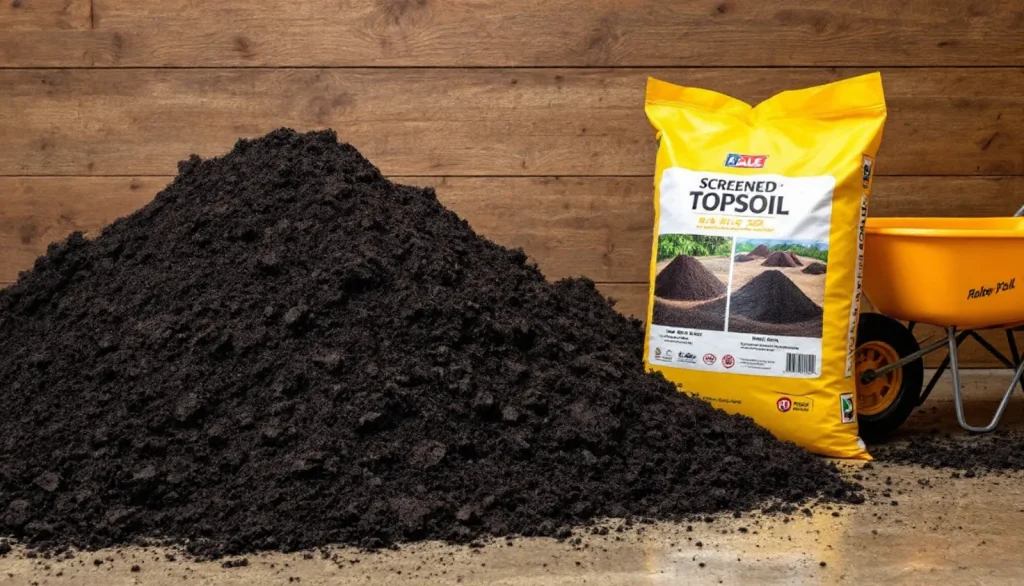
Top Soil: What It Is, vs Garden Soil and Fill Dirt
Top soil (more often written as one word, topsoil) is the dark, fertile upper layer of ground, usually the first 2 to 8 inches, where roots, organic matter, and soil life concentrate. It is what you buy to build a lawn, fill a raised bed, or repair a low spot, and it is not the same product as garden soil, fill dirt, compost, or bagged potting mix. This guide explains what topsoil actually is, how screened grades differ, how to judge quality before a truck dumps it on your driveway, and what a yard costs in 2026. For the volume math (how many cubic yards your project needs), use our soil volume calculator; this page is the buying decision.
What is topsoil?
Topsoil is the uppermost soil horizon, the layer that holds most of a site’s organic matter, nutrients, and biological activity. Soil scientists call it the A horizon. It typically runs 2 to 8 inches deep in undisturbed ground and carries roughly 2 to 10 percent organic matter by weight, according to USDA Natural Resources Conservation Service soil survey data. Below it sits subsoil (the B horizon), which is mostly mineral clay and rock with little fertility. When a supplier sells “topsoil,” they are selling stripped and stockpiled A-horizon material, which is why quality varies so much from one yard to the next.
The bag or bulk pile you buy has usually been screened, blended, or amended after it was dug. There is no single national grading standard that forces a supplier to sell true A-horizon soil, so the word “topsoil” on a sign tells you less than the screening spec and a look at the pile. That gap between the marketing word and the actual product is the reason quality tells (covered below) matter more than the label.
Topsoil vs garden soil vs fill dirt vs compost
These four products get used interchangeably at the store, and that is where money gets wasted. Topsoil is general-purpose native soil. Garden soil is topsoil already amended with compost and tuned for planting beds. Fill dirt is cheap subsoil for structural filling, not growing. Compost is pure decomposed organic matter, an amendment you mix in, not a standalone growing medium. The table below shows where each one belongs.
| Product | What it is | Organic matter | Best use | Do not use for |
|---|---|---|---|---|
| Topsoil | Native A-horizon soil, screened or raw | ~2 to 10% | Lawn base, leveling low spots, backfill around beds | Sole medium for heavy feeders without amending |
| Garden soil | Topsoil pre-blended with compost and nutrients | ~10 to 30% | Raised beds, vegetable and flower beds | Deep structural fill (too rich, settles) |
| Fill dirt | Subsoil: clay, sand, rock, minimal organics | Near 0% | Grading, raising elevation, foundation backfill, compactable base | Anything you want to grow in |
| Compost | Fully decomposed organic matter | ~30 to 100% | Amendment mixed into soil, topdressing | Standalone planting medium (too hot, holds too much water) |
A practical rule: if you are growing something, start with topsoil or garden soil. If you are changing the shape or height of the ground, use fill dirt and cap the top few inches with topsoil. If you are feeding existing soil, add compost. For container plants on a deck or windowsill, none of these apply; you want a soilless potting mix, which we cover in our growing-medium guides, because bagged “potting soil” is engineered with peat, coir, and perlite, not field soil.
What are the screened grades of topsoil?
Screened topsoil is run through a mesh to pull out rocks, roots, clumps, and debris, which leaves a uniform product you can rake and grade smoothly. Unscreened (or “raw”) topsoil is sold as dug and costs less, but it carries stones, sticks, and weed seed. Screen size is the spec that actually defines the grade, and most suppliers offer two or three. Finer screens cost more because more material gets rejected.
| Grade | Typical screen | Texture | Best for |
|---|---|---|---|
| Unscreened / economy | None | Clumpy, rocky, variable | Bulk fill behind walls, rough leveling where quantity beats quality |
| Screened, general purpose | 1/2 inch | Coarse but workable | New lawn base, bed building, general grading |
| Screened, fine / premium | 3/8 inch or 1/4 inch | Crumbly, smooth, near rock-free | Seedbeds, topdressing, leveling under sod, vegetable beds |
For lawn topdressing and seeding, ask for a 1/4 inch or 3/8 inch screen so the soil drops evenly through new grass without burying seedlings. For building up a bed or leveling, a 1/2 inch screen is fine and cheaper. “Pulverized” topsoil is simply fine-screened material broken up so it flows; it is a marketing word, not a separate grade, so confirm the actual screen size.
How can I tell if topsoil is good quality?
Good topsoil is dark, crumbly, and smells earthy, with a loose structure that holds together when squeezed but breaks apart when poked. Bad topsoil looks grey or orange, smells sour or chemical, stays sticky and slick (high clay), or is full of rock, glass, masonry, and root chunks. Buying soil sight unseen is the most common way homeowners lose a delivery fee on material they cannot plant in, so use these tells before you pay.
- Look at color: dark brown to near-black signals organic matter; grey, orange, or yellow signals subsoil sold as topsoil.
- Squeeze a handful: it should form a loose ball and crumble. A hard slick ribbon means too much clay; a pile that will not hold means too much sand.
- Smell it: earthy is good; sour, sulfur, or chemical odors signal poor drainage, contamination, or anaerobic stockpiling.
- Scan for debris: more than the odd small stone, plus any weed mat, plastic, or construction rubble, is a reject.
- Ask for the source and a screen spec, and if planting food crops, ask whether it was tested for pH and contaminants. Quality topsoil generally falls in a pH of 5.5 to 7.5, the range most lawns and garden plants prefer.
If a supplier cannot tell you where the soil came from or what screen it went through, treat that as a quality flag. Reputable yards keep separate piles by grade and source and will let you inspect before delivery.
How much does topsoil cost in 2026?
Bulk topsoil runs about $15 to $30 per cubic yard unscreened and $35 to $55 per cubic yard screened in 2026, before delivery. Delivery typically adds $50 to $150 per load depending on distance and load size, and spreading by hand or machine can add $30 to $80 per yard if you hire it out. Bagged topsoil from a big-box store runs roughly $6 to $8 per 40-pound bag, which is far more expensive by volume than bulk. Prices below are national ranges; your local yard sets the real number.
| How you buy it | 2026 price range | Notes |
|---|---|---|
| Bulk unscreened, per cubic yard | $15 to $30 | Cheapest; expect debris |
| Bulk screened, per cubic yard | $35 to $55 | Most common for lawns and beds |
| Delivery, per load | $50 to $150 | Often waived above a minimum order |
| Spreading (if hired) | $30 to $80 per yard | Depends on access and slope |
| Bagged, 40-pound bag | $6 to $8 | About 50 to 55 bags equal one cubic yard |
Bulk wins on any job over about a cubic yard. One cubic yard equals roughly 50 to 55 forty-pound bags, so even at $6 a bag, bagged soil for a yard’s worth costs $300 or more versus $35 to $55 bulk plus delivery. Buy bags only for small patch jobs where hauling a pile is not worth it.
How much topsoil do I need?
One cubic yard of topsoil covers 324 square feet at 1 inch deep, about 162 square feet at 2 inches, and roughly 81 square feet at 4 inches. A cubic yard weighs about 2,000 to 2,200 pounds (1 to 1.1 tons), which matters when a supplier quotes by the ton. To estimate fast: multiply your area in square feet by the depth in inches, then divide by 324 to get cubic yards. Add about 10 percent for settling.
| Depth | Coverage per cubic yard | Common use |
|---|---|---|
| 1 inch | 324 sq ft | Lawn topdressing, overseed prep |
| 2 inches | 162 sq ft | Light leveling, seedbed |
| 4 inches | 81 sq ft | New lawn base, bed building |
| 6 inches | 54 sq ft | Raised beds, deep fill |
Worked example: a new 1,000 square foot lawn at 4 inches of topsoil needs about 1,000 times 4, divided by 324, which is roughly 12.3 cubic yards (call it 13 with settling). At $45 a yard screened plus one $100 delivery, that is about $685 in material before spreading. For odd shapes, split the area into rectangles and add them. For the full calculator with depth presets and bag counts, use our soil volume calculator rather than estimating by hand.
When do I use topsoil versus just fertilizing?
Add topsoil when the problem is the soil itself: bare subsoil after construction, low spots that pool water, or a planting area with no fertile layer at all. Fertilize instead when the soil is fine but the plants are hungry, since fertilizer feeds plants without rebuilding structure. Topdressing a thin layer of screened topsoil or compost is the middle path for a tired lawn, and it pairs with seeding to fill thin turf.
If your lawn is patchy rather than missing a soil layer, topdressing plus overseeding usually beats hauling in deep fill. Our guides on fixing bare spots and choosing the right NPK fertilizer cover when feeding the existing soil is the cheaper, faster fix. Reserve a full topsoil delivery for grading, new beds, and post-construction repair where there is genuinely nothing good to grow in.
Topsoil buying checklist
- Match the product to the job: topsoil to grow or level, fill dirt to raise grade, garden soil for beds, compost to amend.
- Pick a screen size: 1/4 or 3/8 inch for lawns and seedbeds, 1/2 inch for general grading, unscreened only for bulk fill.
- Inspect before you pay: dark color, crumbly squeeze test, earthy smell, minimal debris, pH 5.5 to 7.5 if planting food.
- Calculate volume with the depth-and-area math (area times depth in inches, divided by 324), then add 10 percent.
- Compare bulk versus bagged: bulk for anything over a cubic yard, bags only for small patches.
- Confirm delivery and spreading costs up front so the $45 yard does not become a $200 yard delivered and placed.
Last reviewed: June 2026
HMNDP Editorial Team, reviewed by HMNDP turf and horticulture editors.
Frequently asked questions
What is the difference between topsoil and fill dirt?
Topsoil is the fertile upper soil layer with 2 to 10 percent organic matter, used to grow lawns and beds. Fill dirt is subsoil (clay, sand, rock, almost no organics) used to raise grade, level ground, or backfill foundations. Use topsoil where you plant and fill dirt where you change elevation, then cap the fill with a few inches of topsoil.
Is topsoil the same as garden soil?
No. Topsoil is general-purpose native soil, screened or raw. Garden soil is topsoil already blended with compost and nutrients for planting, carrying roughly 10 to 30 percent organic matter. Garden soil suits raised beds and vegetable plots; plain topsoil is cheaper for lawn bases, leveling, and backfill, and you amend it yourself if you plan to grow heavy feeders.
How much does topsoil cost in 2026?
Bulk topsoil runs about $15 to $30 per cubic yard unscreened and $35 to $55 screened in 2026, before delivery. Delivery adds $50 to $150 per load, and hired spreading adds $30 to $80 per yard. Bagged topsoil costs $6 to $8 per 40-pound bag, far pricier by volume, so buy bags only for small patch jobs.
How much topsoil do I need?
One cubic yard covers 324 square feet at 1 inch deep, 162 square feet at 2 inches, and about 81 square feet at 4 inches. To estimate, multiply your area in square feet by depth in inches, divide by 324 for cubic yards, then add about 10 percent for settling. A new 1,000 square foot lawn at 4 inches needs roughly 13 cubic yards.
What is screened topsoil?
Screened topsoil is run through a mesh to remove rocks, roots, clumps, and debris, leaving a uniform product you can rake and grade smoothly. Screen size sets the grade: 1/2 inch for general grading and bed building, 3/8 inch or 1/4 inch for seedbeds, topdressing, and leveling under sod. Unscreened topsoil is cheaper but carries stones and weed seed.
How can I tell if topsoil is good quality?
Good topsoil is dark brown to near-black, crumbly, and smells earthy, forming a loose ball that breaks apart when squeezed. Reject grey, orange, or sticky soil, anything that smells sour or chemical, or piles full of rock, rubble, and roots. Aim for a pH of 5.5 to 7.5 for lawns and gardens, and ask the supplier for the source and screen size.
Is bulk or bagged topsoil cheaper?
Bulk is far cheaper for any job over about one cubic yard. One cubic yard equals roughly 50 to 55 forty-pound bags, so bagged soil for a yard’s worth costs $300 or more versus $35 to $55 bulk plus delivery. Buy bags only for small patch repairs where hauling and shoveling a pile is not worth the savings.
Should I add topsoil or just fertilize my lawn?
Add topsoil when the soil layer is missing or damaged, such as bare subsoil after construction or low spots that pool water. Fertilize when the soil is fine but plants are hungry, since fertilizer feeds plants without rebuilding structure. For a tired but intact lawn, topdress a thin layer of screened topsoil or compost and overseed instead of hauling in deep fill.