
By the HMNDP Editorial Team. Last reviewed: June 2026.
Riding lawn mower repair starts with one question: what is the symptom?
Riding lawn mower repair is faster and cheaper when you match the symptom to the part before touching a wrench. Most no-start calls trace back to four cheap items: stale fuel, a dead battery, a clogged carburetor, or a tripped safety switch. About 90 percent of common riding mower failures on gas models (Craftsman, John Deere, Husqvarna, Cub Cadet) are DIY-fixable for under 60 dollars in parts.
Use the table below to self-triage in under a minute, then jump to the matching section. Before any repair, turn the fuel shut-off valve to off and pull the spark plug wire so the engine cannot fire while your hands are near the blades.
60-second symptom-to-cause diagnostic table
This table maps the four failure patterns owners actually report to the parts most likely responsible and the realistic DIY cost. Find your symptom in the left column, then read across. The most common cause is listed first. Competitors list parts in isolation; this connects symptom to part to price so you can decide your next move immediately.
| Symptom | Most likely causes (in order) | First check | Typical DIY parts cost |
|---|---|---|---|
| No crank (engine silent, nothing turns) | Dead/corroded battery, blown fuse, bad starter solenoid, tripped seat/brake interlock | Battery voltage and seat switch | 0 to 120 dollars |
| Cranks but won’t start | Stale fuel, clogged carburetor, fouled spark plug, clogged fuel filter | Fresh fuel and spark plug | 5 to 40 dollars |
| Starts then dies in 3 to 10 seconds | Clogged carburetor jet, blocked fuel cap vent, dirty fuel filter, choke stuck | Carburetor bowl and fuel flow | 0 to 50 dollars |
| Runs but won’t move (no drive) | Loose/broken drive belt, transmission release lever engaged, low hydro fluid | Drive belt and freewheel lever | 20 to 90 dollars |
| Runs but cuts grass poorly | Dull or bent blade, broken deck belt, clogged deck | Blade edge and deck belt | 15 to 70 dollars |
Won’t start: the most common riding lawn mower repair
A riding mower that won’t start almost always fails at one of three points: no electricity, no fuel, or no spark. Work them in that order. Confirm the battery turns the starter, confirm fresh fuel reaches the carburetor, and confirm the plug sparks. The first cause to rule out is the seat safety switch, because it blocks starting even when everything else is fine.
- Sit on the seat, set the parking brake, and disengage the blade (PTO off). Most mowers will not crank otherwise.
- Turn the key. Dead silence points to the battery, fuse, or solenoid. A crank with no fire points to fuel or spark.
- Check fuel level and age. Gas older than 30 days is the single most common no-start trigger.
- Pull and inspect the spark plug for a black, wet, or fouled tip.
Battery: dead, corroded, charging, and replacement
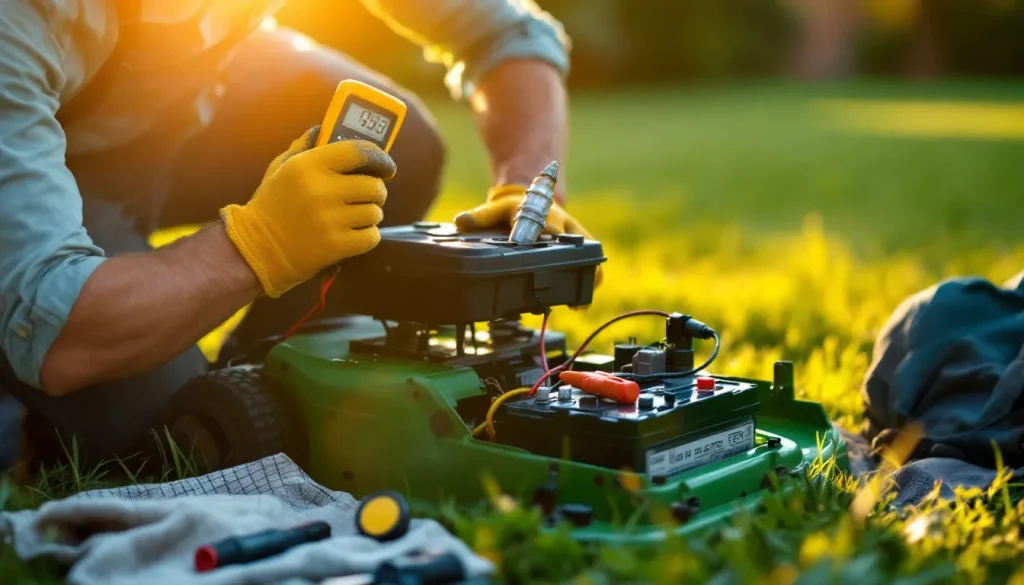
A riding mower battery should read 12.6 to 12.8 volts at rest with the engine off. Below 11.8 volts it is discharged; below 10 volts it likely will not recover. Test with any multimeter on DC volts. Corroded terminals (white or green crust) block current even on a good battery, so clean them first with a wire brush and a baking-soda-and-water paste.
If the battery holds under 12 volts after a full charge, replace it. A standard U1 riding mower battery runs 35 to 70 dollars at retailers like Tractor Supply, Walmart, or Amazon, and swaps in 10 minutes with a single wrench. Always disconnect the negative terminal first and reconnect it last.
Starter and solenoid problems
If the battery is good (12.6 volts) but turning the key gives a single click or nothing, suspect the starter solenoid. The solenoid is a relay that sends battery power to the starter motor. A faulty one clicks but fails to engage; a dead one stays silent. Tap the solenoid lightly with a wrench while a helper turns the key, a stuck solenoid sometimes frees momentarily.
A replacement solenoid costs 12 to 35 dollars and bolts on in about 20 minutes. A full starter motor runs 40 to 110 dollars. Confirm with a multimeter that 12 volts reaches the solenoid input before replacing the starter itself, so you do not buy the wrong part.
Fuel system: stale fuel, bad gas, filter, and lines
Stale or ethanol-blended gasoline is the leading cause of riding mower no-starts and start-then-die failures. Pump gas with up to 10 percent ethanol (E10) absorbs water and gums up within 30 to 60 days, leaving varnish in the carburetor. Drain old fuel, refill with fresh gas, and add a stabilizer such as STA-BIL if the mower sits between uses.
Replace an inline fuel filter (3 to 10 dollars) if it looks dark or clogged, and squeeze the rubber fuel lines for cracks or stiffness. A pinched or vapor-locked fuel cap vent can also starve the engine; loosen the cap and restart to test it in seconds.
Carburetor: clean or rebuild after old fuel
The carburetor mixes air and fuel, and its tiny jets clog easily with varnish from stale gas. A mower that cranks but won’t start, or starts then dies, usually has a fouled carb. Cleaning often fixes it without parts: remove the bowl, spray the jets and passages with carburetor cleaner, and clear the main jet hole with a thin wire.
A carburetor cleaning is free if you do it yourself (a 6 dollar can of cleaner). A rebuild kit (gaskets, needle, float) runs 10 to 25 dollars. A full replacement carburetor for common Briggs & Stratton or Kohler engines costs 20 to 60 dollars. Budget 45 to 90 minutes for a first cleaning.
Spark plug inspection and replacement
A spark plug fires the fuel-air mix, and a fouled plug causes hard starting and rough running. Pull the plug with a 13/16-inch socket and read the tip: dry tan is healthy, black and sooty means a rich mix, wet means flooded, and oily means worn rings. Set the gap to the engine spec (commonly 0.030 inch) with a feeler gauge.
A new spark plug costs 3 to 8 dollars and most owners replace it every season or 100 hours. Replacing it takes five minutes and is the cheapest fix on the mower, so try it early when a mower cranks but won’t catch.
Blade maintenance: sharpening and replacing
A sharp blade cuts cleanly; a dull or bent blade tears grass and strains the engine. Sharpen blades twice a season, after roughly 25 hours of mowing. Disconnect the spark plug wire, tip the mower with the air filter side up, remove the blade bolt, and grind the cutting edge to a butter-knife sharpness at the factory angle (about 30 to 45 degrees). Keep it balanced.
Sharpening is free with a file or bench grinder you already own. A replacement blade costs 12 to 35 dollars. Replace any blade that is cracked, badly bent, or worn thin, because an unbalanced blade vibrates and damages the spindle bearings.
Drive belt and transmission: runs but won’t move
When the engine runs fine but the mower won’t drive, check the drive belt and the transmission release (freewheel) lever first. A loose, glazed, or broken drive belt is the most common cause and the cheapest to fix. Many owners accidentally leave the rear bypass lever in the push/freewheel position, which disengages drive entirely.
A drive belt costs 20 to 45 dollars and takes 30 to 60 minutes to swap. A hydrostatic transmission rebuild or replacement is the one repair that often justifies professional help or replacing the mower, with parts and labor commonly running 400 to 900 dollars on consumer models.
Routine maintenance that prevents breakdowns
Most riding mower repairs are preventable with three habits: fresh fuel, clean air, and clean oil. Stale fuel, a clogged air filter, and old oil cause the majority of mid-season failures. A full seasonal service costs 25 to 50 dollars in parts and under an hour, far less than any repair it prevents.
- Oil: change every 50 hours or once a season using the spec grade (often SAE 30 or 10W-30). Cost: 8 to 15 dollars.
- Air filter: inspect monthly, replace yearly. Cost: 6 to 15 dollars.
- Fuel: never store gas over 30 days without stabilizer; drain or run dry for winter.
- Belts: inspect for cracks and glazing each spring.
- Storage: for off-season, stabilize fuel, remove the battery to a trickle charger, and store dry.
How much does riding lawn mower repair cost: DIY vs. shop
Riding lawn mower repair costs far less DIY than at a shop, mainly because shop labor runs 60 to 110 dollars per hour plus a diagnostic fee. The table compares the most common repairs both ways. Use it to decide where paying a pro is worth it. The gap is widest on simple jobs like batteries and plugs, and narrowest on transmission work.
| Repair | DIY parts cost | Shop total (parts + labor) | Worth paying a pro? |
|---|---|---|---|
| Battery replacement | 35 to 70 dollars | 90 to 150 dollars | No, easy DIY |
| Spark plug | 3 to 8 dollars | 50 to 90 dollars | No, easy DIY |
| Carburetor clean/rebuild | 6 to 25 dollars | 120 to 220 dollars | Sometimes |
| Starter solenoid | 12 to 35 dollars | 120 to 200 dollars | Sometimes |
| Blade sharpen/replace | 0 to 35 dollars | 40 to 90 dollars | No, easy DIY |
| Drive belt | 20 to 45 dollars | 150 to 280 dollars | Sometimes |
| Transmission rebuild/replace | 250 to 600 dollars | 500 to 900 dollars | Often, or replace mower |
A mobile or on-site repair service that comes to your home (for walk-behind, riding, and zero-turn mowers) typically charges a 60 to 120 dollar service-call or trip fee on top of parts and labor. That premium can still beat hauling a 500-pound tractor to a shop. For a deeper breakdown of when paying makes sense, see our guide on lawn repair: service vs. DIY.
Is it cheaper to repair or replace your riding mower? A decision rule
Use the 50 percent rule: if a single repair quote exceeds half the cost of a comparable new mower, lean toward replacing. New entry-level riding mowers run 1,500 to 2,800 dollars in 2026, so a repair quote over roughly 750 to 1,400 dollars is a replace signal, especially on a mower past 8 to 10 years old.
- Repair if the fix is under 30 percent of new-mower cost and the engine and frame are sound.
- Get a second quote or go mobile if the repair is 30 to 50 percent and the mower is under 8 years old.
- Replace if the repair tops 50 percent, the transmission is failing, or rust has reached the frame or deck.
Before buying, compare features and engine hours expectations in our lawn mower buying guide, and review fleet-level durability data in the 2026 commercial mower equipment report.
How to find a reliable repair shop or mobile technician
To find a trustworthy mower repair shop near you, prioritize verified review volume, brand familiarity, and a clear written estimate before work begins. Search “small engine repair near me” or your brand plus “service,” then filter by rating count, not just star average. A shop with 4.5 stars across 200 reviews is more reliable than one with 5.0 across 6.
- Confirm they service your brand (Craftsman, John Deere, Husqvarna, Cub Cadet) and engine maker (Briggs & Stratton, Kohler, Kawasaki).
- Ask for a flat diagnostic fee and whether it applies toward the repair.
- Get the estimate in writing and ask whether they offer mobile/on-site service to skip hauling.
- Check that they warranty parts and labor for at least 30 to 90 days.
For more step-by-step repair walkthroughs and seasonal checklists, browse the HMNDP Learn library and the maintenance playbook.
Frequently Asked Questions
Why won’t my riding lawn mower start?
A riding mower that won’t start usually fails on electricity, fuel, or spark. Check in that order: a dead or corroded battery, stale fuel older than 30 days, a clogged carburetor, or a fouled spark plug. A tripped seat or brake safety switch also blocks starting. Roughly 90 percent of no-start cases are fixable at home for under 60 dollars in parts.
How do I troubleshoot a riding mower that cranks but won’t start?
If it cranks but won’t fire, it has electricity but lacks fuel or spark. Add fresh gas, since fuel over 30 days old is the top cause. Pull the spark plug and replace it if black or wet (3 to 8 dollars). If it still won’t catch, clean the carburetor jets with carb cleaner. Confirm the fuel shut-off valve is open and the fuel filter is clear.
How much does riding lawn mower repair cost?
DIY repairs run 3 to 70 dollars for batteries, plugs, blades, and carb cleaning. At a shop, expect 90 to 280 dollars for those same jobs because labor is 60 to 110 dollars per hour plus a diagnostic fee. A transmission rebuild is the costly outlier at 500 to 900 dollars. Mobile technicians add a 60 to 120 dollar trip fee but save you hauling the mower.
Is it cheaper to repair or replace a riding lawn mower?
Apply the 50 percent rule. If a repair quote exceeds half the price of a comparable new mower (1,500 to 2,800 dollars in 2026), replacement usually wins, especially past 8 to 10 years old. Repair when the fix is under 30 percent of new-mower cost and the engine and frame are sound. A failing hydrostatic transmission or frame rust tips the decision toward replacing.
How do I clean or fix the carburetor on a riding mower?
Turn off the fuel valve, disconnect the spark plug wire, and remove the carburetor bowl. Spray the jets, float needle, and internal passages with carburetor cleaner, and clear the main jet hole with a thin wire. Reassemble with a fresh gasket. Cleaning costs about 6 dollars for a can of cleaner; a rebuild kit is 10 to 25 dollars and takes 45 to 90 minutes.
Why does my riding mower start then die after a few seconds?
Start-then-die almost always means fuel reaches the engine to fire but cannot keep flowing. The usual cause is a clogged carburetor jet from stale or ethanol fuel. A blocked fuel cap vent, dirty fuel filter, or stuck choke can also starve it. Test the cap by loosening it and restarting. Then clean the carburetor and replace the filter (3 to 10 dollars).
How do I find a reliable mobile lawn mower repair service near me?
Search “mobile mower repair near me” and filter by review volume, not just star rating. Confirm the technician services your brand and engine maker, and that they handle walk-behind, riding, and zero-turn mowers. Ask for the trip fee (commonly 60 to 120 dollars), a written estimate before work, and a 30 to 90 day parts-and-labor warranty. Mobile service saves hauling a heavy tractor.
What routine maintenance keeps a riding mower from breaking down?
Three habits prevent most failures: fresh fuel, clean air, clean oil. Change the oil every 50 hours or yearly (8 to 15 dollars), replace the air filter annually (6 to 15 dollars), and never store fuel over 30 days without stabilizer. Sharpen blades twice a season and inspect belts each spring. A full seasonal service costs 25 to 50 dollars and prevents far costlier repairs.