
By the HMNDP Editorial Team. Last reviewed: June 2026.
What a remote control lawn mower is
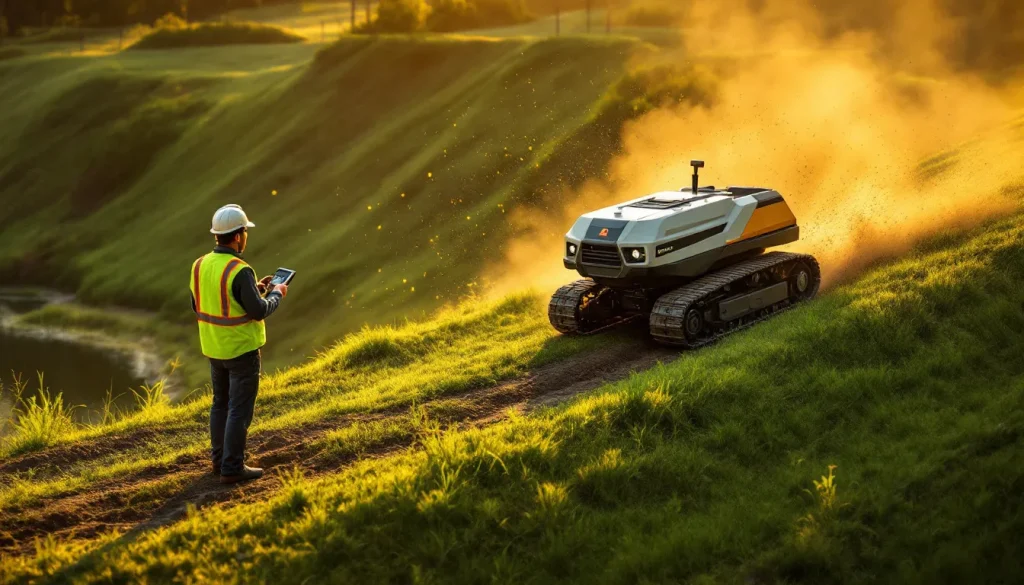
A remote control lawn mower is a self-propelled mowing machine the operator drives from a distance using a handheld radio remote, with no rider on board. It is built mainly to cut steep slopes, embankments, ditches, and pond banks where putting a person on a ride-on or push mower creates a rollover risk. Most commercial units track on rubber tracks or wide tires for stability.
The category is sometimes called a slope mower, RC slope mower, or remote operated brush mower. Leading makers include Spider (Dvorak), RC Mowers, Greenzie-equipped platforms, and Kut Kwick. Decks are typically flail or rotary, sized for tall grass and light brush rather than fine turf finishing.
These machines are distinct from robotic mowers that run autonomously inside a boundary wire. The operator stays in control the entire time, watching the cut and steering around obstacles in real time.
Primary use case: mowing steep slopes safely from a distance
The core job of a remote control lawn mower is cutting terrain too dangerous for a seated operator. The person controlling the machine stands on flat, stable ground, often 50 to 300 feet away, while the mower works the slope. This removes the operator from the single biggest hazard in grounds maintenance: a mower rolling over on a grade.
Typical jobs include highway embankments, levees, retention and detention ponds, dam faces, drainage ditches, solar farm rows, and overgrown vacant lots. Municipalities, departments of transportation, solar operators, and commercial landscape crews are the main buyers.
For flat residential or fine-turf work, a standard mower is cheaper and cuts better. See our picks for everyday machines in the best electric lawn mower guide.
Maximum slope capability and grade rating
Slope rating is the headline spec. Consumer and prosumer remote control mowers commonly handle grades up to about 30 to 40 percent. Commercial tracked units routinely rate for 50 percent and many handle 60 percent or steeper, with some Spider and RC Mowers models cited at slopes near 50 degrees in short bursts. Grade is expressed as a percent (rise over run) or in degrees; 100 percent grade equals 45 degrees.
Two cautions matter. First, a wet slope cuts the usable grade sharply, because traction, not engine power, sets the real limit. Second, sustained sidehill operation stresses tracks and the cooling system more than the brochure number suggests. Buy margin: pick a machine rated 10 to 15 percentage points above your worst slope.
Commercial-grade vs prosumer positioning
Most remote control lawn mowers sold today are commercial tools, not homeowner gear. Commercial units use heavier frames, hydrostatic track drives, larger engines or battery packs, and decks built for brush. They are rated for daily contract use and carry dealer service networks. Prosumer or imported budget units exist but trade durability, slope rating, and parts support for a lower sticker price.
If you mow slopes for hire, the distinction shapes warranty, uptime, and resale. Light-duty units can struggle on a full commercial schedule. For broader equipment benchmarking, see the 2026 commercial mower equipment report.
Power source: battery vs gas
Remote control slope mowers come in two power formats: gas or diesel internal combustion, and battery-electric. Gas and diesel units dominate the heavy commercial slope segment because they refuel in minutes and run long shifts. Battery-electric models run quieter, cut emissions, and lower fuel cost, but runtime per charge and recharge time limit long contract days unless you swap packs.
| Factor | Gas / diesel | Battery-electric |
|---|---|---|
| Runtime per refuel/charge | 4 to 8+ hours (refuel in minutes) | Roughly 1 to 4 hours, then recharge |
| Energy cost per hour | Higher (fuel + oil) | Lower (grid electricity) |
| Noise / emissions | Higher | Much lower |
| Best fit | All-day commercial slope contracts | Noise-sensitive sites, shorter routes, indoor storage |
Compare engine-driven options in our best gas lawn mower 2026 guide for context on fuel-engine tradeoffs.
Best remote control mower for steep slopes: spec comparison
The best remote control mower for steep slopes is the one whose slope rating, deck width, runtime, remote range, and weight match your worst terrain, not the one with the highest single number. Use the framework below to score candidates against your actual site before requesting quotes. The ranges reflect typical commercial-class machines as of mid-2026.
| Spec | Typical range (commercial) | Why it matters |
|---|---|---|
| Slope rating | 40% to 60%+ (some near 50 deg) | Must exceed your worst wet-slope grade |
| Cutting deck width | 24 in to 60 in | Wider = faster acres; narrower = tight ditches |
| Runtime / fuel capacity | 4 to 8 hrs gas; 1 to 4 hrs battery | Sets uninterrupted work window |
| Remote range | 200 to 1,000+ ft | Operator distance from hazard and dust |
| Weight | 700 to 1,800 lb | Low weight + low center = stability; affects transport |
| Warranty | 1 to 3 yrs (varies by maker) | Uptime and parts support over the machine’s life |
Rule of thumb: choose deck width for your tightest ditch, not your widest field. A 60-inch deck is useless in a 40-inch drainage channel.
Cutting deck width and terrain handling
Deck width and drive type decide what terrain a remote control lawn mower can actually clear. Narrow 24 to 36 inch decks fit drainage ditches and tight pond benches. Wider 48 to 60 inch decks cover embankments and open slopes faster. Rubber-tracked drives grip steep, wet, and uneven ground far better than wheels, which is why most slope-rated units run tracks.
For ponds and retention basins, low ground pressure and a sealed drivetrain matter so the machine works soft, saturated banks without sinking or bogging. Flail decks handle tall grass, weeds, and light woody brush better than rotary decks on neglected sites.
Total cost of ownership: real numbers
A remote control lawn mower costs roughly $8,000 at the consumer/prosumer end and $20,000 to $35,000+ for commercial tracked slope machines, with premium configurations running higher. Sticker price is only part of it. Operating cost (fuel or electricity, blades, track wear) and financing change the real five-year number, and that is what competing pages leave out.
| Tier | Typical purchase price | Slope rating | Best buyer |
|---|---|---|---|
| Consumer / prosumer | $8,000 to $15,000 | ~30% to 40% | Large-property owners, light slope work |
| Commercial entry | $18,000 to $28,000 | ~45% to 55% | Landscape crews, smaller municipalities |
| Commercial heavy | $28,000 to $35,000+ | 50% to 60%+ | DOTs, solar, dam/levee contractors |
Operating cost guidance: gas/diesel units typically burn fuel plus oil and may run higher hourly than battery units charging on grid power. Blades, belts, and track wear add ongoing spend on abrasive slope sites. Financing through dealers or equipment lenders may spread a $30,000 machine into monthly payments, and terms vary by lender, credit, and structure, so confirm specifics before you commit. Run the labor math too: one operator replacing a two-person string-trimming crew on a slope can repay the machine faster than the price tag implies.
Remote control mower vs robot mower: decision matrix
A remote control mower is operator-driven for steep, dangerous terrain; a robot mower runs autonomously on gentle, defined lawns. The practical split is slope and supervision. Robotic mowers (Husqvarna Automower, Worx Landroid, Segway Navimow) generally top out near 30 to 45 percent grade on premium models, and most consumer units are far lower. RC slope mowers exist precisely to go past that.
| Question | Choose RC slope mower | Choose robot mower |
|---|---|---|
| Slope | Above ~40% / unsafe to ride | Gentle, under ~30 to 45% |
| Supervision | Operator present, real-time control | Unattended, scheduled |
| Terrain | Brush, ditches, ponds, embankments | Maintained residential/commercial turf |
| Cut quality | Clearing/maintenance cut | Fine, frequent turf finish |
| Cost | $8k to $35k+ | Hundreds to a few thousand dollars |
Choose an RC slope mower if your problem is danger and grade. Choose a robot if your problem is routine maintenance on safe ground.
Safety, ANSI slope guidance, and liability
The reason this category exists is operator safety. ANSI B71 guidance and most operator manuals warn against riding mowers on slopes beyond roughly 15 to 20 degrees, and OSHA-tracked rollover incidents make steep slopes a known cause of serious mower injuries. A remote control lawn mower removes the person from the rollover zone entirely, which is the safety case for the spend.
Safe-operation practices: stand uphill or off to the side of the machine on stable ground, keep bystanders out of the discharge and downhill path, never operate beyond the rated grade, and stop on wet or unstable banks. Crews should confirm coverage with their insurer, because workers’ compensation exposure and liability terms for slope mowing may differ depending on state, policy, and how the work is classified. Treat that as conditional and verify with your carrier.
Where to buy a commercial remote control lawn mower
Commercial remote control lawn mowers are sold mainly through brand dealer networks (Spider/Dvorak, RC Mowers, Kut Kwick) and equipment retailers, with some prosumer units and parts listed on Amazon and outdoor-power retailers such as Farmry. Buying through a dealer usually means demos, financing, warranty service, and operator training, which matter for a five-figure machine.
Before you buy, request an on-site demo on your actual worst slope, get the warranty and parts-availability terms in writing, and confirm transport weight against your trailer. Build vendor and product literacy first through the HMNDP learn hub.
Frequently Asked Questions
What is a remote control lawn mower and how does it work?
A remote control lawn mower is a riderless, self-propelled machine the operator drives from a distance with a handheld radio remote. The operator stands on stable ground and steers the mower across steep or dangerous terrain in real time. Most commercial units use rubber tracks for grip and a flail or rotary deck sized for tall grass and light brush.
What is the steepest slope a remote control mower can cut?
Consumer and prosumer remote control mowers typically handle about 30 to 40 percent grade. Commercial tracked units routinely rate for 50 percent, and many handle 60 percent or steeper, with some Spider and RC Mowers models cited near 50 degrees in short runs. Wet ground lowers the safe limit because traction, not power, sets the real ceiling.
How much does a remote control lawn mower cost?
Prices run roughly $8,000 to $15,000 for consumer and prosumer units and about $18,000 to $35,000+ for commercial tracked slope machines, with premium builds higher. Add operating costs (fuel or electricity, blades, belts, track wear) and any financing. Dealer financing may spread a $30,000 machine into monthly payments, though terms vary by lender, credit, and structure.
What’s the difference between a remote control mower and a robot mower?
A remote control mower is operator-driven for steep, dangerous slopes and brush, costing $8,000 to $35,000+. A robot mower runs autonomously on defined, gentle lawns, costing hundreds to a few thousand dollars. Robot mowers generally top out near 30 to 45 percent grade on premium models. Choose RC for danger and grade; choose a robot for routine turf maintenance on safe ground.
Are remote control slope mowers gas or battery powered?
Both. Gas and diesel models dominate heavy commercial slope work because they refuel in minutes and run 4 to 8+ hour shifts. Battery-electric models run quieter with lower fuel cost and no local emissions, but runtime is roughly 1 to 4 hours per charge plus recharge time. Choose gas for long contracts, battery for noise-sensitive or shorter routes.
Who needs a remote-controlled lawn mower?
Buyers who must mow terrain unsafe for a rider: highway embankments, levees, dam faces, retention and detention ponds, drainage ditches, solar farm rows, and steep vacant lots. Main users are municipalities, departments of transportation, solar operators, and commercial landscape crews. If your slopes exceed roughly 20 degrees or you face rollover risk, the machine pays back through safety and labor savings.
What’s the best remote control mower for steep slopes?
The best one matches your worst terrain across six specs: slope rating, deck width, runtime, remote range, weight, and warranty. Pick a slope rating 10 to 15 points above your steepest wet grade, deck width for your tightest ditch, and rubber tracks for traction. Leading commercial makers include Spider (Dvorak), RC Mowers, and Kut Kwick.
Where can I buy a commercial remote control lawn mower?
Commercial units sell mainly through brand dealer networks (Spider/Dvorak, RC Mowers, Kut Kwick) and equipment retailers, with prosumer units and parts also listed on Amazon and outdoor-power sellers such as Farmry. Dealers typically provide demos, financing, warranty service, and operator training. Request an on-site demo on your worst slope and get warranty and parts terms in writing before buying.