
Lawn Cart Buying Guide: Types, Capacity, and Towing
A lawn cart is a wheeled hauler for moving soil, mulch, bagged fertilizer, pavers, and yard debris, and the three styles that cover almost every yard are the dump cart (a four-wheel bed that tilts to empty), the utility wagon (a flat-sided box you pull or tow), and the two-wheel garden cart (a deep tub that dumps forward). The right pick depends on three things: your load weight, your surface, and whether you pull by hand or tow behind a mower. This guide sorts the types, the real capacity numbers, the tire choices, and when to rent instead of buy.
Dump cart vs utility wagon vs garden cart: what’s the difference?
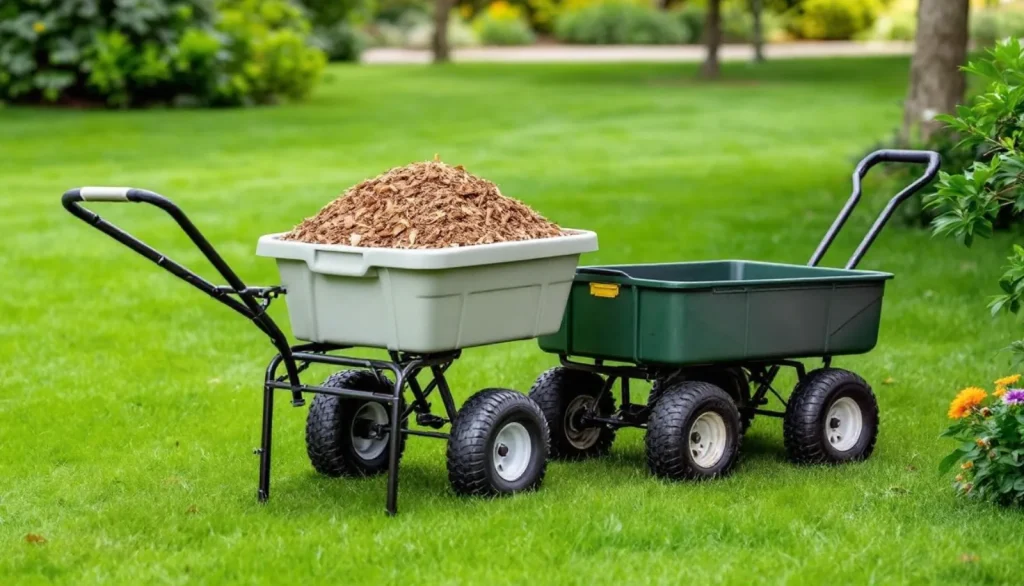
A dump cart is a four-wheel cart with a hinged bed that tilts like a dump truck, built to empty bulk material (soil, gravel, leaves) without lifting. A utility wagon is a flat-sided box on four wheels that you pull or tow; many have removable sides to convert to a flatbed. A two-wheel garden cart has a deeper tub, dumps forward over the axle, and pivots in tight spaces. Capacity rises across that order, and so does the surface you need to roll it on.
The shorthand most homeowners get wrong: a wagon hauls, a dump cart unloads, and a two-wheel garden cart does both in a small footprint. If you move loose material into beds and along fence lines, dumping matters more than versatility. If your loads change every trip (tools one run, bricks the next), a wagon with removable sides earns its keep.
Wheel count drives stability. Two wheels pivot tightly but can tip if you load unevenly. Four wheels keep the load level through lots of little stops, which is why dump carts and wagons dominate for heavier hauling. The trade-off is turning radius: most carts need at least three feet of clearance between raised beds, where a single-wheel wheelbarrow still wins.
| Type | Wheels | Typical capacity | Dumps? | Best surface | Best for |
|---|---|---|---|---|---|
| Two-wheel garden cart | 2 | 200 to 400 lb | Forward tilt | Lawn, compacted dirt | Loose material, tight spaces, short runs |
| Dump cart (poly) | 4 | 400 to 600 lb | Yes, full tilt | Lawn, gravel, mixed | Soil, mulch, leaves you unload often |
| Utility wagon | 4 | 300 to 1,200 lb | Some models | Patio, gravel, flat ground | Mixed loads, tools, plants, bricks |
| Tow-behind dump cart (steel) | 4 | 750 to 1,200 lb | Yes | Open yard, acreage | Riding-mower or ATV hauling |
| Wheelbarrow (for contrast) | 1 to 2 | 200 to 300 lb | Forward tip | Any, narrow paths | Tight rows, precise pours |
Capacity figures above reflect the ranges reported across 2025 and 2026 buying guides from Bob Vila, Epic Gardening, and Family Handyman. Always read the spec sticker on the model you buy, because the same brand sells light- and heavy-duty versions that look nearly identical.
How much weight can a lawn cart hold?
Most consumer lawn carts fall into three tiers: light-duty at 200 pounds or less, mid-duty at 300 to 350 pounds, and heavy-duty at 350 to 600 pounds. Tow-behind steel carts and motorized units climb to 750, 1,000, or even 1,200 pounds. For the average homeowner moving mulch, soil amendments, or a load of firewood, the 400 to 600 pound band is the practical sweet spot.
Match capacity to the heaviest single thing you move, not the average. A 60-pound bag of concrete mix or a stack of pavers fills a cart’s rated weight faster than its volume. Wet soil is the silent killer: a cubic foot of saturated topsoil can run 90 to 110 pounds, so a 5 cubic-foot bed of wet fill easily exceeds 450 pounds. Buy headroom.
Bed volume matters alongside weight. Family Handyman and other 2026 guides point to 4 to 6 cubic feet for medium-to-large gardens with regular maintenance, and 2 to 3 cubic feet for occasional tasks. A bigger tub tempts you to overload past the weight rating, so the two limits work together: hit whichever you reach first.
Cart capacity is not the same as towing capacity
Bed capacity is how much weight the cart can carry; towing capacity is how much a powered vehicle can pull behind it. They are different numbers, and confusing them is the most common buying mistake. A motorized cart rated to hold 500 pounds in its bed may be rated to pull up to 1,000 pounds on a trailer. The bed rating governs what you load; the towing rating governs what your mower or ATV can drag.
If you plan to tow, check two specs before you buy: the cart’s bed capacity and the towing capacity of your riding mower or tractor. Most lawn and garden tractors handle a loaded cart in the 400 to 800 pound range on level ground, less on slopes. A gas or electric riding unit commonly pulls 500 to 1,000 pounds depending on traction and grade. Loading a 1,200-pound steel cart to the brim behind an undersized mower strains the drivetrain and the hitch.
- Find your mower or tractor’s rated towing or drawbar capacity in its manual.
- Add the cart’s empty weight to the load you intend to haul.
- Keep the loaded total under the tractor’s rating, and cut it further on hills.
- Confirm the cart’s hitch pin matches your tractor’s drawbar before you buy.
- Test the first heavy load on flat ground before working a slope.
Pneumatic, flat-free, or solid tires: which should you pick?
Tire type is the choice that decides how a cart feels on your specific ground. Pneumatic (air-filled) tires absorb shock and roll over rough lawn, gravel, ruts, and roots, but they can puncture and lose pressure. Flat-free (solid rubber) tires never go flat and need no maintenance, but transmit more jolt and roll harder on uneven ground. Solid plastic tires are cheapest and lowest-maintenance, best kept to smooth patios and paved paths.
Tire size shifts the math too. Consumer cart tires run from about 7 inches up to 20 inches, and larger wheels bridge bumps, ruts, and soft turf with less effort. Tow-behind and dump carts commonly ship with 10- to 15-inch pneumatic tires for that reason. If you push by hand across thick grass or gravel, bigger pneumatic tires save your back; if you only roll across a paved driveway, solid tires are fine.
| Tire type | Ride | Maintenance | Best surface | Watch out for |
|---|---|---|---|---|
| Pneumatic (air-filled) | Smoothest over rough ground | Check pressure, can puncture | Lawn, gravel, ruts, slopes | Flats, slow leaks in cold |
| Flat-free (solid rubber) | Firmer, more jolt | None | Mixed, low-thorn yards | Harder pull on soft turf |
| Solid plastic | Hard on bumps | None | Patio, paved paths | Sinks and bogs on grass |
Pull, push, or tow: which handle setup fits your yard?
You pull most garden carts and wagons like a wagon, push a wheelbarrow while balancing on its wheel, and tow heavy steel carts behind a riding mower or ATV. Pulling spreads effort and keeps the load level for frequent stops; pushing gives tighter control in narrow spots; towing moves loads no person should carry by hand. Many wagons offer a convertible handle that pins to a tractor drawbar for the heaviest jobs.
Pick by route and load. Short runs of loose material close to the house favor a pull-handle two-wheel cart that dumps where you stand. Mixed loads across a patio or gravel drive favor a four-wheel wagon. Hauling across half an acre or more, or moving pavers and firewood by the cubic yard, is tow-behind territory. Brakes are worth the upgrade on any cart you will run downhill loaded.
Steel or poly bed: which lasts longer?
Steel beds carry the heaviest loads and shrug off sharp gravel and pavers, but they rust where the paint chips and need a wire brush and touch-up paint to last. Poly (polyethylene) and polycarbonate beds never rust, resist dents and cracks, shed sticky soil and mulch cleanly, and weigh less, but top out at lower capacities than heavy steel. For tow-behind hauling of rock and firewood, steel wins; for daily mulch and compost duty, poly is easier to live with.
Frame and axle quality matter more than bed material for longevity. Look for a 1.25- to 1.5-inch handle diameter, greaseable or sealed axles, and bolts you can re-tighten. A cart left outdoors should sit up off bare ground and stay covered, or the axle bearings and any steel surfaces corrode in a season or two.
Should you rent or buy a lawn cart?
Buy if you do regular yard work, since a mid-duty dump cart or wagon pays for itself fast against the effort it saves and lasts many seasons with light care. Rent only for a one-time heavy project, like spreading several cubic yards of gravel or demolition debris, where you need a far larger tow-behind cart than your routine work justifies. Most homeowners own one general cart and never rent.
If your project is a one-off landscape install, the cart is usually the cheapest part of the job. The cost that moves the budget is material delivery and labor, not the hauler. Our breakdown of lawn care cost benchmarks for 2026 covers where the real dollars land on bigger projects, and the contractor directory at find lawn care and landscape contractors is the place to start if the job outgrows a cart.
How to choose: a quick decision path
Work through four questions in order: how heavy is your worst single load, what surface do you cross, do you pull or tow, and how often do you unload. Those four answers point at one cart type and one tire choice. Everything else (bed material, brakes, removable sides) is a refinement on top of that core match.
- Size capacity to your heaviest load, then add 25 percent headroom for wet material.
- Pick pneumatic tires for lawn, gravel, or slopes; solid tires only for paved surfaces.
- Choose four wheels and a dump bed if you unload bulk material often.
- Go tow-behind steel only if you have a rated riding mower and open ground.
- Pick poly for rust-free daily mulch and compost duty, steel for rock and pavers.
Whatever cart you land on, matching it to the actual material you move is the same logic behind sizing fertilizer to a measured lawn. Our guides on measuring lawn square footage and the year-round grass maintenance schedule help you plan how much material you will be hauling across the season in the first place.
Last reviewed: June 2026
HMNDP Editorial Team, reviewed by HMNDP turf and horticulture editors.
Frequently asked questions
What is the difference between a dump cart, a utility wagon, and a garden cart?
A dump cart is a four-wheel cart with a hinged bed that tilts to empty bulk material like soil and gravel. A utility wagon is a flat-sided box on four wheels you pull or tow, often with removable sides for a flatbed. A two-wheel garden cart has a deeper tub, dumps forward, and pivots in tight spaces. Capacity rises across that order.
How much weight can a lawn cart hold?
Consumer lawn carts split into three tiers: light-duty at 200 pounds or less, mid-duty at 300 to 350 pounds, and heavy-duty at 350 to 600 pounds. Tow-behind steel and motorized carts climb to 750, 1,000, or 1,200 pounds. For most homeowners moving mulch, soil, or firewood, the 400 to 600 pound band is the practical sweet spot. Match the rating to your heaviest single load.
Is a lawn cart’s capacity the same as its towing capacity?
No. Bed capacity is how much weight the cart carries; towing capacity is how much a powered vehicle can pull behind it. A motorized cart rated to hold 500 pounds in its bed may be rated to pull up to 1,000 pounds on a trailer. The bed rating governs what you load, while the towing rating governs what your mower or ATV can drag.
What kind of tires should a lawn cart have?
Pneumatic air-filled tires absorb shock and roll over rough lawn, gravel, and ruts but can puncture. Flat-free solid rubber tires never go flat and need no upkeep but transmit more jolt. Solid plastic tires suit smooth patios only. Tires run from about 7 to 20 inches; larger wheels cross bumps and soft turf with less effort. Pick pneumatic for grass and gravel, solid for paved surfaces.
Do you push or pull a garden cart?
You pull most garden carts and wagons like a wagon, which spreads effort and keeps the load level for frequent stops. You push a wheelbarrow while balancing on its single wheel for tighter control. Heavy steel dump carts tow behind a riding mower or ATV. Many wagons offer a convertible handle that pins to a tractor drawbar for the heaviest loads.
Should I buy a steel or poly lawn cart?
Steel beds carry the heaviest loads and resist sharp gravel and pavers, but they rust where paint chips and need touch-up to last. Poly and polycarbonate beds never rust, resist dents, shed sticky soil cleanly, and weigh less, but top out at lower capacities. Choose steel for towing rock and firewood, and poly for daily mulch and compost duty.
Should I rent or buy a lawn cart?
Buy if you do regular yard work, since a mid-duty dump cart or wagon pays for itself fast and lasts many seasons with light care. Rent only for a one-time heavy project, like spreading several cubic yards of gravel, where you need a far larger tow-behind cart than your routine work justifies. Most homeowners own one general cart and never rent.
Can a lawn cart be towed behind a riding mower?
Yes, tow-behind steel dump carts rated from 750 to 1,200 pounds are built to pull behind a riding mower, lawn tractor, or ATV, and commonly ride on 10- to 15-inch pneumatic tires. Before buying, check your tractor’s rated towing capacity, confirm the cart’s hitch pin matches your drawbar, and keep the loaded total under the rating, cutting it further on slopes.