
By the HMNDP Editorial Team, independent reporting on lawn care, landscaping, fertilizer, water, and the green-industry business.
Last reviewed: June 2026
How to sharpen a lawn mower blade, start to finish
To sharpen a lawn mower blade: disconnect the spark plug wire (or pull the battery on an electric mower), tip the mower with the air filter side up, remove the center bolt, then file or grind the cutting edge to the existing 30 to 45 degree bevel until it is “butter-knife” sharp. Balance the blade, reinstall it, and torque the bolt to spec. The whole job takes 20 to 40 minutes.
A dull blade tears grass instead of slicing it, which leaves frayed brown tips and invites disease. Sharpening restores a clean cut and can cut fuel or battery use because the engine works less. This guide gives the numbers most pages skip: actual angle ranges, torque specs, and a balance test with a real danger threshold.
You do not need a workshop. A $10 flat file does the job. Faster tools exist, and the HMNDP maintenance playbook covers where each one fits.
Safety first: kill the power before you touch the blade
Before touching the blade, disconnect the spark plug wire and tuck it away from the plug so the engine cannot fire. On an electric or battery mower, remove the battery pack or safety key entirely. A mower blade can spin if the engine kicks, and that turns a maintenance job into an emergency-room visit. Wear cut-resistant gloves and eye protection.
Gas mowers store enough compression that a single crank can rotate the blade. Pulling the wire removes that risk for good. On cordless models from brands like EGO, Greenworks, or Ryobi, the pack is the only power source, so removing it makes the blade inert.
Let a recently run mower cool first. The deck and muffler hold heat for 10 to 15 minutes after shutoff.
Tip the mower the right way (or you will flood the carburetor)
Tip the mower so the air filter and carburetor point up, never down. On most walk-behind mowers that means tipping it onto its side with the handle-bar controls facing the ground and the spark plug pointing skyward. Tipping the wrong way lets oil and fuel run into the air filter and cylinder, which causes hard starting and white smoke.
Better still, run the tank near empty or siphon the fuel before you start. An empty tank cannot leak. For riding mowers, do not tip at all: use ramps or a jack and jack stands to lift the deck so you can reach the blade from underneath.
Take a photo of the blade in place before removal. It saves you guessing about orientation later.
Remove the blade: bolt, block, and a reference mark
To remove the blade, fit a socket or wrench on the center bolt and turn counterclockwise. Jam a block of wood between the blade and the deck wall to stop it from spinning, or clamp the blade in a vise. Before the bolt comes all the way out, mark the down-facing side with a paint pen or scratch so you reinstall it the same way.
Blade bolts are often torqued tight from the factory, so a breaker bar or a long-handled ratchet helps. Penetrating oil loosens a stubborn or rusted bolt: give it 10 minutes to soak.
The cutting edge and orientation matter. A blade installed upside down will not cut and can damage the deck. The mark you made is your insurance.
Tools to sharpen with: file vs angle grinder vs bench grinder
The best sharpening tool depends on blade condition, your budget, and how much you trust yourself near a fast-spinning wheel. A hand file is cheapest and safest but slowest. Powered grinders are fast but generate heat that can ruin the blade if you rush. The table below compares the four common methods so you can match the tool to the job.
| Method | Typical cost | Time per blade | Skill level | Heat / temper risk | Best for |
|---|---|---|---|---|---|
| Flat metal file (hand) | $8 to $15 | 10 to 20 min | Beginner | Very low | Light dulling, first-timers, electric-mower blades |
| Angle grinder, 60-grit flap or grinding disc | $30 to $70 | 3 to 6 min | Intermediate | High if rushed | Nicked or badly dull blades, fast work |
| Bench grinder | $60 to $150 | 3 to 5 min | Intermediate | High if rushed | Multiple blades, a fixed shop setup |
| Drill-mounted sharpening stone (e.g. Oregon, Arnold) | $10 to $20 | 5 to 10 min | Beginner to intermediate | Moderate | Keeping the factory angle with a built-in guide |
If you sharpen one mower a couple of times a year, a file is the honest answer to “file or grinder.” It cannot overheat the steel and needs no electricity. If you face deep nicks or sharpen for a fleet, a grinder pays for itself in time. Dedicated drill stones include a plastic bevel guide that holds the angle for you.
What angle do you sharpen a mower blade to (and where to find yours)
Most lawn mower blades use a cutting bevel between 30 and 45 degrees, with 30 degrees being the most common factory grind on walk-behind blades. Match the existing angle rather than inventing one. The simplest method is to follow the bevel that is already on the blade: lay your file flat against it and you will feel the correct plane.
To find your exact spec, check the blade part number stamped on the steel and look it up in the OEM parts catalog, or search the manufacturer site (Oregon, Rotary, and Stens publish blade specs, and most OEMs list a sharpening angle in the operator manual). A few examples reported across OEM and aftermarket references:
- Most Oregon and standard walk-behind blades: about 30 degrees
- Some commercial and mulching blades: 30 to 40 degrees
- A general DIY-safe range when no spec is available: 30 to 45 degrees
A steeper angle (closer to 45) leaves a thicker, more durable edge. A shallower angle (closer to 30) cuts cleaner but dulls and chips faster. When in doubt, copy what the factory put there.
Sharpening technique: follow the edge, even strokes, watch the color
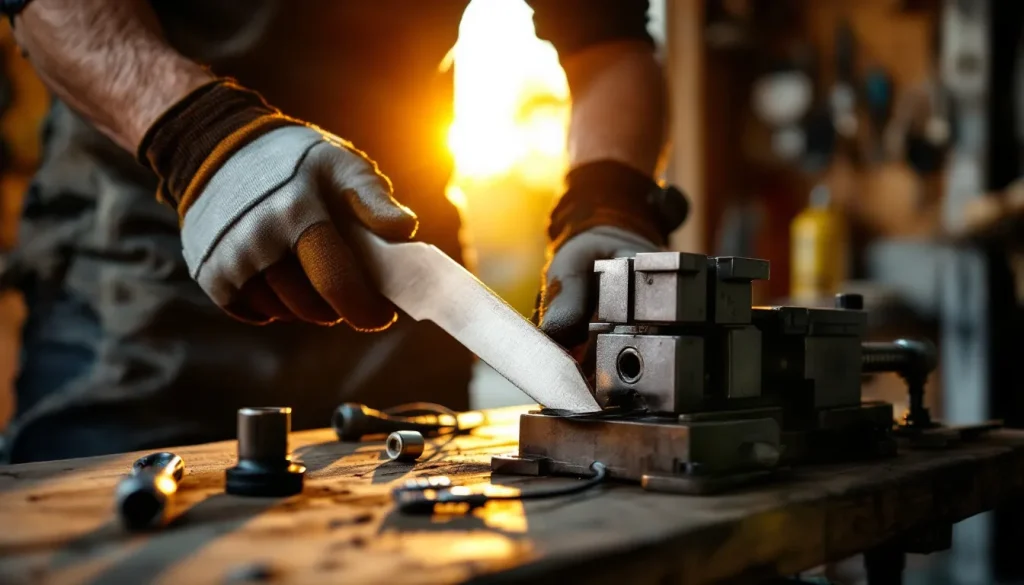
Sharpen by working along the cutting edge in one direction, matching the existing bevel, and giving each side of the blade an equal number of strokes or passes. With a file, push along the edge on the forward stroke only (files cut one way) and lift on the return. With a grinder, draw the edge across the wheel in smooth passes, never holding it in one spot.
Each mower blade has two cutting edges, one at each end, that spin in opposite directions. Sharpen both equally so the blade stays balanced. Remove nicks first by grinding the edge back to clean steel, then refine the bevel.
Watch the steel color if you use a powered tool. If the metal turns straw-yellow or blue, you have overheated it and ruined the temper, which leaves the edge soft and quick to dull. Keep a cup of water nearby and dip the blade often to keep it cool to the touch. A file never has this problem.
How sharp should a lawn mower blade be?
A lawn mower blade should be “butter-knife” sharp, not razor sharp. You want an edge that would not cut your finger if you ran it across slowly. A razor edge is thin and chips the first time it hits a stone, stick, or pine cone. A butter-knife edge slices grass cleanly and holds up through a full mowing season.
Grass is soft. The blade cuts by speed, not by a fine edge, spinning at roughly 200 mph at the tip. A durable, slightly blunt edge cuts grass just as well as a sharp one and survives debris far better.
Balance the blade: the nail test and the real danger threshold
After sharpening, balance the blade before reinstalling it. An unbalanced blade is the single most-skipped step and the leading cause of mower vibration, premature spindle-bearing wear, and cracked crankshafts. To test balance, hang the blade on a thin nail through the center hole and watch which end drops. If one end consistently swings down, that side is heavier and needs more metal removed.
- Drive a nail into a wall or clamp a screwdriver shaft horizontally, or use a $5 magnetic blade-balancer cone.
- Slide the blade’s center hole onto the nail so the blade hangs freely.
- Watch it settle. A balanced blade stays roughly level. If one end dips, it is heavier.
- File a little more metal from the cutting bevel on the heavy end (never thin the back of the blade), then retest.
- Repeat until the blade holds level, or close to it, in any rotational position.
How much imbalance is dangerous? A rough field rule: if either end visibly and consistently swings down within a second or two, it is out of balance enough to cause noticeable vibration at full RPM. A balancer cone is more precise than a nail because it shows tilt in two planes, not just one. Spend the $5 if your mower vibrates after sharpening.
Reinstall and torque the bolt to spec
Reinstall the blade in the same orientation you marked, with the cutting edges facing the direction of rotation (the sharp leading edge sweeps forward, the lifted “wing” trails). Hand-thread the bolt, then torque it with a torque wrench. Under-tightening lets the blade shift or fly off; over-tightening can snap the bolt or strip the crankshaft threads.
Manufacturers publish exact torque values, so check your operator manual first. Reported ranges across common consumer mowers fall in these bands:
| Mower type | Typical blade-bolt torque range |
|---|---|
| Walk-behind (push/self-propelled) | 35 to 50 ft-lb (commonly around 40 to 45) |
| Riding mower / lawn tractor | 50 to 90 ft-lb (often 60 to 70) |
| Cordless / battery walk-behind | 30 to 45 ft-lb (lighter spindle, check manual) |
These are general bands, not a substitute for your manual. If you cannot find a spec, a walk-behind blade tightened to a firm 40 to 45 ft-lb is a safe default. Block the blade again with wood to stop rotation while you torque.
Can you sharpen a mower blade without removing it?
Yes, you can sharpen a mower blade without removing it, using a file or a drill-mounted stone reached from under a safely tipped or lifted deck. It is faster for a quick touch-up, but you cannot balance the blade in place, and balance is what protects your bearings. Use the in-place method only for light, even dulling, never after grinding out nicks.
Disconnect the spark plug wire or remove the battery first, every time, even for a quick file. The blade is still a blade. For anything more than a light touch-up, take it off so you can balance it.
How often to sharpen, and the signs a blade is dull
Sharpen a lawn mower blade roughly every 20 to 25 hours of cutting, which for most homeowners means once or twice per mowing season, or about every 8 to 10 mows. Sharpen more often if you cut sandy soil, mow over twigs, or have a large lot. The clearest sign of a dull blade is grass that looks torn and frayed with brown or white tips a day after mowing.
Other dull-blade signs: the mower leaves uncut streaks or “wisps,” the lawn looks ragged from a distance, or cutting takes more passes and bogs the engine. Torn grass tips also lose more water and open the plant to disease, which matters most right after you overseed a lawn or seed a new lawn and the young grass is vulnerable.
Keep a spare sharpened blade on hand. Swapping a pre-sharpened blade takes five minutes, and you sharpen the dull one on your own schedule. Picking the right mower in the first place helps too; the HMNDP lawn mower buying guide covers blade access and deck design.
When to replace the blade instead of sharpening
Replace a mower blade instead of sharpening when it has cracks, deep gouges you cannot grind out, a worn-thin trailing edge, or a bent body. A cracked or thinned blade can shatter at 3,000 RPM and become a projectile. Replacement blades cost $10 to $30 for most walk-behind mowers, far cheaper than a damaged deck or an injury.
Specific replace-now signals:
- Any visible crack, especially near the center hole or bolt area
- The cutting edge has worn back so far the air-lift wing is thinning
- Deep notches or gouges that would take aggressive grinding to remove
- The blade is bent and will not sit level (a bent blade cannot be balanced)
- You have sharpened it so many times the metal is visibly thinner than a new one
For more seasonal lawn-care guides, see the HMNDP learn hub.
If you would rather match the technique above to the right tool, our breakdown of drill attachments, bench grinders, and angle grinders for blade sharpening ranks each option by control, speed, and how easy it is to hold the correct angle.
Frequently Asked Questions
How often should you sharpen a lawn mower blade?
Sharpen a lawn mower blade about every 20 to 25 hours of use, which is roughly once or twice per season or every 8 to 10 mows for most homeowners. Sharpen more often if you mow sandy soil, large lots, or over twigs and debris. Torn, frayed, brown grass tips a day after mowing are the clearest sign it is time.
What angle do you sharpen a lawn mower blade to?
Most lawn mower blades are sharpened to a bevel between 30 and 45 degrees, with about 30 degrees being the common factory grind on walk-behind blades. The safest approach is to match the existing angle by laying your file flat against the current bevel. For an exact number, find the blade part number and check the OEM or Oregon, Stens, or Rotary spec.
Can you sharpen a mower blade without removing it?
Yes, you can sharpen a mower blade in place with a file or drill-mounted stone reached from under a safely tipped or lifted deck. Always disconnect the spark plug wire or remove the battery first. The drawback is you cannot balance the blade while it is mounted, so use the in-place method only for light, even touch-ups, not after grinding out nicks.
Is it better to sharpen a mower blade with a file or a grinder?
A file is better for beginners and light dulling because it is cheap (about $10), safe, and cannot overheat the steel. A grinder is better for nicked or badly dull blades and for speed, taking 3 to 6 minutes versus 15 with a file. The grinder’s risk is heat: if the steel turns blue, you have ruined the temper.
How sharp should a lawn mower blade be?
A lawn mower blade should be “butter-knife” sharp, not razor sharp. The edge should not cut your finger when run across slowly. A razor edge is too thin and chips on the first rock or stick. Because the blade tip spins near 200 mph, a slightly blunt, durable edge cuts grass cleanly and lasts a full season.
How do you balance a lawn mower blade after sharpening?
Hang the blade on a nail through its center hole, or use a $5 balancer cone, and watch which end drops. The heavier end dips. File a little more metal from the cutting bevel on the heavy end, never the back, then retest until the blade holds roughly level. An unbalanced blade causes vibration and premature spindle-bearing wear.
How do you know when a mower blade needs sharpening or replacing?
Sharpen when grass tips look torn, frayed, and brown a day after mowing, or when the mower leaves uncut streaks. Replace instead of sharpening when the blade has any crack, a bend that will not sit level, deep gouges you cannot grind out, or a trailing edge worn dangerously thin. A cracked blade can shatter at full RPM.
Do you need to take the blade off the mower to sharpen it?
No, you do not strictly need to remove the blade for a light touch-up, which you can file in place under a tipped or lifted deck. But removing it is strongly recommended because it is the only way to balance the blade, and unbalanced blades cause vibration and bearing damage. Always cut power before either method by pulling the spark plug wire or battery.