
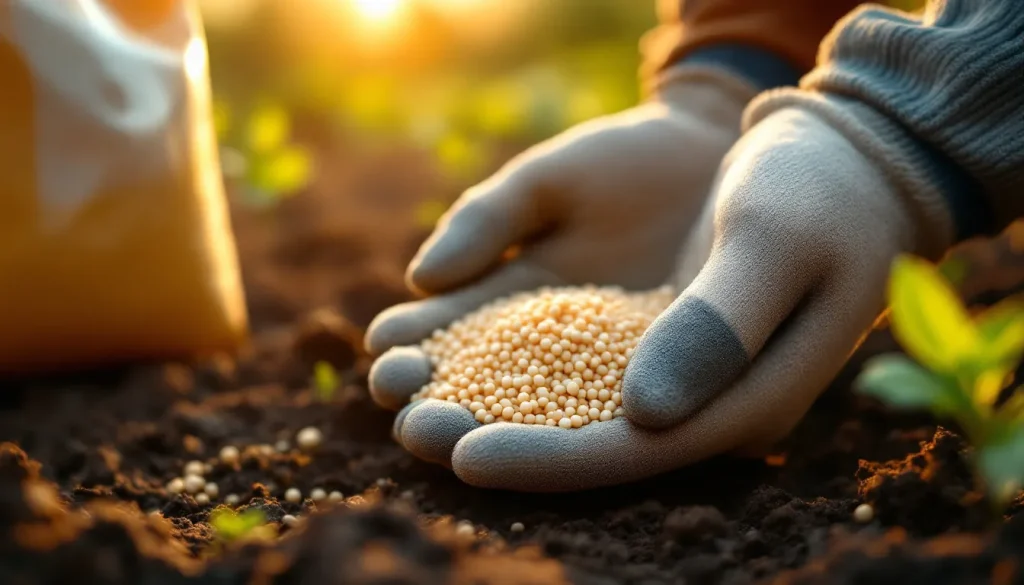
What is a chemical fertilizer?
A chemical fertilizer is a manufactured, inorganic compound made to supply plants with concentrated nutrients, usually nitrogen (N), phosphorus (P), and potassium (K). It is produced through industrial chemical processes rather than from decomposed plant or animal matter. Because the nutrients are in mineral salt form, they dissolve quickly in water and become available to roots within days.
The term covers products like urea, ammonium nitrate, and superphosphate. Each carries a printed NPK ratio (for example 10-10-10) that states the percentage of nitrogen, phosphorus, and potassium by weight.
Gardeners choose chemical fertilizers for speed and precision. A bag labeled 46-0-0 delivers a known, exact dose of nitrogen, which is harder to guarantee with compost or manure.
Last reviewed: June 2026.
Chemical vs synthetic vs inorganic vs mineral fertilizer: the same thing?
Yes, in everyday use these four terms describe the same category: nutrients delivered as manufactured mineral salts rather than from living or once-living matter. “Chemical” and “synthetic” emphasize the industrial process. “Inorganic” describes the chemistry (no carbon-based organic molecules). “Mineral” points to the salt form the plant absorbs. Gardeners and product labels use them interchangeably.
There is one nuance. Chemists note that all fertilizers, including compost, eventually break down into the same inorganic ions that roots take up. The practical difference is the starting material and the speed of release, not the final nutrient a plant absorbs.
| Term | What it stresses | Example |
|---|---|---|
| Chemical fertilizer | Made by chemical reaction | Urea |
| Synthetic fertilizer | Man-made, not from nature directly | Ammonium nitrate |
| Inorganic fertilizer | Non-carbon-based salts | Muriate of potash |
| Mineral fertilizer | Nutrients in mineral salt form | Superphosphate |
What does NPK mean on chemical fertilizer?
NPK is the three-number ratio printed on every fertilizer bag. It states the guaranteed percentage by weight of nitrogen (N), available phosphate (P2O5), and soluble potash (K2O). A 20-10-10 bag is 20 percent nitrogen, 10 percent phosphate, and 10 percent potash. The remaining weight is filler, carrier, or secondary nutrients.
Each nutrient does a specific job. Nitrogen drives green leafy growth and lawn color. Phosphorus supports roots, flowers, and fruit. Potassium builds overall hardiness, water regulation, and disease resistance.
A 50 lb bag of 10-10-10 therefore contains 5 lb of nitrogen, 5 lb of phosphate, and 5 lb of potash. This math lets you dose by the exact pound of nutrient, which is the main reason growers reach for chemical products over bulk organic matter.
How chemical fertilizers are manufactured
Chemical fertilizers are made by fixing or refining raw elements into water-soluble salts through industrial reactions. Nitrogen fertilizers start with ammonia produced by the Haber-Bosch process, which combines atmospheric nitrogen with hydrogen (usually from natural gas) under high heat and pressure. Phosphorus and potassium products are refined from mined rock.
- Nitrogen: The Haber-Bosch process, developed around 1909 to 1913, converts N2 and H2 into ammonia at roughly 400 to 450 degrees Celsius and 150 to 300 atmospheres. Ammonia is then processed into urea or ammonium nitrate.
- Phosphorus: Mined phosphate rock is treated with sulfuric acid to make phosphoric acid, then converted into superphosphate or ammoniated phosphates like DAP and MAP.
- Potassium: Potash is mined from underground deposits (large reserves exist in Saskatchewan, Canada, and Belarus) and refined into muriate of potash (potassium chloride).
The Haber-Bosch process is energy intensive. It is estimated to consume 1 to 2 percent of global energy and supply the nitrogen behind a large share of the world’s food, which is why chemical fertilizer sits at the center of both modern agriculture and its environmental debate.
Examples and types of chemical fertilizers
The most common chemical fertilizers are urea, ammonium nitrate, ammonium sulfate, DAP, MAP, superphosphate, and muriate of potash. Each supplies one or two of the primary nutrients at a known concentration. The table below maps specific products to their typical NPK values and best garden use.
| Product | Typical NPK | Supplies | Best use |
|---|---|---|---|
| Urea | 46-0-0 | Nitrogen | Fast green-up on lawns and leafy growth; high burn risk |
| Ammonium nitrate | 34-0-0 | Nitrogen | Quick nitrogen for row crops and pasture |
| Ammonium sulfate | 21-0-0 (plus sulfur) | Nitrogen, sulfur | Nitrogen in high-pH soils; mild acidifier |
| DAP (diammonium phosphate) | 18-46-0 | Nitrogen, phosphorus | Starter fertilizer at planting for root establishment |
| MAP (monoammonium phosphate) | 11-52-0 | Nitrogen, phosphorus | Phosphorus boost near seedlings; gentler than DAP |
| Single superphosphate | 0-20-0 (plus sulfur, calcium) | Phosphorus | Phosphorus for flowers, fruit, and root crops |
| Muriate of potash | 0-0-60 | Potassium | Potassium for hardiness and fruiting; avoid on chloride-sensitive plants |
| Balanced blend | 10-10-10 | N, P, K | All-purpose garden feeding |
Blended products (10-10-10, 20-20-20, and lawn formulas like 24-4-8) combine these raw salts to hit a target ratio. Our guide to the best fertilizer for grass breaks down which of these ratios fits common turf types.
Chemical vs organic fertilizer: side-by-side comparison
Chemical and organic fertilizers both feed plants the same ions, but they differ in source, speed, and effect on soil life. Chemical products give a fast, precise, concentrated dose. Organic products (compost, manure, blood meal, bone meal) release nutrients slowly as soil microbes break them down and add organic matter that improves structure over time.
| Factor | Chemical (synthetic) | Organic (natural) |
|---|---|---|
| Source | Manufactured mineral salts | Plant or animal matter |
| NPK concentration | High and exact (up to 46% N) | Low and variable (often 1% to 6% N) |
| Nutrient release | Days; immediate uptake | Weeks to months; microbe-dependent |
| Burn risk | Higher (salt content) | Lower |
| Soil organic matter | Adds none | Builds structure and microbial food |
| Runoff risk | Higher when over-applied | Lower, slower |
| Cost per unit of nutrient | Lower | Higher |
| Precision | High | Low |
Many gardeners use both: a chemical dose to correct a fast deficiency, plus compost to build long-term soil health. The choice is not moral, it is a match of tool to problem.
Benefits of chemical fertilizers
Chemical fertilizers offer speed, precision, and yield. Because nutrients are water-soluble salts, roots absorb them within days, which corrects a visible deficiency far faster than compost. The printed NPK ratio lets a grower deliver an exact pound of nitrogen or phosphorus, and the high concentration means less product to buy, store, and haul.
- Fast availability: Nutrients dissolve and reach roots in days, not the weeks organic matter needs.
- Precise NPK: A labeled 46-0-0 or 0-0-60 bag gives an exact, repeatable dose.
- Higher yield: Synthetic nitrogen is credited with a large share of 20th-century crop yield gains; studies attribute up to roughly half of global food production to synthetic nitrogen inputs.
- Lower cost per nutrient: Concentrated salts cost less per pound of actual N-P-K than bulky organic sources.
- Targeted correction: A single-nutrient product fixes one deficiency without adding the others.
For seasonal lawn feeding where timing matters, this speed is an advantage. Our best fall lawn fertilizer guide explains how a quick-release nitrogen dose fits the autumn root-building window.
Downsides and negative effects of chemical fertilizers
The main drawbacks of chemical fertilizers are nutrient runoff, soil acidification, and pressure on soil microbes. Because the nutrients are highly soluble, any amount plants do not absorb can leach into groundwater or wash into waterways. Repeated ammonium-based dosing lowers soil pH, and heavy synthetic-only programs can reduce the organic matter that feeds soil bacteria and fungi.
- Nutrient runoff: Roughly 40 to 60 percent of applied nitrogen can be lost to leaching, volatilization, or runoff depending on soil, timing, and rate. Excess nitrogen and phosphorus feed algal blooms; nutrient runoff is a primary driver of the Gulf of Mexico hypoxic “dead zone,” which has spanned thousands of square miles in recent summers.
- Soil acidification: Ammonium and urea fertilizers release hydrogen ions as they nitrify, lowering pH over years. Acidic soil can lock up other nutrients and force lime applications to correct.
- Microbial disruption: Because synthetic salts add no organic carbon, long-term chemical-only use can shrink the food supply for beneficial soil bacteria, fungi, and earthworms, reducing biological activity compared with soils that receive organic matter.
- Salt buildup and burn: Over-application raises soil salt concentration, drawing water out of roots and scorching foliage.
These effects are dose-dependent, not automatic. Correct rates, split applications, and pairing with organic matter reduce most of them, which is the difference between a tool used well and one used carelessly.
Are chemical fertilizers bad for plants and soil?
Chemical fertilizers are not inherently bad; the harm comes almost entirely from over-application and synthetic-only programs. Used at label rates and split across the season, they feed plants effectively with limited downside. The documented problems (runoff, acidification, reduced microbial activity) scale with excess dose and the absence of organic matter, not with the mere presence of synthetic nutrients.
The nutrient ion a plant absorbs is chemically identical whether it came from urea or compost. A plant cannot tell the difference. What soil “notices” is the salt load, the lack of organic carbon, and the timing.
The evidence-based verdict: chemical fertilizer is a precise, powerful tool that punishes carelessness. The gardener who over-applies and never adds compost sees the harm; the one who doses correctly and returns organic matter to the soil largely does not.
How to use chemical fertilizer for plants and gardens without burning them
Apply chemical fertilizer at the labeled rate, split into smaller doses, water it in, and keep granules off leaves. Fertilizer burn happens when salt concentration in the soil spikes and pulls water out of roots, so the fixes are lower rates, even spreading, and moisture. Never guess: measure by the pound of nutrient the NPK ratio states.
- Test first: A soil test (many county extension offices offer one for roughly 10 to 25 US dollars) tells you which nutrient you actually lack, so you avoid adding what is already present.
- Match the ratio: Use high-N (like 24-4-8) for lawns and leafy growth, higher-P (like 10-52-10 starter) at planting, and balanced (10-10-10) for general beds.
- Dose by nutrient: Lawns typically want about 0.5 to 1 lb of actual nitrogen per 1,000 square feet per application. Divide by the N percentage to get product weight.
- Split applications: Two or three smaller feedings beat one heavy dose and cut both burn and runoff.
- Water it in: Irrigate after applying to dissolve granules and move salts away from foliage and root crowns.
- Keep off leaves and stems: Brush granules off foliage; direct contact with concentrated salt scorches tissue.
- Mind timing: Avoid applying right before heavy rain (runoff) or during peak heat and drought stress (burn).
Signs of over-application include yellow or brown leaf edges, a white salt crust on the soil, and wilting despite moist ground. If you see them, flush the area with water to dilute the salts. For broader lawn-care context, our 2026 fertilizer market report tracks how product prices and formulations are shifting, and if you are weighing whether a “weed” even needs treating, see are dandelions weeds.
Frequently Asked Questions
What is a chemical fertilizer?
A chemical fertilizer is a manufactured inorganic compound made to supply plant nutrients, mainly nitrogen, phosphorus, and potassium, in concentrated water-soluble salt form. It is produced by industrial processes such as the Haber-Bosch reaction rather than from decomposed plant or animal matter. Roots absorb it within days, and every bag lists an exact NPK ratio like 10-10-10.
What are examples of chemical fertilizers?
Common examples include urea (46-0-0), ammonium nitrate (34-0-0), ammonium sulfate (21-0-0), diammonium phosphate or DAP (18-46-0), monoammonium phosphate or MAP (11-52-0), single superphosphate (0-20-0), and muriate of potash (0-0-60). Blended all-purpose products like 10-10-10 and 20-20-20 combine these raw salts to hit a target nutrient ratio for general garden use.
What is the difference between chemical and organic fertilizer?
Chemical fertilizer is a manufactured mineral salt that releases nutrients in days at high, exact concentrations. Organic fertilizer comes from plant or animal matter and releases nutrients slowly over weeks as soil microbes break it down, while adding organic matter that improves soil structure. Chemical is faster and more precise; organic builds long-term soil health and carries lower burn and runoff risk.
Are chemical fertilizers bad for plants and soil?
Chemical fertilizers are not inherently bad. Harm comes mainly from over-application and synthetic-only use, which can cause nutrient runoff, soil acidification, and reduced microbial activity. At labeled rates, split across the season and paired with organic matter, they feed plants effectively with limited downside. The nutrient ion a plant absorbs is identical whether it came from urea or compost.
What is the best chemical fertilizer for plants?
The best chemical fertilizer depends on the plant and a soil test. Use high-nitrogen products like urea (46-0-0) or 24-4-8 for lawns and leafy growth, high-phosphorus starters like 10-52-10 or DAP at planting for roots, and a balanced 10-10-10 for general beds. There is no single best; match the NPK ratio to the deficiency you actually have.
What does NPK mean on chemical fertilizer?
NPK is the three-number ratio on the bag showing the guaranteed percentage by weight of nitrogen (N), available phosphate (P2O5), and soluble potash (K2O). A 20-10-10 product is 20 percent nitrogen, 10 percent phosphate, and 10 percent potash. Nitrogen drives leafy growth, phosphorus supports roots and flowers, and potassium builds hardiness and disease resistance.
How do you apply chemical fertilizer without burning plants?
Apply at the labeled rate, split into smaller doses, spread evenly, keep granules off leaves and stems, and water in afterward to dissolve the salts. Burn happens when soil salt concentration spikes and pulls water from roots. Lawns typically want 0.5 to 1 lb of actual nitrogen per 1,000 square feet per feeding. Avoid applying before heavy rain or during drought stress.
Is chemical fertilizer the same as synthetic or inorganic fertilizer?
Yes. Chemical, synthetic, inorganic, and mineral fertilizer all describe the same category: nutrients supplied as manufactured mineral salts rather than from living matter. “Chemical” and “synthetic” stress the industrial process, “inorganic” describes the non-carbon chemistry, and “mineral” points to the salt form roots absorb. Product labels and gardeners use the terms interchangeably.