
By the HMNDP Editorial Team, independent reporting on lawn care, landscaping, and the green industry.
Last reviewed: June 2026
Which aphid insecticide should you actually buy?
The best aphid insecticide depends entirely on where the aphids are. For food crops, use insecticidal soap or neem oil, never a systemic. For roses and ornamentals, imidacloprid (systemic) or a pyrethroid like bifenthrin works but harms bees. For houseplants, insecticidal soap or neem is safest. Match the product to the plant first, then to the infestation.
Most pages ranking for “aphid insecticide” hand you a product list with no logic behind it. That is how gardeners end up spraying a bee-killing neonicotinoid on tomatoes. The single most important rule in aphid control is this: the plant you are treating decides the product, not the other way around.
| Your situation | Best first choice | Avoid |
|---|---|---|
| Vegetables, herbs, fruit | Insecticidal soap or neem oil | Imidacloprid, any systemic |
| Roses, ornamentals (no blooms open) | Imidacloprid systemic or bifenthrin | Spraying open flowers |
| Houseplants | Insecticidal soap or neem oil | Broad-spectrum pyrethroids indoors |
| Beneficial-friendly / organic garden | Ladybugs, lacewings, soap | Any residual pyrethroid |
How to identify an aphid infestation
Aphids are soft-bodied insects about 1/16 to 1/8 inch long, usually green but also black, red, yellow, or gray. Look for dense colonies clustered on new growth and the undersides of leaves. Signs include sticky honeydew on leaves below, black sooty mold, curled or yellowing leaves, and ants farming the colony. A heavy infestation stunts growth and distorts buds.
Check leaf undersides first. Aphids feed there because it hides them from predators and from sprays applied only to the tops of leaves. That hiding spot is exactly why coverage matters more than product choice, a point covered in the application section below.
Honeydew, the sugary waste aphids excrete, is often the first thing you notice. It coats lower leaves, attracts ants, and grows black sooty mold that blocks photosynthesis. If your car or patio under a tree turns sticky in summer, aphids overhead are usually the cause.
Systemic insecticides: imidacloprid and how they work
Systemic insecticides like imidacloprid are absorbed into the plant’s sap, so aphids die when they feed anywhere on the plant, including hidden leaf undersides. Products include Bayer/BioAdvanced Tree and Shrub Insect Control and Merit. A soil drench gives weeks of protection. The catch: imidacloprid is a neonicotinoid, acutely toxic to bees, and must never be used on food crops.
Imidacloprid is the most common systemic for aphids. Applied as a soil drench around roses, shrubs, or trees, it moves up through the plant and can protect for several weeks to a full season depending on the product and plant size. Because it works from inside, spray coverage is not an issue.
That strength is also its liability. Neonicotinoids move into pollen and nectar, which is why they are among the most bee-toxic insecticides in home use. In 2024 and into 2025, the EPA moved to restrict outdoor neonicotinoid uses and tighten label directions, and several states already limit consumer sales of imidacloprid products. Always read the current label, which may prohibit uses printed on older packaging.
Never use imidacloprid on vegetables, herbs, or fruit. Homeowner systemic products are labeled for ornamentals and non-bearing plants only. Applying them to food crops is both unsafe and, in most cases, an illegal off-label use.
Contact and residual insecticides: Tempo, Talstar, Suspend SC
Contact insecticides kill aphids on direct spray contact and leave a residual film that keeps killing for days to weeks. The main home and pro products are pyrethroids: Talstar P (bifenthrin), Tempo SC Ultra (beta-cyfluthrin), and Suspend SC (deltamethrin). They act fast and cost little per application, but they are highly toxic to bees and kill beneficial insects like ladybugs too.
| Product | Active ingredient | Class | Typical use |
|---|---|---|---|
| Talstar P | Bifenthrin | Pyrethroid | Ornamentals, perimeter |
| Tempo SC Ultra | Beta-cyfluthrin | Pyrethroid | Ornamentals, structures |
| Suspend SC | Deltamethrin | Pyrethroid | Ornamentals, indoor labeled uses |
These are concentrates you dilute in a sprayer, so a single bottle treats many applications, which keeps cost low. Most labels direct roughly 0.25 to 1 fluid ounce per gallon of water, but the exact rate is on your product label and must be followed. They are broad-spectrum, so they wipe out the aphids’ natural enemies along with the aphids.
Do not spray pyrethroids on blooming plants or when bees are active. Apply at dusk when pollinators have stopped foraging, and keep spray off open flowers. For a broader look at contact sprays across pests, see our guide to the best insecticide spray options.
Neem oil for aphids: how it works and how to apply it
Neem oil kills aphids two ways: as a contact spray that smothers them, and through azadirachtin, a compound that disrupts feeding and molting so survivors stop reproducing. Mix about 2 tablespoons (1 ounce) of neem oil concentrate per gallon of water plus a few drops of dish soap as an emulsifier. Spray until leaves drip, coating undersides. Repeat every 7 days.
Neem is one of the few options that is both edible-safe on food crops (check the label for a pre-harvest interval) and gentler on established beneficial-insect populations than a broad pyrethroid. It works slower, so expect a few days rather than instant knockdown.
Apply neem in early morning or evening, never in midday sun or above about 90°F, because oil plus heat can burn foliage. Test one leaf first on sensitive plants. Because neem is still an oil that can harm bees on direct contact, spray when pollinators are not active.
Insecticidal soap and horticultural oil
Insecticidal soap and horticultural oil kill aphids on contact by breaking down their protective coating or smothering them. Both are OMRI-listed organic options safe for vegetables, herbs, and houseplants. They leave no residual, so they only kill what the spray touches, which makes complete coverage of leaf undersides essential. Reapply every 4 to 7 days until the colony is gone.
Ready-to-use insecticidal soap (potassium salts of fatty acids) is the safest starting point for houseplants and edibles. It has no lasting residue, so it will not harm ladybugs that arrive after the spray dries. Its weakness is the flip side: miss a cluster on a leaf underside and those aphids survive to rebuild.
Horticultural oil, including lightweight “summer oils,” smothers aphids and their eggs. Like neem, avoid applying in high heat or full sun to prevent leaf burn. Both soap and oil pair well with a hard water spray first to knock loose colonies off before you treat.
Organic vs chemical aphid control: full comparison
Chemical insecticides (systemics and pyrethroids) kill fast and last longer but harm bees, kill beneficial insects, and are mostly off-limits on food. Organic options (soap, neem, oil, beneficials) are edible-safe and pollinator-friendlier but work slower and need repeating. The right call depends on whether you are protecting a food crop, an ornamental, or a houseplant, and how much you value pollinators.
| Method | Speed of kill | Residual | Edible-safe | Pollinator risk | Relative cost |
|---|---|---|---|---|---|
| Imidacloprid (systemic) | Slow (days) | Weeks to season | No | High | Low per use |
| Pyrethroids (Talstar, Tempo, Suspend) | Fast (hours) | Days to weeks | No | High | Low per use |
| Neem oil | Moderate (days) | Low | Yes (check PHI) | Moderate | Low to medium |
| Insecticidal soap | Fast on contact | None | Yes | Low | Low |
| Horticultural oil | Moderate | Low | Yes | Low to moderate | Low |
| Beneficial insects | Slow (weeks) | Ongoing | Yes | None | Medium |
Homemade and DIY aphid sprays
A simple homemade aphid spray is 1 to 2 teaspoons of mild liquid dish soap per quart of water, sprayed directly on aphids and leaf undersides. A garlic spray (2 crushed cloves blended with water, strained, mixed with a little soap) adds a repellent effect. Both are cheap and edible-safe, but they have no residual and must be reapplied every few days.
The soap-water spray works the same way as commercial insecticidal soap: it strips the aphid’s outer coating so it dries out. Use a plain, additive-free dish soap and keep the concentration low, because too much soap or a degreasing detergent can scorch leaves. Test on one leaf first.
Garlic and hot-pepper sprays mostly repel and deter rather than kill on contact. They can help protect new growth after you knock down the main colony with soap. A strong jet of plain water from the hose is the most underrated DIY tool of all: it physically blasts aphids off, and most cannot climb back.
Beneficial insects: biological control
Beneficial insects control aphids naturally with no spray at all. Ladybugs (lady beetles) and green lacewing larvae are the top aphid predators; a single lacewing larva can eat hundreds of aphids before it matures. Parasitic wasps also help. Release them in the evening onto watered plants, and stop using broad-spectrum insecticides, which kill these allies along with the pests.
Biological control works best as prevention and for moderate infestations, not as an emergency knockdown. Predators take weeks to bring a population down, but they keep working as long as prey is present. Planting alyssum, dill, and yarrow draws native lacewings and hoverflies whose larvae also feed on aphids.
The catch that trips people up: buying ladybugs while still spraying pyrethroids is money wasted, because those sprays kill the ladybugs. Biological control and broad-spectrum chemicals do not mix. Choose one strategy per plant. A healthy, well-fed garden also resists aphids better, which is why balanced feeding, covered in our guide to the best fertilizer for grass and lawn health, supports pest resistance across the yard.
How to apply aphid insecticide correctly
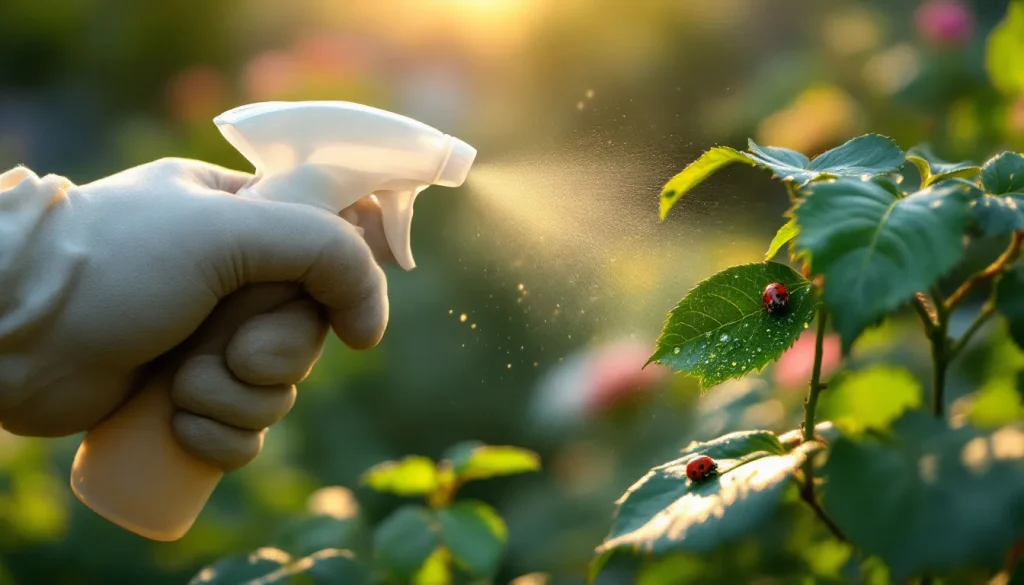
Correct application matters more than product choice. Aphids hide on leaf undersides, where sprays applied only to the tops miss them entirely. Coat every surface until it drips, hold the nozzle upward to hit undersides, and repeat every 5 to 7 days for 2 to 3 cycles to catch newly hatched aphids. Spray at dawn or dusk to protect bees and avoid leaf burn.
- Blast first. Knock the colony loose with a hard water spray a day before treating.
- Mix to the label rate. Follow the exact dilution on your product; more is not better and can burn foliage.
- Hit the undersides. Aim upward and cover both leaf surfaces, stems, and new growth until dripping.
- Time it for pollinators. Spray at dusk when bees are not foraging, and never on open flowers.
- Repeat on schedule. Reapply every 5 to 7 days for contact products, since eggs and hidden aphids survive one pass.
- Watch the weather. Avoid spraying above 90°F or in full sun, and do not spray before rain.
Rotate active ingredients if you spray repeatedly, because aphids can develop resistance to a single class like pyrethroids. For garden-wide pest and soil decisions, our best mulch for flower beds guide and the broader HMNDP guides hub cover the surrounding practices that keep infestations from returning.
Frequently Asked Questions
What is the best insecticide for aphids?
The best insecticide for aphids depends on the plant. For vegetables and houseplants, insecticidal soap or neem oil is safest and effective. For roses and ornamentals, a systemic like imidacloprid or a pyrethroid like bifenthrin gives longer control. There is no single best product; match it to whether you are treating food crops, ornamentals, or indoor plants.
What insecticide kills aphids fast?
Pyrethroid contact sprays like Talstar (bifenthrin), Tempo (beta-cyfluthrin), and Suspend SC (deltamethrin) kill aphids fastest, often within hours of direct contact. Insecticidal soap also kills quickly on contact but only what it touches. For speed you sacrifice pollinator safety, since pyrethroids are highly toxic to bees and beneficial insects, so spray at dusk and avoid open blooms.
Is imidacloprid safe to use on vegetables for aphids?
No. Imidacloprid, a systemic neonicotinoid, should never be used on vegetables, herbs, or fruit. Homeowner imidacloprid products are labeled for ornamentals and non-bearing plants only, and using them on food crops is unsafe and generally an illegal off-label use. For edible plants, use insecticidal soap, neem oil, or horticultural oil instead.
What natural or organic insecticide kills aphids?
Insecticidal soap, neem oil, and horticultural oil are effective organic aphid killers safe for edibles and houseplants. Neem also disrupts aphid feeding and reproduction. A homemade spray of mild dish soap in water works similarly. Beneficial insects like ladybugs and lacewings provide ongoing biological control. All organic options need repeat applications and thorough coverage of leaf undersides.
Will neem oil kill aphids and how do you apply it?
Yes, neem oil kills aphids on contact and stops survivors from feeding and reproducing. Mix about 2 tablespoons of neem concentrate per gallon of water with a few drops of dish soap, then spray until leaves drip, coating undersides. Repeat every 7 days. Apply in early morning or evening, never in midday sun or above 90°F, to avoid leaf burn.
Are aphid insecticides safe for bees and pollinators?
Many are not. Neonicotinoids like imidacloprid and pyrethroids like Talstar and Tempo are highly toxic to bees, and EPA moved in 2024 to restrict outdoor neonicotinoid uses. Insecticidal soap, horticultural oil, and biological control are far safer for pollinators. If you must use a chemical, spray at dusk when bees are not foraging and never treat open flowers.
What is the best systemic insecticide for aphids?
Imidacloprid is the most common systemic insecticide for aphids on ornamentals, sold as BioAdvanced Tree and Shrub Insect Control and Merit. Applied as a soil drench, it protects for weeks to a full season and reaches aphids on hidden leaf undersides. Reserve it for roses, shrubs, and trees only, never food crops, and note it is highly bee-toxic.
What is a good homemade aphid insecticide?
A good homemade aphid insecticide is 1 to 2 teaspoons of mild, additive-free dish soap per quart of water, sprayed directly onto aphids and leaf undersides. Adding blended, strained garlic increases the repellent effect. It is cheap and edible-safe but has no residual, so reapply every few days. Test on one leaf first, since too much soap can burn foliage.