
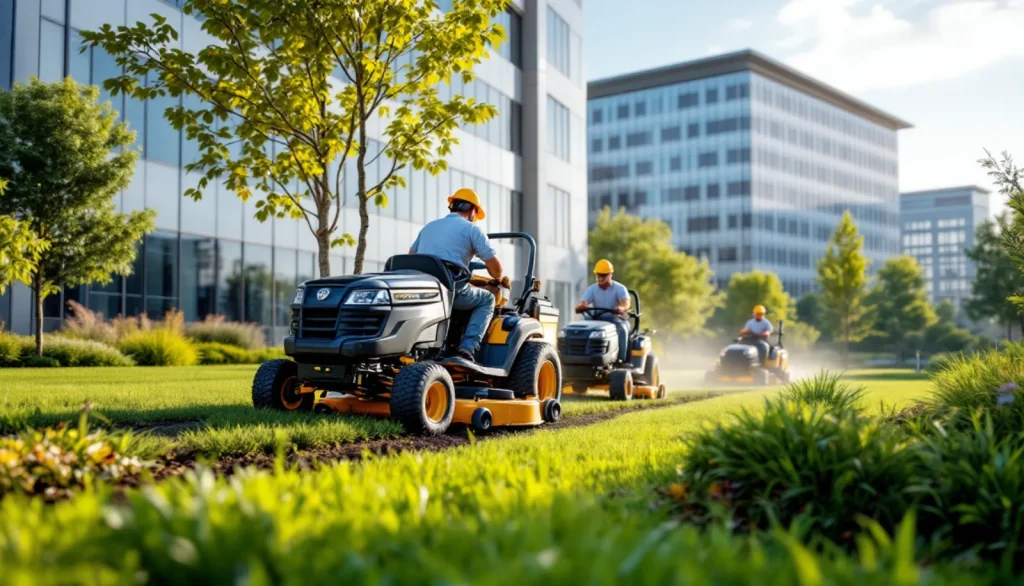
The Ruppert Landscape employee-owned structure has held since the founder-led transition completed in the late 2010s, putting the Mid-Atlantic regional powerhouse on a different track from the private equity roll-ups that swallowed most of its peer set. Headquartered in Laytonsville, Maryland and booking roughly $300 million in annual revenue, Ruppert is one of the largest 100% employee-owned commercial landscape firms in the United States, alongside Davey Tree and Bartlett Tree Experts. The PE wave reshaped the top 10. Ruppert kept its independence, kept its founder’s intent, and kept growing.
The short version
- Ruppert Landscape founded 1976 by Craig Ruppert in Maryland, headquartered in Laytonsville, MD
- ~$300M+ revenue and roughly 1,800 employees as of FY 2025
- 100% employee-owned through ESOP, transitioned in stages from founder ownership
- Operates 22+ branches across MD, VA, DC, PA, NC, GA, TX and expanding
- Commercial landscape maintenance + design-build + tree care services
- Bucking the PE roll-up that took BrightView, Yellowstone, SavATree, Heartland, Monarch
The Ruppert story
Craig Ruppert founded the company in 1976 in Ashton, Maryland with a single truck. The firm grew steadily through the 1980s and 1990s as the Washington DC and Baltimore commercial real estate markets boomed. Ruppert built a reputation on grounds maintenance for Class A office parks, federal contracts, and high-end HOAs, then added landscape design-build and tree services as adjacent revenue lines. In 1998, Ruppert sold the company to TruGreen LandCare (then a subsidiary of ServiceMaster), then bought it back in 2008 when ServiceMaster restructured.
The 2008 buyback set up the eventual employee-ownership transition. Craig Ruppert and the management team structured a long-running ESOP that allowed the founder to gradually monetize his equity while transferring ownership to employees. The company completed the transition to 100% ESOP ownership over the following decade. Today Ruppert operates without outside private equity, without strategic acquirers, and without public shareholders.
What Ruppert does
Ruppert runs three primary business lines. Landscape management (the largest, roughly 60% of revenue) handles commercial grounds maintenance for office parks, HOAs, retail centers, and corporate campuses. Landscape construction (design-build, hardscape, irrigation installation) handles capital projects. Tree care (a smaller but growing line) handles pruning, removal, and plant healthcare for the same customer base.
The geographic footprint spans the Mid-Atlantic core (Maryland, Virginia, DC, Pennsylvania) with expansion branches in North Carolina, Georgia, and Texas. As of 2025, Ruppert operated 22+ branches employing roughly 1,800 people. Annual revenue is above $300 million based on trade publication rankings (Lawn & Landscape Top 100, March 2026) and company disclosures to the ESOP Association.
Why bucking the PE trend matters
The PE story in commercial landscape services over the past decade is straightforward. BrightView (now KKR / One Rock Capital since late 2024). Yellowstone Landscape (CIVC Partners). SavATree (Apax Partners). Heartland (Carlyle). Monarch (Audax). Lambert (formerly Lambert’s Landscape, multiple PE rotations). At the residential lawn-care end, TruGreen has been Clayton Dubilier & Rice and Bain Capital since 2017. Of the top 15 commercial landscape firms in the US, only Davey Tree, Bartlett, Ruppert, and a handful of regionals (Russell Landscape, U.S. Lawns franchise system) remain non-PE. See the full PE picture at lawn and landscape private equity in 2026.
The ESOP structure is what makes Ruppert different from a PE roll-up. Employees vest in ESOP allocations over time, the company contributes annually based on payroll, and the trust holds 100% of the equity. There is no LP committed capital that needs an exit. There is no IRR clock running. There is no preferred return that has to be paid before management equity becomes whole. The capital stack is patient by design.
What it means for operators
For a regional operator considering exit options, Ruppert’s existence does not change the buyer market. Ruppert is not aggressively acquiring competitors the way BrightView did in its 2018 to 2024 IPO years. But it does prove an alternative path. Operators with strong management teams and culture-driven workforces can stay independent through an ESOP transition. The trade-off is that ESOPs are slower to deploy capital, more constrained on M&A, and require ongoing share-repurchase liability against cash flow.
Other employee-owned landscape firms in the top 100 include Bartlett Tree (~$400M+, family-influenced but largely employee-driven), Russell Landscape (Georgia, ~$80M), Cagwin & Dorward (California, employee-owned through ESOP, ~$70M+), and McHale Landscape Design (Maryland, ESOP, ~$50M+). The cohort is smaller than the PE cohort but the median employee tenure across these firms runs significantly higher than industry average.
By the numbers
| Metric | Ruppert (2025) | Davey Tree (2025) | BrightView (FY24) | Yellowstone (est.) |
|---|---|---|---|---|
| Revenue | ~$300M+ | $1.7B+ | $2.86B | ~$450M |
| Employees | ~1,800 | ~12,000 | ~21,500 | ~5,200 |
| Ownership | 100% ESOP | 100% ESOP | KKR / One Rock | CIVC Partners |
| Founded | 1976 | 1880 | 1939 / 2014 | 2008 |
| HQ | Laytonsville, MD | Kent, OH | Blue Bell, PA | Bunnell, FL |
| Branches | 22+ | 230+ | ~285 | 50+ |
Sources: Lawn & Landscape Top 100, ESOP Association, National Center for Employee Ownership, company disclosures.
What homeowners and property managers should know
For a property manager evaluating a maintenance contract bid, ownership structure matters less than service quality and price. But there are real operational differences. ESOP-owned firms typically show lower employee turnover, longer crew tenure, and more institutional knowledge of recurring sites. PE-backed firms often have stronger national scale, better technology infrastructure, and more aggressive pricing on multi-site portfolio bids. For HOAs and corporate campuses in the Mid-Atlantic, Ruppert competes head-to-head with BrightView and Yellowstone on most major bids.
For a homeowner needing residential service in Ruppert’s footprint, the company does limited residential design-build but does not run a residential maintenance program at scale. See our 2026 lawn care cost guide for what residential maintenance typically runs.
Background: ESOPs in landscape services
ESOPs in the landscape industry are growing as a succession-planning option. The 2017 federal Main Street Employee Ownership Act expanded SBA financing options for ESOP transitions, and the 2022 SECURE 2.0 Act made several provisions friendlier to ESOP-owned companies. For founders considering an alternative to a PE sale or a strategic acquisition, the ESOP option preserves the workforce, avoids the capital-gains hit of a single-event sale (selling shares to an ESOP at fair market value qualifies for Section 1042 tax deferral if structured correctly), and keeps the company independent.
The trade-offs are real. ESOPs require ongoing valuation work, ongoing repurchase liability funding, and ERISA compliance. They cap how aggressively a company can deploy capital because the share-repurchase obligation competes with growth investment. For an operator weighing options, Ruppert’s path is one model. The PE roll-up path is another. Neither is universally right.
FAQ
Is Ruppert publicly traded?
No. Ruppert is a private company. The ESOP trust holds all of the equity. The company is not required to file public quarterly reports.
How big is Ruppert relative to BrightView?
BrightView books roughly $2.86 billion. Ruppert books roughly $300 million plus. BrightView is national. Ruppert is regional (Mid-Atlantic core with Southeast expansion).
Can Ruppert be acquired?
Mechanically yes, but the ESOP trustee would have to vote to sell and would owe fiduciary duty to plan participants. A sale at less than ESOP fair market value would face ERISA challenge. Hostile acquisition is not possible because there are no public shares.
Does Ruppert do residential work?
Limited. Ruppert’s primary book is commercial (HOAs, office parks, corporate campuses, federal sites). The design-build line includes some high-end residential but not a residential maintenance program at scale.
Where does Ruppert operate?
Maryland (HQ), Virginia, DC, Pennsylvania, North Carolina, Georgia, Texas, and expanding. The Mid-Atlantic remains the core revenue base.
The Mid-Atlantic context
Ruppert’s footprint sits in one of the most competitive commercial landscape markets in the country. The Washington DC region carries roughly 95 million square feet of Class A office, plus the federal government as the largest single property holder. Maryland and Virginia HOAs run multi-year competitive bids. The corporate-campus market (Marriott, Lockheed Martin, Capital One, Hilton, Northrop Grumman) anchors high-spec work that requires consistent crew quality. Ruppert’s expansion into North Carolina and Georgia followed the same playbook: target Class A commercial and high-end HOA work, build branch density, and let the maintenance book compound. The Texas expansion is more recent and focuses on Dallas-Fort Worth corporate campuses where the customer profile mirrors the home market.
Bottom line
Ruppert Landscape stayed independent through a decade in which most of its peer set went private equity. The 100% employee-owned structure is durable, the Mid-Atlantic commercial book is solid, and the company is one of three or four large commercial landscape firms in the country that prove an ESOP can hold its own against a PE-funded competitor. For founders thinking about exit and for property managers thinking about contract continuity, Ruppert is a working example of an alternative model.