
By the HMNDP Editorial Team. Last reviewed: June 2026.
What a lawn mower lift is and how it works
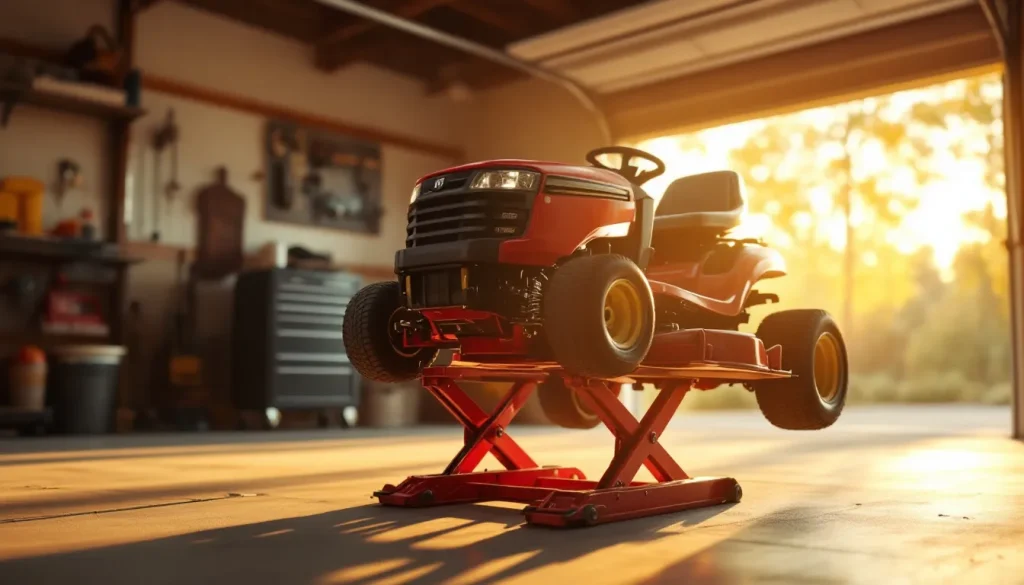
A lawn mower lift is a steel device that raises a riding mower, lawn tractor, or zero-turn off the ground so you can reach the deck, blades, and underside safely. Most residential models are jack-style lifts (the MoJack type) that hook under the front frame and crank the machine up 20 to 27 inches, then hold it on a locking pin.
The lift replaces the risky habit of tilting a mower on its side, which can leak oil into the cylinder and flood the air filter. Raising the machine level keeps fluids in place and gives you a stable, standing-height work zone for sharpening blades, scraping the deck, and changing oil.
The 4 types of lawn mower lifts compared
There are four lift types, and the right one depends on your mower weight, budget, and how often you service. Jack-style lifts dominate the residential market because they are cheap and store flat. Lift tables and scissor lifts suit shops and heavy zero-turns. Hydraulic lifts are commercial-grade. Ramps are the budget entry point but limit underside access.
| Lift type | Typical capacity | Lift height | Price band | Best for |
|---|---|---|---|---|
| Jack lift (MoJack type) | 300 to 750 lb | Front raised 20 to 27 in | $130 to $400 | Homeowners servicing 1 to 2 mowers |
| Lift table / scissor | 500 to 1,000 lb | Whole machine 10 to 30 in | $300 to $900 | Heavy zero-turns, level whole-deck access |
| Hydraulic lift | 500 to 1,500 lb | 12 to 40 in, foot or air pump | $700 to $2,500 | Light-commercial and fleet shops |
| Ramp (drive-up) | 400 to 900 lb | Fixed 6 to 12 in tilt | $60 to $200 | Deck rinsing only, tight budgets |
The honest tradeoff: a jack lift only raises the front, so the mower sits at an angle, which is fine for blades and belts but awkward for deep deck work. A lift table raises everything level but costs more and needs floor space. Hydraulics save your back on daily use but rarely pay off for a single homeowner.
How to match lift capacity to your mower weight
Size the lift to your mower’s real weight plus roughly 1.5x headroom, not to a round marketing number. Find your dry weight in the owner’s manual or on the spec sticker under the seat, then add fuel and battery weight. Multiply by 1.5 to cover uneven loading and the leverage a jack applies to the frame.
Most residential riding mowers weigh 350 to 550 lb dry. A typical 42-inch lawn tractor near 480 lb wants a lift rated around 720 lb, which pushes you past the 300 lb entry tier into a 500 or 750 lb model. Zero-turns run heavier, often 600 to 900 lb, so light-commercial operators should treat 750 lb as the practical floor.
| Machine type | Typical weight | Add 1.5x headroom | Rated lift to buy |
|---|---|---|---|
| Push / walk-behind | 60 to 95 lb | ~140 lb | Lift usually not needed |
| Riding mower / lawn tractor | 350 to 550 lb | ~525 to 825 lb | 500 to 750 lb |
| Garden tractor | 500 to 700 lb | ~750 to 1,050 lb | 750 lb or lift table |
| Zero-turn | 600 to 900 lb | ~900 to 1,350 lb | 750 lb+ or hydraulic |
This 1.5x rule is the piece missing from product pages that leave buyers guessing between 300 and 750 lb. When in doubt, round up: a lift never suffers from extra capacity, but an overloaded one bends.
Lift compatibility by machine type
Lawn mower lifts are widely compatible but not truly universal. Jack lifts grip the front frame or axle, so they fit most riding mowers, lawn tractors, and garden tractors with a solid front cross-member. Zero-turns and articulated-steer machines often need a zero-turn adapter kit because their frames sit differently.
Before buying, confirm three things: front frame clearance for the lift arms, the mower’s wheelbase against the lift’s reach, and whether the maker lists a zero-turn bracket. MoJack, for example, sells a dedicated ZT rail for zero-turns. Ramps and lift tables are the most machine-agnostic because the mower simply drives onto a platform.
How to safely lift and lower a riding mower
Lift on level concrete, engage the safety lock before touching the machine, and never work under a mower held only by hydraulic pressure or a crank. The locking pin (or safety bar) is the load-bearing part once raised, not the jack mechanism. Skipping it is the single most common cause of crush injuries in home shops.
- Park on flat, dry concrete and set the parking brake. Turn the key off and remove it.
- Close the fuel valve if fitted and disconnect the spark plug wire (or the battery on battery-powered machines) so it cannot start.
- Position the lift arms under the front frame per the maker’s contact points, not under the deck or plastic shroud.
- Raise slowly, checking that the non-slip feet stay flat and the frame seats squarely in the cradle.
- Insert the locking pin or drop the safety bar into the notch. Give the machine a firm shake to confirm it is seated.
- Do your service work. Wear eye protection when sharpening blades and wedge a block to stop the blade turning.
- To lower, take the weight on the jack, pull the pin, then release pressure slowly. Keep hands clear of the pinch points.
Budget and DIY lift alternatives
You can raise a mower without a purpose-built lift, but each shortcut carries real risk. The safest DIY method is a hydraulic floor jack paired with rated jack stands, never a jack alone. Drive-up ramps work for rinsing the deck. Tilting the mower back is a last resort and can foul the engine.
| DIY method | Rough cost | Access enabled | Main risk |
|---|---|---|---|
| Floor jack + 2 jack stands | $90 to $180 | Blades, deck, oil | Tipping if stands not rated or unlevel |
| Drive-up ramps | $60 to $200 | Deck rinse, quick look | Roll-off; limited underside reach |
| Tilt-back on rear wheels | $0 | Fast blade check | Oil into cylinder, fuel and acid spill |
Only tilt a mower with the fuel low and the carburetor side up, and never leave it tilted longer than a quick blade swap. For any oil or underside work, a rated lift or jack-plus-stands setup is worth the modest cost over a trip to the emergency room.
How much a lawn mower lift costs and where to buy
Residential jack lifts run $130 to $400, with the popular MoJack EZ near the entry point and the 750 lb MoJack PRO at the top. Lift tables land at $300 to $900, and commercial hydraulics reach $700 to $2,500. You will find them at Tractor Supply, Home Depot, Amazon, and directly from MoJack.
For a homeowner with one riding mower or a modest gas riding mower, a 500 lb jack lift around $180 covers blade sharpening, deck cleaning, and oil changes for years. Part-time operators servicing heavier zero-turns or an electric fleet should budget for a 750 lb model or a lift table with level access.
Frequently Asked Questions
What is a lawn mower lift and how does it work?
A lawn mower lift is a steel device that raises a riding mower or zero-turn off the ground for service. Jack-style models hook under the front frame and use a crank or hydraulic ram to lift the machine 20 to 27 inches, then hold it on a locking pin so you can reach the deck, blades, and underside safely.
How much weight capacity do I need for my riding mower or zero-turn?
Find your mower’s dry weight on the seat sticker or in the manual, add fuel and battery, then multiply by about 1.5 for headroom. Most riding mowers weigh 350 to 550 lb, so buy a 500 to 750 lb lift. Zero-turns often run 600 to 900 lb, making 750 lb the practical minimum.
What is the difference between a lift jack, a lift table, and a hydraulic lift?
A jack lift raises only the front, tilting the mower, and costs $130 to $400. A lift table or scissor raises the whole machine level for $300 to $900 and suits heavy zero-turns. A hydraulic lift uses a foot or air pump for daily commercial use at $700 to $2,500. Jacks store flat; tables and hydraulics need floor space.
How do you safely lift a riding mower without a lift?
Use a hydraulic floor jack under a rated frame point, then place two jack stands rated above your mower weight before going underneath. Work on level concrete, set the parking brake, and disconnect the spark plug. Never rely on a jack alone, and avoid tilting the mower on its side, which can push oil into the cylinder.
How high does a lawn mower lift raise the mower?
It depends on the type. Jack-style lifts raise the front 20 to 27 inches, angling the machine for blade and belt access. Lift tables and scissors raise the whole mower level, roughly 10 to 30 inches. Hydraulic shop lifts reach 12 to 40 inches. Drive-up ramps only tilt the machine 6 to 12 inches.
Are lawn mower lifts universal, and will one fit any mower?
They are widely compatible but not truly universal. Jack lifts fit most riding mowers, lawn tractors, and garden tractors with a solid front frame. Zero-turns often need a maker-specific adapter, such as MoJack’s ZT rail, because their frames sit differently. Always check front clearance, wheelbase, and whether a zero-turn bracket exists before buying.
How much does a lawn mower lift cost and where can I buy one?
Residential jack lifts cost $130 to $400, lift tables $300 to $900, and commercial hydraulics $700 to $2,500. A 500 lb jack lift around $180 covers most homeowners. You can buy them at Tractor Supply, Home Depot, Lowe’s, Amazon, and directly from MoJack, the category-anchor brand for jack-style lifts.
How do I use a lawn mower lift safely to sharpen blades or clean the deck?
Park on level concrete, set the brake, and disconnect the spark plug so the engine cannot start. Position the lift arms on the maker’s frame contact points, raise slowly, and insert the locking pin before working. Wear eye protection, block the blade from turning, and lower by taking the weight on the jack before pulling the pin.