
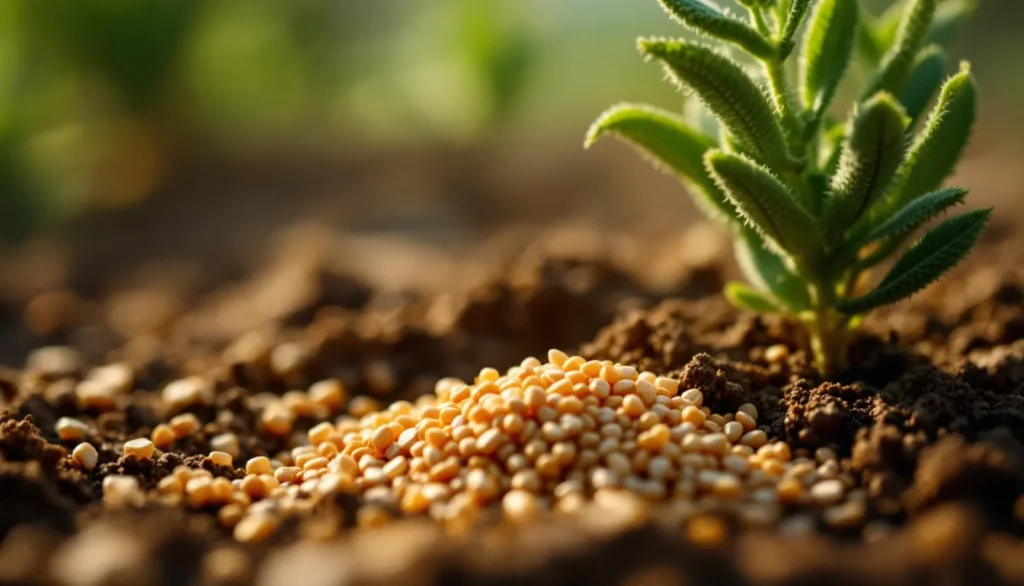
If you are looking for the best garden fertilizer for plants under drought stress, the rule is counterintuitive: feed less, feed slower, and avoid anything with a high salt index. The reflex during a stressed summer is to push fertilizer to “help” the plants recover, but high-salt synthetic fertilizers (especially anything with muriate of potash, KCl) actively pull moisture from already-stressed roots through osmotic pressure. The right pick is low-salt, slow-release nitrogen plus sulfate of potash (K2SO4), applied at half the normal rate. Below are the specific products, the ratios that work, and the worked-example math on application rates.
The short version
- Avoid muriate of potash (KCl, salt index 116) in drought. Switch to sulfate of potash (K2SO4, salt index 43). Same potassium, less than half the osmotic stress.
- Slow-release nitrogen sources (sulfur-coated urea, polymer-coated urea, methylene urea) deliver 30 to 70 percent of N over 8 to 16 weeks, preventing burn on stressed plants.
- Best drought-stress picks: Milorganite 6-4-0 (organic, salt index ~3), Yard Mastery 18-0-1 (50 percent slow-release), Andersons Humic DG (humic plus 7-1-2).
- Skip Scotts Turf Builder during drought stress. NPK 32-0-4 with quick-release urea burns water-stressed turf.
- Cut application rate to 0.5 lb N per 1,000 sq ft (half the standard 1 lb) when plants show drought stress (leaf rolling, dull color, slow recovery from foot traffic).
- For vegetable beds, fish emulsion (5-2-2) at half rate plus liquid kelp (1-0-2) is the lowest-risk drought feeding combo. Foliar application bypasses root osmotic stress entirely.
Why salt index matters more than NPK in drought
Salt index is a measurement of how much a fertilizer raises the soil’s salt concentration relative to sodium nitrate (which gets a salt index of 100). When you fertilize a healthy plant under normal moisture, the salt index does not matter much because the plant can outpace the osmotic gradient with vigorous root uptake. When you fertilize a drought-stressed plant, the salt concentration in soil water spikes immediately after application and pulls water OUT of the root cells (reverse osmosis), which is the technical mechanism behind “fertilizer burn.”
The worst offenders in salt index are muriate of potash (potassium chloride, KCl) at 116, ammonium nitrate at 105, and urea at 75. The best are sulfate of potash (potassium sulfate, K2SO4) at 43, ammonium sulfate at 69, and most organic sources (Milorganite, feather meal, fish emulsion) at 2 to 8. When you read a fertilizer label that says “31-0-4” or similar, the third number (potassium) is almost always coming from muriate of potash because it is the cheapest source. That is fine for healthy spring turf, brutal for drought-stressed July turf. Our NPK fertilizer guide walks through the underlying chemistry and how to read product labels for source ingredients.
Drought-stress fertilizer comparison
| Product | NPK | Salt index (approx) | Slow-release % | 2026 price (40 lb bag) |
|---|---|---|---|---|
| Milorganite | 6-4-0 | 3 | ~85% (organic N) | $18 to $26 |
| Yard Mastery 18-0-1 Bio-Stim Pack | 18-0-1 | ~25 | 50% (Meth-Ex 40) | $45 to $55 |
| Andersons Humic DG | 7-1-2 | ~20 | ~60% (composted N + humic) | $50 to $65 |
| Lesco 24-0-11 Polyon (sulfate K) | 24-0-11 | ~35 | 65% (polymer-coated) | $55 to $70 |
| Sunday Lawn Care liquid pouches | varies (12-0-3 typical) | ~15 (foliar) | 40% (urea + iron) | $35 to $50 per pouch |
| Scotts Turf Builder (avoid in drought) | 32-0-4 | ~85 (KCl based) | 20% | $22 to $35 |
The table is ranked roughly by drought-stress safety from top to bottom. Milorganite is the gold standard because it is composted heat-dried microbes (an organic by-product of Milwaukee’s wastewater treatment) with essentially zero salt risk, but the low NPK means you need 2 to 3 applications to match the nitrogen output of a synthetic product. Yard Mastery’s Bio-Stim pack and Andersons Humic DG both hit a sweet spot of moderate nitrogen with humic acid additives that improve drought tolerance through root development. Lesco 24-0-11 Polyon is the contractor pick when you need real nitrogen output but want the salt index controlled, and yes it uses sulfate of potash, not muriate. See our what causes drought guide for more.
The application rate math
The standard turf fertilizer application rate is 1 lb of actual nitrogen per 1,000 sq ft per application, 3 to 5 times per growing season. The formula to calculate how much product you need: 100 divided by the first NPK number equals pounds of product per 1,000 sq ft for 1 lb of N. So Milorganite 6-4-0 needs 100 divided by 6 equals 16.7 lbs per 1,000 sq ft. Scotts Turf Builder 32-0-4 needs 100 divided by 32 equals 3.1 lbs per 1,000 sq ft. See our organic fertilizer for vegetable garden guide for more.
For drought-stressed plants, cut that to 0.5 lb N per 1,000 sq ft (half the standard rate). So Milorganite drops to 8.3 lbs per 1,000 sq ft, Yard Mastery 18-0-1 drops to 2.8 lbs per 1,000 sq ft. Worked example: a 5,000 sq ft lawn at half rate with Milorganite needs 8.3 times 5 equals 41.6 lbs of product, which is roughly one 40-lb bag at $20, so the application cost is $0.004 per sq ft. To calculate your lawn area accurately, see our measuring guide.
Slow-release versus quick-release in drought
Quick-release nitrogen (uncoated urea, ammonium sulfate, urea ammonium nitrate solution) dumps the full nitrogen load into the soil solution within 7 to 14 days. In a normal moisture environment, plants absorb it. In a drought environment, much of it leaches deeper than roots can reach, volatilizes off, or sits in the root zone increasing salt concentration. Slow-release nitrogen (sulfur-coated urea SCU, polymer-coated urea PCU, methylene urea MU, IBDU, urea formaldehyde) releases nitrogen over 8 to 16 weeks as moisture and temperature permit, which is mechanically a better match for stressed plant uptake.
The percentage you want during drought is 50 percent slow-release minimum, 70 percent ideal. Read the bag. Reputable manufacturers (Lesco, Andersons, Yard Mastery) print the slow-release breakdown. If the bag does not specify, assume it is quick-release. Most homeowner-aisle big-box products (Scotts Turf Builder, Pennington Ultragreen) sit at 15 to 25 percent slow-release and are fine for spring but not for drought-stress feedings.
The case for organic during drought
Composted organic nitrogen sources (Milorganite, Sustane, Espoma) are functionally slow-release by definition because the nitrogen is bound in microbial protein and only becomes available as soil microbes break it down. The release rate is temperature-dependent (faster in warm soil, slower in cold) and moisture-dependent (faster in moist soil, slower in dry), which sounds like a drought problem but actually works out fine because the plants are not absorbing much nitrogen in dry conditions anyway. The release self-throttles. Add the near-zero salt index and organic sources are the lowest-risk drought feeding by a wide margin.
The trade-off is nitrogen percentage. Milorganite is 6 percent N. Synthetic ammonium sulfate is 21 percent. You apply 3 to 4 times more product by weight to deliver the same nitrogen, which is fine economically (Milorganite costs $20 to $26 per 40-lb bag versus $50 to $70 for premium synthetic blends) but a real labor difference for large properties. For a 20,000 sq ft lawn, Milorganite at standard rate means hauling and spreading 333 lbs of product, which is 8 bags. The contractor calculus usually favors a hybrid: organic in summer (drought protection), synthetic slow-release in fall and spring (output).
Humic acid and biostimulants
Humic acid is a fraction of soil organic matter that improves cation exchange capacity (CEC), increases nutrient retention, and (per multiple university trials, including Kansas State and Penn State) increases drought tolerance roughly 10 to 20 percent through enhanced root development. Most contractor-grade products bundle humic with fertilizer (Yard Mastery’s Humic 12 has 12 percent humic, Andersons Humic DG is 70 percent humic). Liquid humic concentrates (Big Foot, Humic12L) cost $30 to $60 per gallon and treat 10,000 to 15,000 sq ft.
The biostimulant category (seaweed extract, kelp meal, fulvic acid, microbial inoculants) is harder to evaluate because the trial data is mixed and the marketing is intense. The fairest read: kelp and seaweed extracts (Sunday Lawn Care uses kelp in several pouches; standalone products like North Atlantic Kelp Meal at $25 for 5 lbs) have moderate evidence for drought stress mitigation through cytokinin content. Microbial inoculants are mostly snake oil for established lawns and useful only on disturbed or newly seeded soil.
Shrubs, perennials, and trees under drought stress
For ornamental beds and trees during drought, the rule shifts further toward “less is more.” Established trees and shrubs are not nitrogen-limited under drought stress, they are water-limited. Adding nitrogen forces new vegetative growth that the root system cannot support, which makes drought stress worse. The right move for trees during drought: skip nitrogen entirely for one growing season, apply a deep-root watering once every 14 days with a soil needle injector (Easy Translator, Ross Root Feeder) and add liquid humic at the manufacturer’s reduced rate.
For perennial beds, foliar application of liquid fish emulsion (Neptune’s Harvest 5-2-2) at half the manufacturer’s rate, applied early morning, is the lowest-risk supplemental feeding during drought stress. The foliar route delivers nutrients through leaf cuticles and bypasses the root-zone osmotic gradient that causes burn. Skip granular feedings on stressed beds until water returns to normal. For more on drought-resilient plant selection for these beds, see our drought-tolerant alternatives guide.
Timing the application around watering windows
Drought-stage watering restrictions complicate fertilizer timing because granular products need 0.25 to 0.5 inches of irrigation within 24 hours of application to activate the nitrogen release. If your utility allows watering on Tuesdays and Saturdays only, apply your granular fertilizer the morning of an allowed watering day so the activation cycle lands cleanly within the window. Applying on a Sunday with no allowed watering until Tuesday means 48 hours of product sitting on warm soil, which is where volatilization losses (ammonia gassing off) and burn risk both climb.
Liquid foliar feedings (fish emulsion, kelp, liquid humic) escape this constraint because the nutrients are delivered directly to the leaf. Apply early morning before 8 a.m. on any day, regardless of irrigation schedule. The cuticle uptake happens within 4 to 8 hours, and the application water (typically 1 gallon per 1,000 sq ft mixed at the manufacturer rate) is small enough that most utilities allow hand-watering or backpack-sprayer application even during Stage 2 or Stage 3 restrictions. Verify your local rules first because some emergency-stage restrictions ban all outdoor water use.
Soil temperature and microbial activity
Organic fertilizers depend on soil microbial activity to break down the source proteins into plant-available nitrogen. That microbial activity slows below 50 degrees soil temperature and effectively stops below 40 degrees. In drought conditions, soil temperatures often climb above the optimal range (95 to 105 degrees in unmulched soil in Phoenix or Las Vegas summer), which also reduces microbial efficiency. The takeaway: in extreme summer heat, even organic slow-release products release nitrogen unpredictably. Mulched soils stay 15 to 25 degrees cooler and maintain microbial activity longer, which is one more reason 3 inches of shredded hardwood mulch is the cheapest drought intervention you can deploy.
What to skip during drought
Skip Scotts Turf Builder, Pennington Ultragreen Lawn Fertilizer, and any product whose NPK third number (K) comes from muriate of potash and whose nitrogen is mostly uncoated urea. Skip “weed and feed” combination products entirely (the herbicide adds chemical stress on top of drought stress and the timing is wrong because most pre-emergent herbicides need 0.5 inches of irrigation to activate, which is water you do not have). Skip starter fertilizers (high phosphorus, typically 18-24-12) unless you are actually seeding, because excess phosphorus has zero benefit to established plants and is increasingly regulated in runoff-sensitive watersheds.
Skip “iron tonic” products as drought interventions. Iron deficiency yellowing and drought yellowing look similar but are different problems. Adding iron to a drought-stressed lawn turns it darker green for two weeks but does nothing for the underlying water stress. Diagnose first. See our guide on brown patches in lawn to distinguish drought yellowing from disease, fungal damage, and nutrient deficiency.
FAQ
Should I fertilize at all during a drought?
Reduced rate, slow-release, low-salt sources only. The reflex to skip fertilizer entirely is wrong because mild nutrient input through organic or slow-release products supports root maintenance. The wrong move is full-rate synthetic, especially anything with KCl.
Can I apply fertilizer the day before a watering restriction takes effect?
Bad idea. Granular fertilizer needs 0.25 to 0.5 inches of irrigation to activate. Applying just before a restriction means the product sits on the soil surface, increasing burn risk and volatilization loss. Wait for the restriction window to end, apply, then water within 24 hours.
Is liquid fertilizer better than granular during drought?
For foliar applications on stressed plants, yes (fish emulsion, kelp, liquid humic). For root-zone fertilization, liquid offers no real drought advantage over slow-release granular, because both need moisture to move into the root zone. The main argument for liquid is application precision on small areas (vegetable beds, container plants).
How long until I see results from a drought-safe fertilizer?
Slow-release products show color response in 14 to 21 days versus 5 to 7 days for quick-release. Organic sources can take 30 to 45 days, especially in cool soil. Patience is part of the plan.
Does compost count as fertilizer?
Loosely yes, technically no. Compost is typically 1 to 2 percent N, 0.5 to 1 percent P, 1 to 2 percent K, which is well below the threshold for fertilizer labeling. It functions as a slow-release fertilizer plus a soil amendment plus a moisture-retention agent. During drought it is the lowest-risk soil input you can apply, but you would need 200 to 300 lbs per 1,000 sq ft to match a single fertilizer application, so it is more of a long-term soil-building tool than a feeding strategy.
Bottom line
Drought-stressed plants need less fertilizer than healthy plants, and the fertilizer they get needs to be low-salt, slow-release, and ideally organic. Milorganite, Yard Mastery 18-0-1 Bio-Stim, Andersons Humic DG, and Lesco 24-0-11 Polyon (with sulfate of potash) are the four products contractors actually reach for in drought conditions. Skip the high-salt big-box options. Cut the application rate in half. Apply early morning, water in immediately, and resist the urge to push extra nitrogen because the lawn looks tired.
The deeper issue is that no fertilizer will save a lawn from inadequate water. Fertilizer is a multiplier, not a substitute. Get the irrigation and the soil moisture right first, see our drought prep playbook for sequencing, and the fertilizer choice becomes the last 5 percent of the work, not the first move. For the marketing-distortion side of how the fertilizer industry labels these products, see our explainer on lawn food versus fertilizer.