
By the HMNDP Editorial Team, independent reporting on lawn care, landscaping, and the green industry.
Last reviewed: June 2026
What is mulching?
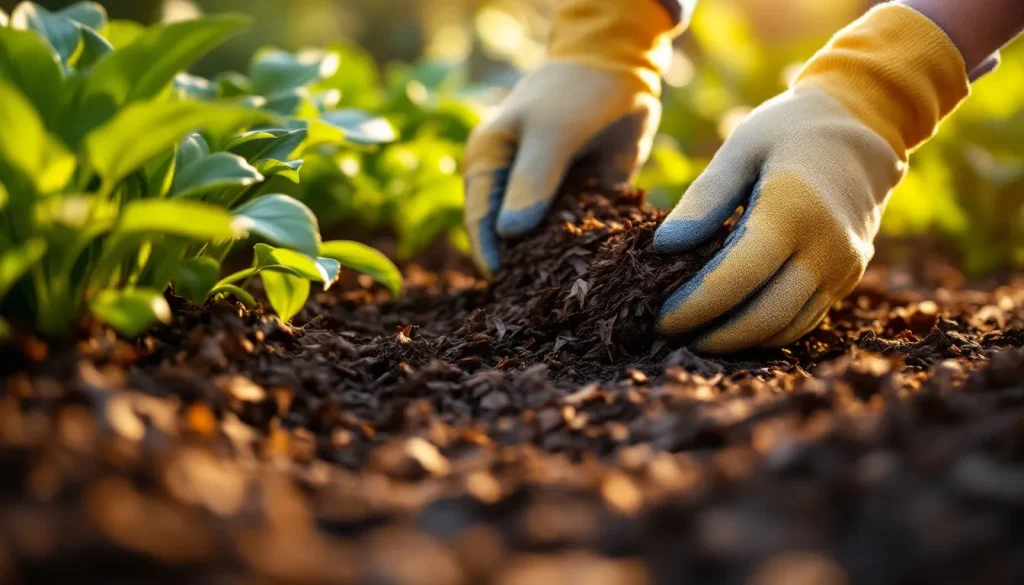
Mulching is the practice of spreading a layer of material over the soil surface around plants, usually 2 to 4 inches deep, to hold in moisture, block weeds, steady soil temperature, and slowly feed the soil. The material itself is called mulch. The act of applying it is mulching. Done right, one layer can cut watering by roughly 25 to 50 percent and suppress most annual weeds.
Mulch can be organic (bark, wood chips, straw, leaves, compost) or inorganic (gravel, landscape fabric, plastic, rubber). Organic mulch breaks down and improves soil. Inorganic mulch does not decompose and is chosen for permanence or looks.
This guide covers garden-bed mulching, then separates it from two things people also call mulching: running a mulching mower on a lawn, and mulching in agriculture. It ends with exact quantities, costs, and the mistakes that waste money.
Mulch vs mulching: the material versus the act
Mulch is the material. Mulching is the act of applying it. A bag labeled “shredded hardwood mulch” holds the material; spreading that material 3 inches deep around your hostas is mulching. The distinction matters because product listings, prices, and coverage math all refer to mulch (the stuff), while how-to instructions refer to mulching (the technique).
A quick vocabulary check keeps the rest simple:
- Mulch: the noun. Any material laid on soil, sold by the bag or cubic yard.
- Mulching: the verb or practice. Applying, refreshing, or maintaining that layer.
- Mulched: the finished state of a bed that already has its layer.
Three different meanings of “mulching” (disambiguated)
“Mulching” refers to three distinct activities that share a name but work differently. Garden-bed mulching lays material on soil around plants. Mulching a lawn means a mulching mower chops grass clippings and drops them back into the turf. Agricultural mulching covers crop rows with plastic film or straw at field scale. Confusing them leads to the wrong tool and the wrong expectations.
| Meaning | What it is | Typical material | Main goal |
|---|---|---|---|
| Garden-bed mulching | Layer spread on soil around plants and trees | Bark, wood chips, straw, gravel | Moisture, weeds, looks |
| Lawn mulching | Mulching mower recuts clippings and returns them to turf | Grass clippings only | Free nitrogen, no bagging |
| Agricultural mulching | Field-scale film or straw over crop rows | Plastic mulch film, straw | Warming soil, weed control at scale |
The rest of this guide focuses on garden-bed mulching, with a dedicated section on lawn mulching further down.
Organic vs inorganic mulch types
Mulch splits into two families. Organic mulch comes from once-living material (wood, bark, straw, leaves, compost) and decomposes over months to years, feeding soil as it breaks down. Inorganic mulch is synthetic or mineral (gravel, stone, landscape fabric, plastic, rubber) and does not decompose, so it lasts longer but adds no nutrients. Your goal decides which family fits.
| Type | Family | Lasts | Feeds soil? | Best for |
|---|---|---|---|---|
| Shredded hardwood bark | Organic | 1 to 2 years | Yes | Ornamental beds, borders |
| Wood chips / arborist chips | Organic | 2 to 4 years | Yes | Trees, shrubs, paths |
| Straw | Organic | 1 season | Yes | Vegetable beds |
| Shredded leaves (leaf mold) | Organic | 1 season | Yes | Any bed, free |
| Compost | Organic | Months | Yes, heavily | Vegetable and nutrient-poor beds |
| Gravel / crushed stone | Inorganic | Indefinite | No | Xeriscape, paths, slopes |
| Landscape fabric | Inorganic | 5 to 10 years | No | Under gravel or paths |
| Plastic sheeting | Inorganic | 1 to 3 years | No | Warming veg soil early |
| Rubber mulch | Inorganic | 10+ years | No | Playgrounds (with cautions) |
Organic mulch examples
Organic mulches are made from once-living material and break down to enrich soil. Common choices are shredded bark, wood chips, straw, shredded leaves, grass clippings, and compost. They cost less on average, improve soil structure as they rot, and need topping up every 1 to 2 seasons. Straw and leaves are often free or nearly free.
Inorganic mulch examples
Inorganic mulches are mineral or synthetic and do not decompose. Common choices are gravel, crushed stone, landscape fabric, plastic sheeting, and rubber. They last far longer and rarely need replacing, but they add no nutrients and can trap heat. Gravel suits dry-climate and low-water designs; landscape fabric works best buried under stone, not exposed.
Why mulch: the five benefits that matter
Mulching pays off in five measurable ways: it holds soil moisture, blocks weeds, steadies soil temperature, feeds soil as organic material decays, and controls erosion. A single 2 to 4 inch layer delivers most of these at once, which is why mulching is the highest-return, lowest-skill task in most gardens.
Moisture retention
Mulch reduces evaporation from the soil surface. A 3-inch organic layer can cut surface water loss by roughly 25 to 50 percent, meaning fewer waterings in summer and more even soil moisture between rains. This matters most in beds exposed to full sun and wind. During dry spells, mulched beds stay usable longer, which pairs well with broader steps to prepare your yard for a drought.
Weed suppression
Mulch blocks light from reaching weed seeds, so most annual weeds never germinate. A 3-inch layer stops the majority of common annual weeds; the few that push through pull easily because the soil below stays loose and damp. Thicker is not always better, since piling mulch past 4 inches can suffocate the plants you want.
Temperature regulation
Mulch insulates soil like a blanket. In summer it keeps roots cooler by shading the surface; in winter it slows freeze-thaw cycles that heave shallow roots out of the ground. This steadier root-zone temperature reduces plant stress and helps perennials survive cold snaps and heat waves.
Soil improvement
Organic mulch feeds the soil as it decomposes. Bark, leaves, and compost break down into humus, adding nitrogen, carbon, and other nutrients while improving structure and drainage. Earthworms and microbes pull that organic matter down, loosening compacted soil over time. Inorganic mulch does not provide this benefit.
Erosion and compaction control
Mulch shields soil from the direct impact of rain and irrigation, which prevents crusting, runoff, and washout on slopes. The layer also cushions the surface against foot traffic and heavy rain, reducing compaction. On grades, coarse wood chips or gravel stay in place better than fine mulch, which floats away.
How to mulch a garden bed: step by step
Mulching a bed takes four steps: clear and prep the soil, edge the bed, spread mulch 2 to 4 inches deep, then pull it back from stems and trunks. The whole job on a small bed takes under an hour. The order matters, since mulching over weeds or dry soil undercuts the benefits.
- Weed and water first. Pull existing weeds and water the bed if the soil is dry, so you trap moisture in rather than sealing dryness under the layer.
- Edge the bed. Cut a clean 2 to 3 inch deep edge so mulch stays contained and does not spill onto lawn or paths.
- Spread evenly to 2 to 4 inches. Rake mulch into a level layer. Use the shallower end (2 inches) for fine mulch and the deeper end (up to 4 inches) for coarse chips.
- Pull back from plants. Leave a 1 to 3 inch gap around plant stems and a wider ring around tree trunks so bark can breathe and stay dry.
How deep should mulch be?
Apply mulch 2 to 4 inches deep for most beds. Fine materials (compost, shredded leaves, grass) work at 2 inches because they pack tightly; coarse materials (bark nuggets, wood chips) go up to 3 to 4 inches because they stay loose. Under 2 inches, weeds break through. Over 4 inches, roots can suffocate and water struggles to reach soil.
Keep mulch off stems and trunks
Never pile mulch against plant stems or tree trunks. Mounding mulch into a cone around a trunk, called volcano mulching, traps moisture against the bark, invites rot, insects, and rodents, and can kill an established tree over several years. Instead, leave a mulch-free ring of a few inches around each trunk so the root flare stays visible and dry.
When to mulch: seasonal timing
The two best times to mulch are mid-to-late spring and fall. Spring mulching, applied after the soil warms, locks in moisture before summer heat and blocks weeds during their peak growing window. Fall mulching insulates roots against winter freeze-thaw and slowly breaks down over the cold months. A light refresh once a year keeps the layer effective.
| Season | Timing | Why |
|---|---|---|
| Spring | After soil warms, once perennials emerge | Locks in moisture, blocks summer weeds |
| Fall | After first hard frost | Insulates roots against freeze-thaw |
| Summer | Only to top up thin spots | Maintains coverage during heat |
| Winter | Avoid fresh application on frozen soil | Layer will not settle or bond |
Mulching too early in spring, before the soil warms, can trap cold and slow plant growth. Wait until the ground is workable and warming.
How much mulch do you need? Quantities and cost
To mulch at 3 inches deep, one cubic yard of mulch covers about 108 square feet, and one 2-cubic-foot bag covers about 8 square feet. For a bed, multiply length by width to get square footage, then divide by the coverage figure for your chosen depth. Buying by the yard is cheaper than bags once you pass roughly 12 to 15 bags.
| Depth | Coverage per cubic yard | Coverage per 2 cu ft bag |
|---|---|---|
| 2 inches | ~162 sq ft | ~12 sq ft |
| 3 inches | ~108 sq ft | ~8 sq ft |
| 4 inches | ~81 sq ft | ~6 sq ft |
A worked example: a 200 square foot bed at 3 inches needs about 1.85 cubic yards, or roughly 25 bags. Bulk almost always wins at that volume. For the underlying math, see how to convert cubic feet in a yard of mulch and how much a yard of mulch weighs before you order a delivery.
As a 2026 price guide, expect roughly 3 to 7 dollars per 2-cubic-foot bag of standard bark, and roughly 30 to 60 dollars per cubic yard delivered for bulk hardwood mulch, with dyed and premium products costing more. Prices vary by region, supplier, and delivery distance.
Mulching a lawn: mulching mowers explained
A mulching mower is a mower fitted with a special blade and a closed deck that chops grass clippings into fine pieces and blows them back down into the turf instead of collecting them. Those clippings decompose within days and return nitrogen to the lawn, cutting fertilizer needs by up to about 25 percent and eliminating bagging. This is grasscycling, and it is different from bed mulching.
For mulch mowing to work well, follow the one-third rule: never remove more than one-third of the grass blade in a single cut, and mow when the grass is dry. Clippings left after cutting too much can clump and smother turf. Regular grasscycling keeps the lawn denser, which also helps crowd out problems like moss in the lawn.
Decorative value of mulch in landscaping
Beyond function, mulch gives beds a finished, uniform look that ties a landscape together. A fresh dark-brown or black layer makes plants stand out, hides bare soil, and defines bed edges cleanly. Color choice is aesthetic: natural bark fades to gray over a season, while dyed mulch holds color longer. Read the caution on dyed and rubber mulch below before choosing color for looks alone.
Mistakes to avoid when mulching
Most mulching failures come from five avoidable mistakes: volcano mulching against trunks, piling the layer too thick, choosing dyed or rubber mulch without knowing the tradeoffs, letting mulch dry into a water-repellent crust, and mulching over weeds or dry soil. Each one wastes money or harms plants, and each is easy to prevent.
- Volcano mulching: mounding mulch against a trunk traps moisture and rots bark, slowly killing trees. Keep a mulch-free ring around the trunk.
- Too thick: layers past 4 inches suffocate roots and repel water. Stay at 2 to 4 inches and rake down anything thicker.
- Dyed mulch: some dyed mulches are made from recycled wood that may include treated lumber. Look for products certified by the Mulch and Soil Council if you use dyed mulch near edibles.
- Rubber mulch: it does not decompose or feed soil, can leach compounds, and is flammable. Many gardeners limit it to non-planted play areas.
- Water-repellent crust: fine mulch left undisturbed can form a dry crust that sheds water. Rake and fluff the layer once or twice a season, and water through it.
- Mulching over weeds or dry soil: always weed and water first, or you seal problems in rather than out.
Frequently Asked Questions
What is mulching in simple terms?
Mulching means spreading a protective layer of material over the soil around your plants, usually 2 to 4 inches deep. That layer, called mulch, holds in moisture, blocks weeds, keeps soil temperature steady, and, if it is organic, feeds the soil as it breaks down. It is one of the simplest, highest-value tasks in a garden.
What is the difference between mulch and mulching?
Mulch is the material, and mulching is the act of applying it. A bag of shredded bark is mulch; spreading that bark around your plants is mulching. Product prices and coverage math refer to mulch (the noun), while how-to steps refer to mulching (the verb). A bed that already has its layer is described as mulched.
What is the purpose of mulching?
Mulching serves five purposes at once: it retains soil moisture and cuts watering, suppresses weeds by blocking light, regulates soil temperature so roots stay cooler in summer and warmer in winter, improves soil as organic mulch decomposes, and controls erosion and compaction. A single 2 to 4 inch layer delivers all five, which is why it is a core gardening task.
What are the main types of mulch (organic vs inorganic)?
Mulch splits into two families. Organic mulch (bark, wood chips, straw, leaves, grass clippings, compost) comes from living material, decomposes, and feeds soil, but needs topping up every 1 to 2 seasons. Inorganic mulch (gravel, stone, landscape fabric, plastic, rubber) is mineral or synthetic, lasts far longer, and needs little upkeep, but adds no nutrients to the soil.
How deep should mulch be and how do I apply it?
Apply mulch 2 to 4 inches deep: about 2 inches for fine materials and 3 to 4 inches for coarse chips. First weed and water the bed, edge it, then rake mulch into an even layer. Finally, pull mulch back a few inches from plant stems and tree trunks so bark stays dry and roots can breathe.
When is the best time of year to mulch?
The two best times are mid-to-late spring, after the soil warms, and fall, after the first hard frost. Spring mulching locks in moisture and blocks summer weeds; fall mulching insulates roots against winter freeze-thaw. Avoid mulching too early in spring, which traps cold, and avoid applying fresh mulch onto frozen winter soil, where it will not settle.
What is a mulching mower and how does mulching a lawn work?
A mulching mower uses a special blade and closed deck to chop grass clippings into fine pieces and blow them back into the turf instead of bagging them. The clippings decompose within days and return nitrogen, cutting fertilizer needs by up to about 25 percent. Follow the one-third rule and mow dry grass so clippings do not clump.
Are there downsides or mistakes to avoid when mulching?
Yes. The biggest mistakes are volcano mulching (piling mulch against trunks, which rots bark), applying it thicker than 4 inches (which suffocates roots), using dyed or rubber mulch without knowing the tradeoffs, letting fine mulch form a water-repellent crust, and mulching over weeds or dry soil. Weed and water first, stay at 2 to 4 inches, and keep mulch off stems.