
By the HMNDP Editorial Team, independent reporting on lawn care, landscaping, and soil science.
Last reviewed: June 2026
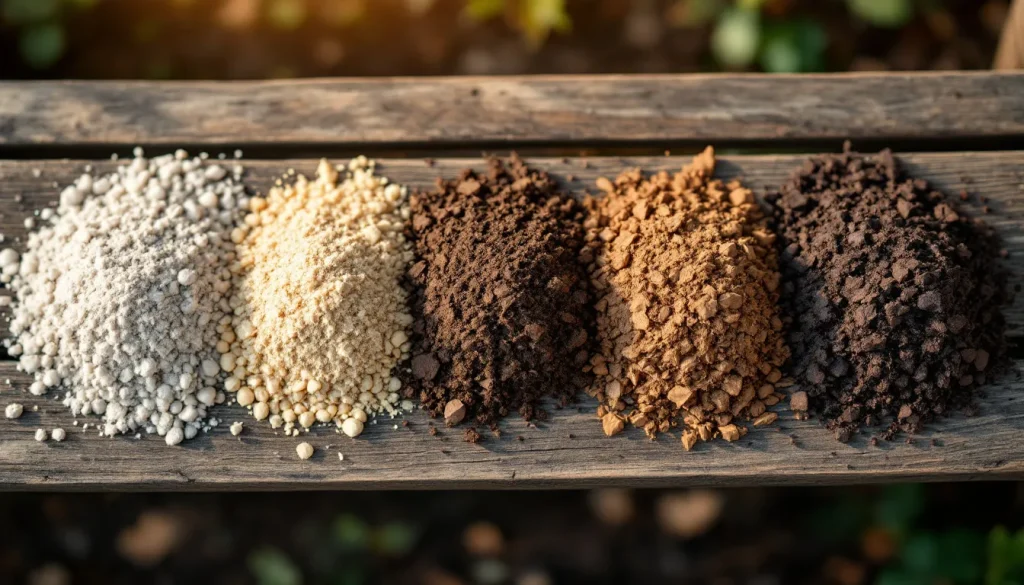
The 6 main types of soil
The six main types of soil are clay, sandy, silty, peaty, chalky, and loamy. This framework, most cited by the Royal Horticultural Society (RHS), groups soils by their dominant mineral particles and organic content. Each type drains, holds water, and feeds plants differently. Loam, a balanced blend of sand, silt, and clay, is widely considered the best for gardening.
Knowing which of these types of soil sits in your garden tells you what will grow well, how often to water, and what to add. The differences are physical: particle size and organic matter decide how water and nutrients move.
| Soil type | Texture (feel) | Drainage | Water retention | Typical pH | Best-suited plants |
|---|---|---|---|---|---|
| Clay | Sticky when wet, hard when dry | Poor | High | 6.0 to 7.5 | Roses, asters, fruit trees, brassicas |
| Sandy | Gritty, loose | Fast | Low | 5.5 to 7.0 | Carrots, potatoes, lavender, tulips |
| Silty | Smooth, floury, soapy | Moderate | High | 6.0 to 7.0 | Most vegetables, grasses, willows |
| Peaty | Spongy, dark, damp | Variable, often waterlogged | Very high | 3.5 to 5.5 | Blueberries, azaleas, rhododendrons |
| Chalky | Stony, crumbly, pale | Free-draining | Low | 7.1 to 8.5 | Lilac, clematis, spinach, beets |
| Loamy | Soft, slightly gritty, crumbly | Good | Good | 6.0 to 7.0 | Almost everything |
How soil is classified: sand, silt, and clay particle sizes
Soil is classified mainly by texture, which means the proportion of three mineral particle sizes: sand, silt, and clay. Sand is the largest particle (0.05 to 2.0 mm), silt is medium (0.002 to 0.05 mm), and clay is the smallest (under 0.002 mm). These three particles in different ratios produce every named soil type, including loam.
The United States Department of Agriculture (USDA) uses these size cutoffs in its soil texture system. Particle size controls everything downstream: large sand grains leave wide gaps that drain fast, while tiny clay particles pack tightly, trapping water and nutrients.
This texture-first method is the bridge between garden advice and soil science. Gardeners describe soil by how it feels and behaves; scientists measure the exact percentages. Our guide to reading the soil texture triangle shows how those percentages map onto each named class.
- Sand: 0.05 to 2.0 mm. Feels gritty. Drains quickly, holds little.
- Silt: 0.002 to 0.05 mm. Feels smooth and floury. Holds moisture and nutrients well.
- Clay: below 0.002 mm. Feels sticky. Holds the most water and nutrients but drains slowly.
Clay soil: heavy, nutrient-rich, slow to drain
Clay soil is made of the smallest mineral particles, which pack together with almost no air space. It feels sticky and moldable when wet and sets hard like brick when dry. Clay drains poorly and warms slowly in spring, but it holds water and nutrients better than any other mineral soil, making it naturally fertile once managed.
Clay soils typically sit at pH 6.0 to 7.5. They suit hungry, moisture-loving plants such as roses, asters, summer-flowering shrubs, and many fruit trees. The main problem is workability: dig clay when it is too wet and it compacts into airless clods.
To improve clay, add 2 to 4 inches of organic matter (compost or well-rotted manure) across the surface each year and fork it in. On heavy clay, horticultural gypsum can help flocculate particles into larger crumbs, improving drainage without changing pH.
Sandy soil: gritty, fast-draining, warms quickly
Sandy soil is dominated by large mineral particles with wide gaps between them. It feels gritty, runs through your fingers, and drains water almost as fast as you apply it. Sandy soil warms quickly in spring, which suits early crops, but it loses nutrients rapidly because water carries them straight through the root zone.
Sandy soils usually fall between pH 5.5 and 7.0. They favor root crops like carrots and potatoes, plus drought-tolerant plants such as lavender, sedum, and tulips. The recurring challenge is feeding and watering, since both leach away fast.
To build up sandy soil, add bulky organic matter (compost, leaf mold, manure) to act as a sponge that holds water and nutrients. Mulching the surface reduces evaporation, and slow-release or split fertilizer applications cut nutrient loss.
Silty soil: smooth, fertile, prone to compaction
Silty soil is built from medium-sized particles that feel smooth, floury, or soapy when rubbed. It holds moisture and nutrients well and ranks among the most fertile soils, which is why river valleys and floodplains are prized farmland. Its weakness is structure: silt compacts easily and can form a surface crust that blocks water and air.
Silty soils generally sit at pH 6.0 to 7.0 and support most vegetables, ornamental grasses, and moisture-loving trees like willows and birches. Because the particles are so fine, walking on wet silt squeezes the air out fast.
To improve silt, add organic matter to bind particles into stable crumbs, and avoid working or treading on it when wet. Permanent beds and stepping paths keep foot traffic off the growing zone.
Loamy soil: the balanced ideal for gardening
Loamy soil is a balanced mix of sand, silt, and clay in roughly equal parts, with a healthy dose of organic matter. The National Oceanic and Atmospheric Administration (NOAA) and NGScience both describe loam as this combination. It drains well yet retains enough moisture and nutrients, making it the soil type most gardeners aim for and the best type of soil for gardening.
Loam combines the strengths of each component: sand provides drainage, silt holds moisture, and clay supplies nutrient-holding capacity. It feels soft and crumbly, holds a loose shape when squeezed, and breaks apart easily. Most loams sit near neutral, pH 6.0 to 7.0, which suits the widest range of plants.
Loam is the target for any soil improvement program. Whether you start with clay or sand, adding organic matter steadily moves the soil toward loamy structure and behavior. Our guide to building healthy garden soil covers how to maintain loam once you have it.
Peaty soil: high organic matter, acidic, moisture-holding
Peaty soil is rich in partially decomposed organic matter, which gives it a dark color and a spongy, damp feel. It holds large amounts of water (sometimes too much) and is naturally acidic, usually pH 3.5 to 5.5. Peaty soils are low in some nutrients despite their organic content, because cold, wet, acidic conditions slow decomposition.
The high acidity suits ericaceous (acid-loving) plants such as blueberries, azaleas, rhododendrons, and camellias. Many vegetables struggle without correction. Drainage can be the limiting factor, since peat often sits waterlogged.
To grow a wider range of plants in peat, improve drainage with raised beds or channels and add lime to raise pH where acid-lovers are not the goal. For acid-loving crops, peaty soil is an asset to keep as-is.
Chalky soil: alkaline, free-draining, often stony
Chalky soil sits over limestone or chalk bedrock, so it is alkaline (typically pH 7.1 to 8.5) and full of calcium carbonate. It is usually pale, stony, and free-draining, which means it dries out fast and can lock up iron and manganese, causing yellowing leaves (lime-induced chlorosis) in sensitive plants.
Chalky soils suit lime-tolerant plants such as lilac, clematis, spinach, beets, and many brassicas. They are poor for acid-lovers like rhododendrons and blueberries, which will struggle to take up iron.
To manage chalk, add organic matter to improve moisture retention, and use chelated iron or acidic feeds to correct yellowing. You cannot easily make chalky soil acidic for long, so it is usually better to choose plants that match the alkaline pH.
How to identify your soil type: two DIY tests with thresholds
You can identify your soil type with two free tests: a hand ribbon test (under a minute) and a jar settling test (about 48 hours). The ribbon test measures texture by feel, and the jar test measures the exact sand, silt, and clay layers. Together they tell you whether you have clay, sand, silt, or loam, with measurable cutoffs rather than guesswork.
The hand ribbon test (1 minute)
The ribbon test reads soil texture from how a moist sample squeezes between your thumb and finger. Take a tablespoon of soil, add water until it is moldable like putty, then press it upward into a ribbon. The length the ribbon reaches before breaking tells you the dominant particle, using these thresholds.
- Will not form a ball or ribbon, feels gritty: sandy soil.
- Forms a weak ribbon under 1 inch (2.5 cm) before breaking: loam.
- Forms a ribbon 1 to 2 inches (2.5 to 5 cm), feels smooth: silty loam or clay loam.
- Forms a strong, sticky ribbon over 2 inches (5 cm): clay soil.
The jar settling test (48 hours)
The jar test separates a soil sample into measurable sand, silt, and clay layers using water and time. Fill a clear straight-sided jar one-third with soil, top up with water and a teaspoon of dish soap, shake hard for two minutes, then let it settle. The particles drop in size order, so timing the layers gives you percentages.
- After 1 minute: mark the sand layer that has settled at the bottom.
- After 2 hours: mark the top of the silt layer above the sand.
- After 48 hours: mark the top of the clay layer, the finest material that settles last.
- Measure each band and divide by total soil depth to get the percentage of sand, silt, and clay.
Plot those three percentages on the soil texture triangle to name the class. Roughly equal thirds, or about 40 percent sand, 40 percent silt, and 20 percent clay, lands you in loam. More than 50 percent sand reads as sandy; more than 40 percent clay reads as clay.
Soil pH and how it relates to soil type
Soil pH measures acidity or alkalinity on a 0 to 14 scale, and it tracks loosely with soil type. Peaty soils are acidic (pH 3.5 to 5.5), chalky soils are alkaline (pH 7.1 to 8.5), and clay, sandy, silty, and loamy soils usually sit near neutral (pH 6.0 to 7.5). pH controls which nutrients plants can absorb, so it matters as much as texture.
Most garden plants prefer pH 6.0 to 7.0, where nitrogen, phosphorus, and potassium stay available. Below 5.5, aluminum and manganese can reach toxic levels; above 7.5, iron and manganese lock up. A simple test kit or meter gives you a reading in minutes, as our step-by-step guide to testing soil pH explains.
To raise pH (make soil less acidic), add garden lime. To lower pH (make soil more acidic), add elemental sulfur or acidic organic matter like pine needles. Changes are gradual, so retest after a few months before adding more.
How to improve any soil and move it toward loam
Almost any soil can be improved by moving it toward loam, and the single most effective step is adding organic matter every year. Compost, well-rotted manure, and leaf mold improve drainage in clay, boost water and nutrient holding in sand, and stabilize structure in silt. The fixes below target each starting soil.
| Starting soil | Main problem | Primary fix | Optional amendment |
|---|---|---|---|
| Clay | Poor drainage, compaction | 2 to 4 inches organic matter yearly | Horticultural gypsum to flocculate |
| Sandy | Leaches water and nutrients | Bulky organic matter and mulch | Slow-release or split feeding |
| Silty | Surface crusting, compaction | Organic matter, avoid treading wet | Permanent beds, cover crops |
| Peaty | Waterlogging, high acidity | Improve drainage, lime if needed | Raised beds for non-acid plants |
| Chalky | Dries fast, alkaline lockout | Organic matter to hold moisture | Chelated iron, acidic feeds |
The principle is the same everywhere: organic matter pushes structure toward the crumbly, balanced behavior of loam. You will not change the underlying mineral particles, but you can dramatically change how the soil drains, holds water, and feeds plants. Start small, test, and build over several seasons. For deeper background on soil and growing, browse the HMNDP learning hub.
Scientific classification: soil orders and taxonomy
Beyond the six garden types, soil scientists use formal taxonomies. The USDA Soil Taxonomy sorts the world’s soils into 12 orders (such as Mollisols, Alfisols, and Histosols) based on formation, climate, and profile layers. These orders describe how soil developed over time, while the garden types describe texture and behavior in a single bed.
The two systems are not in conflict; they answer different questions. Taxonomy explains why a regional soil exists (parent rock, rainfall, age), while the clay-sand-silt-loam framework tells a gardener what to do this weekend. Peaty soil, for example, broadly matches the Histosol order, which is defined by deep organic horizons.
Frequently Asked Questions
What are the 6 main types of soil?
The six main types of soil are clay, sandy, silty, peaty, chalky, and loamy. This framework, most cited by the Royal Horticultural Society, groups soils by their dominant mineral particles (sand, silt, or clay) and organic content. Each type drains, retains water, and holds nutrients differently. Loam, a balanced mix of all three particles, is widely considered the best soil for gardening.
What is the difference between clay, silt, sand, and loam?
Clay, silt, and sand are the three mineral particle sizes: clay is smallest (under 0.002 mm), silt is medium, and sand is largest (up to 2.0 mm). Sand drains fast and holds little; clay drains slowly but holds the most nutrients; silt sits in between and is fertile. Loam is a balanced blend of all three, combining good drainage with strong water and nutrient retention.
How do I identify what type of soil I have?
Use two free tests. The hand ribbon test: moisten a sample and squeeze it upward; a ribbon over 2 inches means clay, under 1 inch means loam, and gritty crumbling means sand. The jar settling test: shake soil with water in a jar, then measure the sand layer at 1 minute, silt at 2 hours, and clay at 48 hours to get exact percentages.
What is the best type of soil for gardening?
Loam is the best type of soil for gardening. It is a balanced mix of sand, silt, and clay in roughly equal parts, plus organic matter. Loam drains well yet holds enough moisture and nutrients to feed most plants, and it sits near neutral pH (6.0 to 7.0). Its crumbly structure is easy to dig and supports the widest range of crops and ornamentals.
What is loam soil and why is it considered the best?
Loam soil is a balanced blend of sand, silt, and clay in roughly equal parts, enriched with organic matter. NOAA and NGScience both define it this way. It is considered the best because it combines each component’s strength: sand for drainage, silt for moisture, and clay for nutrients. The result drains freely yet stays fertile and moist, suiting almost every plant a gardener grows.
How can I improve clay or sandy soil?
For both, add organic matter (compost, manure, leaf mold) every year, which moves the soil toward loam. On clay, spread 2 to 4 inches of organic matter and consider horticultural gypsum to improve drainage. On sand, work in bulky organic matter to hold water and nutrients, mulch the surface to cut evaporation, and feed in small, frequent doses to limit leaching.
What soil type is most fertile?
Silty and loamy soils are the most fertile. Silt holds moisture and nutrients well, which is why river valleys make prized farmland, though it compacts easily. Loam combines silt’s fertility with better structure and drainage, so it supports the widest range of plants. Clay is also nutrient-rich but its poor drainage and workability limit how easily plants use that fertility.
Is my soil acidic or alkaline, and how does that relate to soil type?
Test it with a kit or meter on the 0 to 14 pH scale. Soil type hints at the result: peaty soils are acidic (pH 3.5 to 5.5), chalky soils are alkaline (pH 7.1 to 8.5), and clay, sandy, silty, and loamy soils usually sit near neutral (6.0 to 7.5). pH controls nutrient availability, so most plants do best between 6.0 and 7.0.