
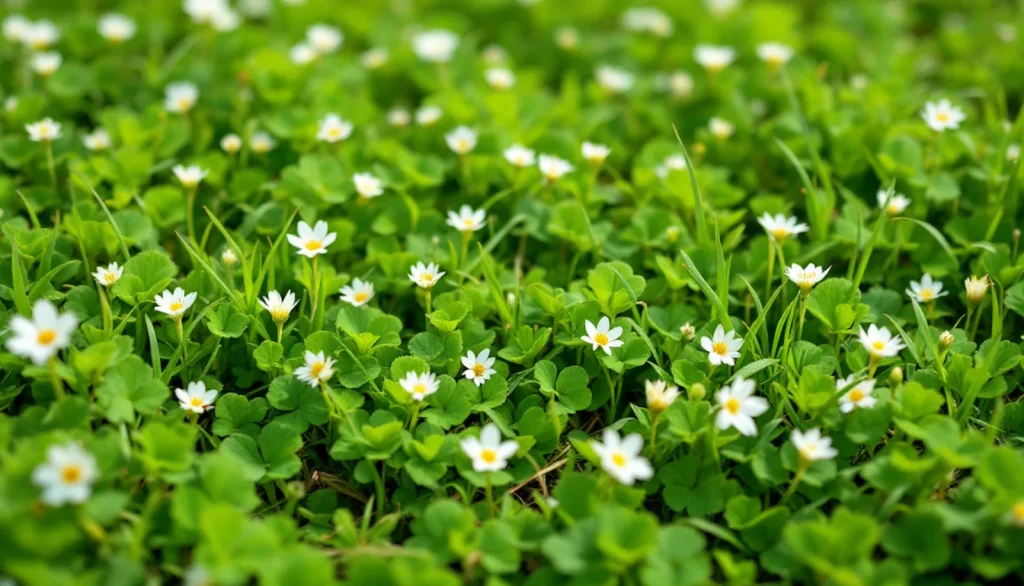
Clover Lawn: Pros, Cons, Microclover, and Keep or Kill
A clover lawn replaces some or all of your turfgrass with low-growing clover that pulls its own nitrogen from the air, stays green in drought, and needs roughly two to four mows a year instead of weekly cutting. The two species homeowners actually use are Dutch white clover (Trifolium repens) and microclover, a dwarf selection of the same species. This guide gives you the keep-or-kill decision, the seeding rates, the cost, and a side-by-side spec table so you can pick before you buy a single bag of seed.
Is a clover lawn a good idea?
A clover lawn is a good idea if you want lower water and fertilizer bills, can tolerate a less uniform look, and do not have heavy foot traffic, a bee-sting allergy in the household, or an HOA that lists clover as a weed. It is a poor fit for kids’ play zones, dog runs, deep shade, and lawns that must look like a putting green. The decision comes down to maintenance tolerance versus appearance, not agronomy.
Clover fixes its own nitrogen through a bacterial partnership in its roots, so it self-feeds and feeds nearby grass. A homeowner-scale clover stand fixes roughly 1 to 2 pounds of nitrogen per 1,000 square feet per year. At the field scale, the University of Georgia Extension Bulletin 1251 reports a vigorous white clover stand fixes 100 to 150 pounds of nitrogen per acre per year. That is the same biology behind the “no fertilizer needed” claim.
The honest trade-offs: clover wears down faster than tough turf like tall fescue or Bermudagrass, it browns and can go bare in hard winters in cold zones, and its summer flowers draw bees. None of these are dealbreakers for the right yard. They are the reason a blend with grass beats a pure clover stand for most households.
Clover lawn pros and cons
The case for clover is water, fertilizer, and mowing savings plus pollinator value. The case against is traffic wear, bee visits, winter dieback in cold climates, and HOA friction. Below is the full ledger so you can weigh it against your own yard rather than a marketing pitch.
| Pros | Cons |
|---|---|
| Fixes its own nitrogen (about 1 to 2 lb N per 1,000 sq ft per year), so little or no synthetic fertilizer | Wears down under heavy foot traffic; not ideal for play areas or dog runs |
| Stays green in drought and uses up to about one-third less water than conventional turf, per Lawn Love and seed-supplier guidance | Flowers attract bees from late spring through summer; a concern for bare feet and sting allergies |
| Needs roughly 2 to 4 mows per year instead of weekly cutting | In freezing climates it dies back in fall and can leave bare, muddy spots in early spring |
| Does not yellow from dog urine the way grass does | Less uniform look; some HOAs and municipal weed ordinances treat clover as a weed |
| Tolerates poor, compacted soil and partial shade better than most lawn grasses | A pure stand loses density and usually needs reseeding every 2 to 3 years |
| Flowers support bees and other pollinators | Microclover seed costs roughly 3 to 4 times more than standard white clover |
The single most oversold claim is “no mowing.” You still mow a clover lawn, just far less often. Mowing also controls bloom: keeping microclover around a 2-inch height suppresses most flowering, which sharply cuts bee traffic at the surface. If bees near bare feet worry you, mow more, not less.
Microclover vs Dutch white clover: which should you plant?
Choose microclover for a manicured, low-bloom look that blends into grass and tolerates close mowing; choose Dutch white clover for faster coverage, lower cost, better shade and slope performance, and a true standalone lawn. Both are the same species (Trifolium repens), so their nitrogen value is identical. The difference is leaf size, bloom, vigor, and price.
Microclover is a dwarf selection bred for smaller leaves and shy blooming when mowed regularly, which is why it reads as a lawn rather than a weed patch. Dutch white is the older, more vigorous plant: it spreads faster by stolons, flowers more, and handles partial shade and slopes better, based on supplier field feedback from OSC Seeds and others.
| Spec | Microclover | Dutch white clover |
|---|---|---|
| Species | Trifolium repens (dwarf selection) | Trifolium repens |
| Leaf size and look | Small leaves, manicured, blends with grass | Larger leaves, more visible clover texture |
| Bloom | Shy bloomer; minimal flowers at a 2-inch mow height | Blooms freely; more flowers and more bees |
| Spread and vigor | Moderate, more compact when mowed | Vigorous; spreads aggressively by stolons |
| Shade and slopes | Less tolerant of semi-shade and slopes | Handles partial shade and slopes better |
| Nitrogen fixation | Same as Dutch white (identical species) | Same as microclover |
| Seed cost | About $15 to $25 per 1,000 sq ft | About $4 per pound (lower cost option) |
| Best use | Overseeding into a fine, manicured turf lawn | Standalone clover lawn or fast, budget coverage |
For most homeowners overseeding an existing lawn, microclover at about 5 percent of the seed blend by weight is the standard recipe, which the University of Maryland Extension and seed suppliers like DLF describe for tall fescue blends. For a budget standalone meadow look, Dutch white wins on price.
How much clover seed do you need? Seeding rates and cost
Seeding rate depends on the species and whether you are overseeding existing grass or planting a pure stand. Overseeding rates are low because you only need to thread clover between existing turf; pure stands need more seed to cover bare ground. Clover seed is small and needs light to germinate, so you press it onto the surface rather than bury it.
| Scenario | Seeding rate (per 1,000 sq ft) | Approx. seed cost |
|---|---|---|
| Dutch white, overseed into existing grass | 1/4 to 1/2 lb (double in shade) | About $1 to $2 (at ~$4/lb) |
| Dutch white, pure standalone lawn | Roughly 1/2 lb | About $2 |
| Microclover, overseed into existing grass | 1/4 to 1/2 lb | About $15 to $25 |
| Microclover, pure standalone lawn | 2 to 5 lb | About $90 to $225+ (10 lb runs ~$450) |
Cost scales fast on pure microclover stands. Seed-supplier pricing puts a 5,000-square-foot pure microclover lawn between roughly $450 and $1,125 in seed alone, while the same area in Dutch white runs a small fraction of that. To size your bag accurately first, use our guide on how to measure lawn square footage.
How to plant a clover lawn (step by step)
Plant clover in early spring or early fall into a clean, lightly raked seedbed, broadcast the seed at the right rate, and keep the surface moist until it germinates. Do not bury the seed; clover needs light to sprout. Spring is the safer window in cold zones because fall planting can leave tender seedlings exposed to winterkill.
- Time it: aim for early spring after the last hard frost, or early fall. Soil around 50 to 60 degrees Fahrenheit germinates clover reliably. The University of Georgia notes a soil pH of at least 6.0 for white clover.
- Prep the seedbed: mow existing grass low and rake to expose soil. For a pure stand, clear or kill the old turf and rake to a fine surface.
- Mix and broadcast: blend the small seed with sand or dry soil to spread it evenly, then broadcast at the rate from the table above. For a blend, target about 5 percent microclover by weight.
- Press, do not bury: roll or gently tamp so seed contacts soil. Keep seeding depth under about 1/4 inch since clover germinates on light.
- Water lightly and often: keep the top inch moist for 2 to 3 weeks until seedlings establish, then taper off.
- Hold off on weed killers: most broadleaf herbicides kill clover, so skip them before and after seeding.
New clover seed is best paired with the right inoculant (a nitrogen-fixing bacteria coating); many lawn-grade seeds come pre-inoculated. If you are repairing thin or bald turf at the same time, our walkthrough on how to make grass grow in bare spots covers seedbed prep that works for clover too.
Clover lawn vs traditional grass: a maintenance comparison
Against conventional turf, clover trades a uniform look and heavy-traffic durability for far lower water, fertilizer, and mowing inputs. Traditional grass gives you the manicured carpet and play-surface toughness but demands weekly mowing, regular feeding, and more irrigation. Many homeowners split the difference with a grass-clover blend.
| Factor | Clover lawn | Traditional turfgrass |
|---|---|---|
| Mowing | About 2 to 4 times per year | Weekly to biweekly in season |
| Fertilizer | Little to none; self-fixes nitrogen | Multiple feedings per year |
| Water | Up to about one-third less; drought-green | Higher; browns in drought without irrigation |
| Foot traffic | Light to moderate; wears under heavy use | High; built for play and pets |
| Appearance | Less uniform; visible flowers if unmowed | Uniform carpet |
| Bees | Yes, during bloom | No |
| Reseeding | Pure stand every 2 to 3 years | Spot overseed as needed |
If your real goal is cutting water use rather than clover specifically, weigh it against other low-input options in our roundup of drought-tolerant lawn alternatives, which also lists active state turf-rebate programs.
How to get rid of clover if you want it gone
If clover is invading a lawn you want to keep as grass, the durable fix is to outcompete it: feed the grass, mow at 3 inches or higher, and water deeply but less often. Clover thrives where grass is thin, hungry, and scalped, so a healthier turf stand crowds it out without chemicals. Spot methods handle small patches.
- Mow high: keep grass at 3 inches or taller. Clover prefers lawns cut under 3 inches, so raising the deck shades it out.
- Feed the grass: clover spreads in low-nitrogen lawns. A balanced feeding program tilts the advantage back to turf. See our best fertilizer for grass picks.
- Pull small patches: remove the whole plant including roots, since fragments resprout.
- Smother large patches: cover with plastic sheeting for a few weeks to deprive clover of light, accepting some grass loss underneath.
- Vinegar spray or corn gluten: a vinegar-and-dish-soap spray dries out clover over repeated applications; corn gluten meal is an organic pre-emergent that limits new clover from seed but will not kill established plants.
Selective broadleaf herbicides will also remove clover from grass, but they kill clover everywhere they land, so they are the wrong tool if you want a clover blend. For stubborn weed problems beyond clover, our brown patches in lawn diagnosis guide rules out look-alike issues.
Last reviewed: June 2026
HMNDP Editorial Team, reviewed by HMNDP turf and horticulture editors.
Frequently asked questions
Is a clover lawn a good idea?
A clover lawn is a good idea if you want lower water, fertilizer, and mowing inputs and can accept a less uniform look. It is a poor fit for heavy foot traffic, deep shade, bee-sting allergies, or HOAs that classify clover as a weed. Clover fixes its own nitrogen, stays green in drought, and needs only about two to four mows per year.
What is the difference between microclover and Dutch white clover?
Microclover is a dwarf selection of the same species (Trifolium repens) as Dutch white clover. Microclover has smaller leaves, blooms little when mowed, and blends into manicured turf, but costs three to four times more. Dutch white is more vigorous, spreads faster, flowers more, handles shade and slopes better, and is cheaper at about $4 per pound.
How much clover seed do I need per 1,000 square feet?
Overseed Dutch white or microclover into existing grass at 1/4 to 1/2 pound per 1,000 square feet, doubling Dutch white in shade. A pure Dutch white stand needs about 1/2 pound per 1,000 square feet, while a pure microclover stand needs 2 to 5 pounds. Press seed onto the surface since clover needs light to germinate.
Does clover come back every year?
Yes. Dutch white clover and microclover are perennials, so they return year after year like grass. In freezing climates they die back in fall and regrow in spring, which can leave bare spots early in the season. A pure clover stand loses density over time and usually needs reseeding every two to three years to stay thick.
Will clover attract bees and is it safe for bare feet?
Clover flowers draw bees from late spring through summer, which matters for bare feet and sting allergies. Mowing controls this: keeping microclover near a 2-inch height suppresses most blooms and sharply reduces bee traffic. Households with young children, barefoot lawn use, or bee allergies should mow more often or choose a grass-clover blend with less clover.
How do I get rid of clover in my lawn naturally?
Outcompete it. Mow grass at 3 inches or higher, feed the turf with nitrogen, and water deeply but less often, since clover thrives where grass is thin and scalped. Pull small patches by the root, smother large patches with plastic for a few weeks, or use repeated vinegar-and-soap sprays. Corn gluten meal limits new clover from seed.
How much does a clover lawn cost?
Dutch white clover costs about $4 per pound, so overseeding 1,000 square feet runs only $1 to $2 in seed. Microclover runs about $15 to $25 per 1,000 square feet. A pure microclover stand is the expensive route: seeding 5,000 square feet can cost roughly $450 to $1,125 in seed, since 10 pounds runs about $450.