
Potting Soil Sale: When to Buy, Types, and DIY Mix
A potting soil sale is worth waiting for, because the same bag swings 15 to 30 percent in price across the year and the cheapest sticker is rarely the right product for what you are planting. This guide covers the two windows when bagged mix actually gets discounted, how to tell potting mix apart from garden soil and topsoil (they are not interchangeable), what to read on the bag before you load the cart, and the per-gallon math on buying bulk or mixing your own. HMNDP does not sell soil. This is a buying guide, not a storefront.
When does potting soil actually go on sale?
Bagged potting mix discounts cluster in two windows: early spring (late March into April) when big-box stores run weekend promos to pull gardeners in, and late-season clearance (September into October) when stores cut 15 to 30 percent or more to empty pallets before winter. Holiday weekends like Memorial Day and Labor Day add shorter promo spikes. Premium and organic mixes rarely discount deeply; standard all-purpose bags move the most.
The fall clearance window is the better deal if you can store the bags. Sealed, unopened potting mix keeps 1 to 2 years in a cool dry spot, and some brands hold five years or longer, so buying September overstock for next spring is a real strategy. The catch: open bags degrade in 6 to 12 months as they clump, lose nutrient charge, and sometimes grow surface mold, so only stock what you will use within a season once opened.
| Window | Typical timing | Discount depth | Best for |
|---|---|---|---|
| Early-spring promo | Late March to April | 10 to 20 percent, weekend ads | Buying right before you plant |
| Holiday weekends | Memorial Day, Labor Day | 10 to 20 percent, short spikes | Mid-season top-ups |
| Fall clearance | September to October | 15 to 30 percent or more | Stocking sealed bags for next year |
| Bulk by the yard (year-round) | Any time, local nursery | 40 to 60 percent vs bagged volume | Raised beds, 10+ bag jobs |
Potting soil vs garden soil vs topsoil: which one is on sale?
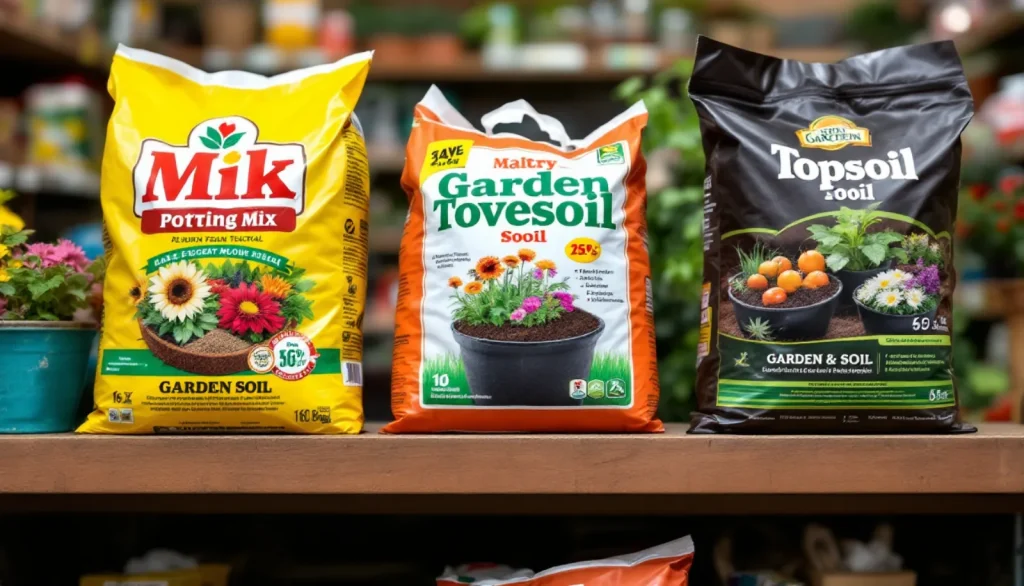
These three products sit side by side on the same shelf and a “sale” sign does not tell you which fits your job. Potting mix is a soilless blend built for containers. Garden soil is heavier and meant to be tilled into native ground, not poured into pots. Topsoil is screened dirt for filling and grading, not for growing in containers at all. Buying the wrong one because it was cheap is the most common potting-soil mistake.
Potting mix (sometimes labeled potting soil) is engineered to drain and hold air in a pot. It blends a base like peat moss or coconut coir with perlite or vermiculite for porosity, plus some compost or bark for nutrients. It is light, often sterilized, and stays loose so roots get oxygen. Use it for containers, hanging baskets, window boxes, and seed starting.
Garden soil is denser and priced lower per bag, which tempts buyers, but it compacts in a pot and drowns roots. It is an amendment to mix into in-ground beds. Topsoil is the cheapest of the three and the least processed: it is not sterile, holds weed seed, and belongs in landscaping fill and grading jobs. For a container, topsoil is the wrong call no matter the discount.
| Product | What it is | Drainage in a pot | Right use | Relative cost |
|---|---|---|---|---|
| Potting mix | Soilless blend (peat or coir + perlite/vermiculite + compost) | Excellent, stays loose | Containers, baskets, seed starting | Highest per bag |
| Garden soil | Heavier blend to amend native ground | Poor, compacts | In-ground beds, tilled in | Mid |
| Topsoil | Screened native dirt, not sterile | Very poor | Landscape fill and grading | Lowest |
Peat moss vs coconut coir: what is in the bag?
The base material is the biggest difference between two bags at the same price. Most US potting mix still uses sphagnum peat moss, which holds water well but is acidic (pH roughly 3.5 to 4.8) and is harvested from bogs that take centuries to regrow. Coconut coir is a coconut-processing byproduct with a near-neutral pH (about 6.0 to 6.8) and is the leading peat-free alternative. Both work; the choice is about pH, sustainability, and price.
Peat is cheap and widely stocked because most North American supply comes from Canada, which has not restricted it. England, by contrast, moved to ban retail peat sales to home gardeners, with the bagged-retail phase-out tied to 2024 and remaining categories pushed to later years, a signal that peat-free mixes are growing on US shelves too. If you see “peat-free” or “coir-based” on a discounted bag, that is why.
Coir drains and rewets more easily than peat once peat dries out, but coir carries its own footprint: most is shipped from India and Sri Lanka. For container growing, the practical read is simple. If your plants like slightly acidic conditions and you want the lowest price, peat-based mix is fine. If you want easier rewetting and a more neutral start, choose a coir or peat-free bag. Either way, check that the mix already contains perlite or vermiculite for drainage.
What to read on the bag before you buy
Before any sale tempts you, read the bag for five things: the base (peat or coir), the aeration material (perlite or vermiculite), whether compost or fertilizer is added, the volume in quarts, and whether it says “potting mix” rather than “garden soil” or “topsoil.” A low price on the wrong product is not a deal. Match the bag to the container job first, then compare price.
- Confirm the label reads potting mix or container mix, not garden soil or topsoil.
- Identify the base: peat moss (acidic, cheap) or coconut coir (near-neutral, peat-free).
- Look for perlite or vermiculite. Without aeration material the mix will compact in a pot.
- Check for added compost or a starter fertilizer charge, which feeds plants for a few weeks only.
- Compare price by volume (quarts), not by bag, so a “cheap” small bag does not beat a larger one.
One more spec: a starter fertilizer charge in the bag typically feeds for only a few weeks, so plan to feed container plants on a schedule after that. Matching feed to plant type follows the same logic as choosing the right blend for in-ground plants, which our NPK fertilizer guide breaks down by number.
How much should potting soil cost, and is bulk cheaper?
Bagged all-purpose potting mix commonly runs around $0.25 to $0.45 per quart at full price, so a 25-quart bag lands near $7 to $9 and a 40-quart organic bag similar. On sale those drop 15 to 30 percent. Bulk by the cubic yard from a local nursery is dramatically cheaper per volume: once you need more than roughly 10 bags, bulk can save 40 to 60 percent, but it suits raised beds more than a few pots.
The gap most price comparisons miss is the per-gallon reality. A cubic yard of quality container or raised-bed mix delivered in bulk often runs $40 to $80, versus $150 to $250 for the same volume in bags. Mixing your own can land near $0.30 per gallon, under $3 per cubic foot, if you buy the components in quantity. For a balcony of containers, bagged on sale is simplest. For raised beds or a big planting weekend, bulk or DIY wins on cost.
| Buying route | Rough cost | Effort | Best when |
|---|---|---|---|
| Bagged, full price | $0.25 to $0.45 per quart | Lowest | A few containers, need it today |
| Bagged, on sale | 15 to 30 percent off the above | Lowest | Spring promo or fall clearance |
| Bulk by the yard | $40 to $80 per cubic yard delivered | Medium (truck or delivery) | Raised beds, 10+ bag volume |
| DIY blend | Near $0.30 per gallon, under $3 per cubic foot | High | Large volume, control over recipe |
How to make your own potting mix (DIY recipe)
You can mix your own container blend from three parts: a base that holds water, an aerator that keeps it loose, and compost for nutrients. A common starting ratio is roughly 2 parts peat or coir, 1 part perlite or vermiculite, and 1 part compost. University of Florida IFAS Extension publishes recipes by plant type, including 2 parts compost, 2 parts peat moss, and 1 part vermiculite for seedlings.
If you use peat as the base, add lime to offset its acidity, since peat sits around pH 3.5 to 4.8. UF/IFAS notes lime is added to balance pH and that homemade media can be sterilized by baking at about 200 degrees Fahrenheit to kill weed seed and disease. Coir, near pH 6.0 to 6.8, usually needs no lime. Pre-wet peat or compressed coir before mixing so it absorbs water evenly.
- Measure parts by any consistent unit (buckets, gallons): 2 parts base, 1 part aerator, 1 part compost.
- Pre-wet peat or expand coir blocks with water until they break apart and feel damp, not soggy.
- Blend the base, perlite or vermiculite, and compost in a tub or wheelbarrow.
- If using peat, add lime per the bag rate to lift pH toward neutral. Skip lime for coir.
- For seed starting, sterilize the mix if reusing components, and keep the blend lighter on compost.
Reusing last year’s container mix is the cheapest move of all. The University of Maryland Extension recommends blending old growing media with fresh mix or compost; a 50:50 refresh is a reliable baseline as long as the old soil shows no mold, pests, or sour smell. Do not reuse soil from plants that had disease or insect problems.
Should you wait for a sale or buy now?
Buy now if you are planting this week and the price is fair, because dead time costs more than a few dollars saved. Wait for a sale if you are stockpiling sealed bags for next season; the September to October clearance window with 15 to 30 percent off is the strongest. For raised beds or any 10-plus bag job, skip the sale question entirely and price bulk by the yard, which beats bagged volume regardless of promo.
Storage decides the strategy. Sealed bags bought on fall clearance keep through winter and into spring planting, so a fall buy beats a spring promo if you have a dry shed or garage. If you cannot store bags, buy on the spring weekend ads right before you plant. Whatever the timing, the product still has to match the job: container plants need potting mix, beds need garden soil, and fill needs topsoil.
For the bigger picture on what your yard and garden inputs cost across the season, see our 2026 lawn care cost benchmarks. If drainage in your beds is the real problem you are trying to solve, our guide to installing drip irrigation and the HMNDP learn hub cover the watering side. Drought-stressed planting plans often start with the right medium, and our notes on drought-tolerant alternatives tie soil choice to water use.
Last reviewed: June 2026
HMNDP Editorial Team, reviewed by HMNDP turf and horticulture editors.
Frequently asked questions
When does potting soil go on sale?
Bagged potting mix discounts cluster in two windows: early spring, late March into April, when big-box stores run weekend promos, and late-season clearance, September into October, when stores cut 15 to 30 percent or more to clear pallets before winter. Holiday weekends like Memorial Day and Labor Day add shorter promo spikes. Premium and organic bags rarely discount deeply.
What is the difference between potting soil, garden soil, and topsoil?
Potting mix is a light, soilless blend built for containers; it drains and holds air. Garden soil is heavier and meant to be tilled into native ground, not poured into pots, where it compacts. Topsoil is screened native dirt for landscape fill and grading, is not sterile, and holds weed seed. For containers, always choose potting mix regardless of price.
Is peat moss or coconut coir better for potting mix?
Both work; the choice is pH, sustainability, and price. Peat moss is cheap and widely stocked but acidic (about pH 3.5 to 4.8) and harvested from slow-regrowing bogs. Coconut coir is a coconut byproduct with near-neutral pH (about 6.0 to 6.8), rewets more easily, and is the leading peat-free option. Either is fine if the mix also has perlite or vermiculite.
Is it cheaper to buy potting soil in bulk or in bags?
Bulk is far cheaper per volume once you need more than roughly 10 bags. A cubic yard of quality mix delivered in bulk often runs $40 to $80, versus $150 to $250 for the same volume in bags, a 40 to 60 percent saving. For a few containers, bagged on sale is simplest. For raised beds, bulk by the yard wins.
How do you make your own potting mix?
Blend three parts: a water-holding base, an aerator, and compost. A common ratio is about 2 parts peat or coir, 1 part perlite or vermiculite, and 1 part compost. UF/IFAS Extension lists a seedling recipe of 2 parts compost, 2 parts peat moss, and 1 part vermiculite. Add lime if using peat to offset acidity; coir usually needs none.
How long does potting soil last?
Sealed, unopened potting mix keeps 1 to 2 years stored cool and dry, and some brands hold five years or more, which makes fall-clearance stockpiling for spring worthwhile. Once opened, quality drops in 6 to 12 months as the mix clumps, loses nutrient charge, and can grow surface mold, so only open what you will use within a season.
Can you reuse old potting soil?
Yes, if it shows no mold, pests, or sour smell. The University of Maryland Extension recommends blending old growing media with fresh mix or compost; a 50:50 refresh is a reliable baseline for most containers. Do not reuse soil from plants that had disease or insect problems, since pathogens and eggs can carry over to your next planting.
Should I wait for a potting soil sale or buy now?
Buy now if you are planting this week and the price is fair, because dead planting time costs more than a few dollars. Wait for the September to October clearance window, 15 to 30 percent off, if you can store sealed bags for next season. For raised beds or any 10-plus bag job, skip the sale and price bulk by the yard instead.