
Clematis Flowers: Pruning Groups, Care, and Wilt Fix
Clematis flowers are the showiest climbing blooms most home gardeners can grow, with star, bell, and tulip-shaped flowers from 1 to 8 inches across in white, pink, wine red, lavender, deep purple, and a few yellows. The genus holds about 380 species in the buttercup family (Ranunculaceae), and most garden hybrids are hardy in USDA zones 3 to 9. The single decision that trips up almost every new grower is not planting or watering. It is figuring out which of the three pruning groups a plant belongs to, because cutting a Group 2 vine like you would a Group 3 removes the buds that carry next spring’s flowers. This guide settles the group question first, then covers planting, support, and the wilt problem that makes healthy stems collapse overnight.
What do clematis flowers look like?
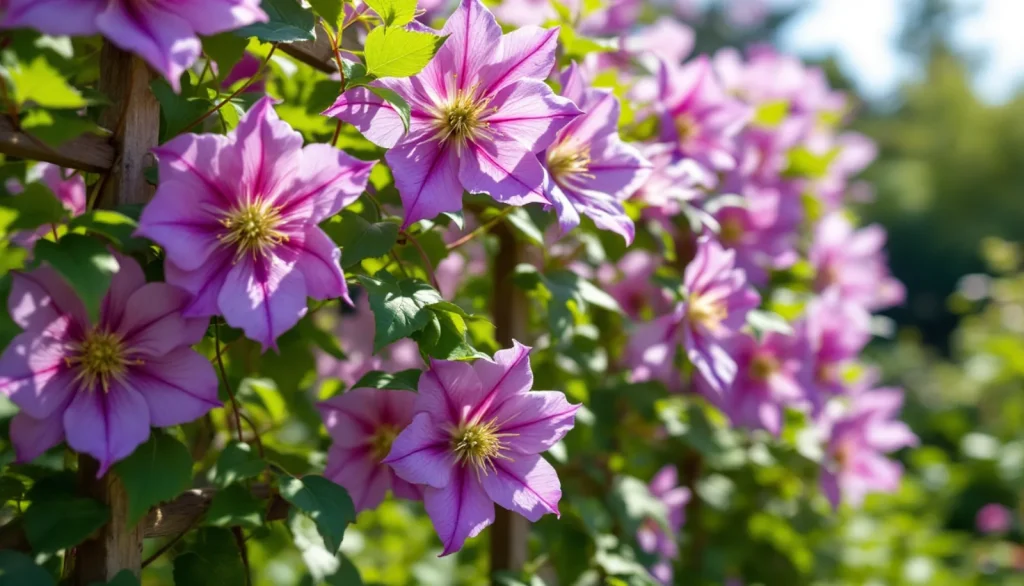
Clematis flowers are made of colored sepals, not true petals, usually 4 to 8 per bloom, arranged around a central boss of stamens. Large-flowered hybrids run 5 to 8 inches across; small-flowered and species types (alpina, montana, viticella) carry 1 to 2 inch bells or stars in heavier numbers. Colors span white, mauve-pink, carmine, blue, violet, deep purple, and yellow, and many are lightly scented.
Bloom form varies more than color. You can buy single, semi-double, and fully double cultivars, plus nodding bells (the alpina and texensis types) and the tiny fragrant white sprays of Sweet Autumn clematis (Clematis terniflora). After flowering, many produce silvery, feathery seed heads that hold interest into winter, which is where the common name old man’s beard comes from.
The three clematis pruning groups (and how to tell which you have)
Clematis fall into three pruning groups based on whether they flower on old wood, new wood, or both. Group 1 blooms in early spring on last year’s growth and needs almost no cutting. Group 2 blooms late spring on old wood, then again in summer on new growth. Group 3 blooms mid to late summer only on the current season’s growth and gets cut hard. Match the group to the plant or you will cut off the flowers.
If the plant tag is gone, the Royal Horticultural Society’s rule of thumb sorts it by bloom timing. A clematis that flowers before early June, leave it alone (Group 1 or the first flush of Group 2). A clematis that flowers from late June onward gets pruned in late winter (Group 2 or 3). A plant that flowers once in spring and again in late summer is almost always Group 2. One that only flowers after midsummer is Group 3.
| Group | Blooms on | When it flowers | How to prune | Example cultivars |
|---|---|---|---|---|
| Group 1 (early) | Old wood (last year’s stems) | Early to mid spring, one flush | Minimal. Remove dead stems and tidy right after flowering. Hard renovation cut to 6 in only if overgrown, no more than once every 3 years. | C. montana, C. alpina, C. armandii |
| Group 2 (mid) | Old wood, then new wood | Late spring on old wood, repeat in summer on new growth | Light. Late winter, remove dead and weak stems back to a strong pair of buds. Deadhead after the first flush to push the second. | ‘Nelly Moser’, ‘Henryi’, ‘The President’ |
| Group 3 (late) | New wood only | Midsummer to first frost, one long flush | Hard. Late winter or early spring, cut all stems down to a strong pair of buds 12 to 18 in above the ground. | ‘Jackmanii’, ‘Perle d’Azur’, Sweet Autumn (C. terniflora) |
The most common mistake is treating a Group 2 plant like a Group 3. Cutting ‘Nelly Moser’ or ‘The President’ to 18 inches in spring strips the old wood that carries the big early flowers, so the plant skips its first bloom and looks bare until late summer. When you genuinely do not know the group, prune conservatively for one full year, watch when it flowers, then assign the group with confidence.
How to plant clematis so it survives
Plant clematis with the crown buried 2 to 3 inches below the soil surface, deeper than you would set almost any other perennial. This buried depth is the single best insurance against clematis wilt, because dormant buds below ground can regrow even after the top of the plant collapses. Plant in spring or fall in well-drained soil enriched with compost.
- Dig a hole about twice the width of the pot and 18 inches deep, and work 1 to 2 shovelfuls of compost into the bottom and backfill.
- Set the plant so the top of its root ball sits 2 to 3 inches below grade, burying the lowest pair of leaf nodes. This is the deep planting that protects against wilt.
- Backfill, firm gently, and water in with at least 1 gallon.
- Position the roots in shade. Plant a low perennial, lay flat stones, or mulch 2 to 3 inches deep over the root zone to keep it cool. Keep mulch off the stems.
- Tie the young stems to a support right away, since clematis grip with twining leaf stalks and need something narrow to hold.
The old gardener’s line, head in the sun, feet in the shade, captures the two non-negotiable conditions. Clematis want at least 6 hours of sun on the foliage to bloom well, with 4 hours the floor for shade-tolerant cultivars like ‘Nelly Moser’. The roots want to stay cool and moist, which is why root-zone shading and mulch matter as much as the sun exposure.
Sun, soil, water, and support
Clematis bloom best in full sun (6 or more hours) in moist, well-drained, near-neutral soil around pH 6.5 to 7. Give established plants about 1 gallon of water per week, more in heat and during the first season while roots establish. Vines climb by wrapping leaf stems around thin supports, so they need a trellis, wire, or netting with elements half an inch or narrower to grip.
Feeding is light. A balanced or slightly phosphorus-forward fertilizer in early spring as growth starts, repeated after the first bloom for repeat-flowering Group 2 plants, covers most needs. Avoid heavy nitrogen, which pushes leafy growth at the expense of flowers. For the basics on reading a fertilizer label, see our NPK fertilizer guide.
Support choice depends on the cultivar’s size. Compact Group 2 hybrids reach 6 to 10 feet and suit an obelisk or wall trellis. Vigorous Group 1 species like C. montana can run 20 to 30 feet and need a pergola, fence, or large tree to climb. Match the structure to the mature spread before you plant, because moving an established clematis sets it back a full season.
Why is my clematis wilting or not blooming?
Sudden collapse of healthy stems, often right as buds form, is clematis wilt, a fungal stem infection (Calophoma clematidina). It looks fatal but usually is not if the plant was set deep. Cut the affected stems back to healthy tissue or to ground level, clear the debris, and water the root zone. Deeply planted vines regrow from the buried buds, often within the same season.
No flowers usually trace to one of three causes. Wrong pruning is the most common: cutting a Group 1 or 2 plant in late winter removes the old wood that holds the buds. Too little sun is next, since under 4 to 6 hours suppresses bloom. Excess nitrogen is the third, producing a wall of leaves and few flowers. A young plant in its first or second year may also spend its energy on roots before it blooms heavily, so a slow start is normal.
| Problem | Likely cause | Fix |
|---|---|---|
| Healthy stems collapse near bloom time | Clematis wilt (Calophoma clematidina) | Cut back to healthy wood or ground; deep-planted vines regrow |
| Few or no flowers | Wrong pruning, too little sun, or excess nitrogen | Confirm pruning group; ensure 6+ hours sun; ease off high-nitrogen feed |
| Bare base, all leaves and flowers up high | Natural leggy habit, common in Group 3 | Hard-prune Group 3 in late winter; plant a low shrub at the base |
| Yellowing leaves | Poor drainage or nutrient gap | Improve drainage; check soil; avoid soggy roots |
Are clematis flowers toxic?
Yes, clematis is toxic to dogs, cats, and horses, according to the ASPCA. The toxic principle is an irritant glycoside called protoanemonin found in all parts of the plant, including flowers, vines, and seeds. Clinical signs are salivation, vomiting, and diarrhea. Cases are uncommon because the plant tastes bitter and animals rarely eat much.
The toxicity is generally mild to moderate, not usually fatal, but keep clippings away from pets and rinse skin after handling sap, which can irritate. If a pet swallows a large amount and shows persistent symptoms, contact a veterinarian or the ASPCA Animal Poison Control Center.
Choosing a clematis: a quick decision guide
Pick a clematis by matching bloom season and mature size to your spot, then accept the pruning group that comes with it. For a low-maintenance plant, choose Group 3 (hard prune once a year, hard to get wrong). For the biggest early flowers, choose Group 2 and learn its lighter pruning. For a fast cover-everything vine, choose a Group 1 species like montana, but give it room.
- Want easiest care: Group 3 such as ‘Jackmanii’ or Sweet Autumn. One hard cut each late winter, no group confusion.
- Want the largest, earliest blooms: Group 2 such as ‘Nelly Moser’ or ‘The President’, zones 4 to 8, 6 to 10 feet, 6 to 8 inch flowers.
- Want a vigorous screen: Group 1 such as C. montana, reaching 20 to 30 feet, minimal pruning.
- Have part shade: ‘Nelly Moser’ tolerates 4 hours of sun and holds color better out of harsh afternoon light.
Clematis pairs well with climbing roses and other vines if you match their water and sun needs. If you are building beds around a new trellis or planting groundcovers to shade the roots, our guide to growing in shade and the seasonal maintenance schedule help you time the surrounding planting. For watering the root zone efficiently in dry regions, see how to install drip irrigation.
Last reviewed: June 2026
HMNDP Editorial Team, reviewed by HMNDP turf and horticulture editors.
Frequently asked questions
How do I know which clematis pruning group I have?
Use bloom timing. A clematis that flowers before early June is Group 1 (or the first flush of Group 2) and needs no winter pruning. One that flowers from late June onward gets pruned in late winter and is Group 2 or 3. A plant that blooms in spring and again in late summer is almost always Group 2. One that only blooms after midsummer is Group 3.
Why is my clematis not blooming?
Three causes account for most cases. Wrong pruning is first: cutting a Group 1 or 2 plant in late winter removes the old wood holding the buds. Too little sun is next, since under 4 to 6 hours suppresses flowering. Excess nitrogen is third, pushing leaves over flowers. Young plants in their first or second season may also bloom lightly while roots establish, so a slow start can be normal.
How deep should I plant clematis?
Set the crown 2 to 3 inches below the soil surface, deeper than most perennials, burying the lowest pair of leaf nodes. This deep planting is the best insurance against clematis wilt, because dormant buds below ground can regrow even if the top collapses. Plant in spring or fall in well-drained soil enriched with compost, then shade the root zone.
Are clematis flowers toxic to dogs and cats?
Yes. The ASPCA lists clematis as toxic to dogs, cats, and horses. The toxic principle is an irritant glycoside called protoanemonin found in all parts of the plant, including flowers, vines, and seeds. Clinical signs are salivation, vomiting, and diarrhea. The toxicity is usually mild to moderate, not fatal, and poisoning is uncommon because the plant tastes bitter.
How much sun do clematis need?
Clematis bloom best with at least 6 hours of direct sun on the foliage, though shade-tolerant cultivars like ‘Nelly Moser’ manage on about 4 hours. The roots are the opposite: they want cool, moist, shaded soil. The old rule, head in the sun and feet in the shade, sums it up. Shade the root zone with a low plant, flat stones, or 2 to 3 inches of mulch.
What causes clematis to wilt suddenly?
Sudden collapse of healthy stems, often as buds form, is clematis wilt, a fungal stem infection (Calophoma clematidina). It looks fatal but rarely kills a deeply planted vine. Cut affected stems back to healthy tissue or to ground level, clear the debris, and water the root zone. Plants set with the crown 2 to 3 inches deep usually regrow from buried buds, often in the same season.
What support do clematis vines need?
Clematis climb by wrapping their leaf stems around thin supports, so they need a trellis, wire, netting, or twiggy structure with elements half an inch or narrower to grip. They cannot cling to flat walls or thick posts on their own. Match the support size to the cultivar: compact hybrids reach 6 to 10 feet, while vigorous species like C. montana can run 20 to 30 feet.
When do clematis flowers bloom?
Bloom time depends on the pruning group. Group 1 species such as C. montana flower in early to mid spring on old wood. Group 2 large-flowered hybrids like ‘Nelly Moser’ bloom in late spring, then repeat in summer. Group 3 plants such as ‘Jackmanii’ and Sweet Autumn flower from midsummer to first frost on new growth. Choosing across groups can give blooms from spring through fall.