
Lawn Mower Buying Guide: Size, Price, and Repair Rules
This lawn mower buying guide maps the five mower types (push, self-propelled, riding, zero-turn, robotic) to lawn size, power source, and budget, then adds the two things most guides skip: when a repair is no longer worth it, and how the 2024 California gas-engine rule and its copycats may limit what you can buy new. The short answer: match the cut width and drive to your acreage first, pick gas or battery second, and check your state and city rules before you assume a gas push mower is still on the shelf.
What lawn mower do I need for my lawn size?
Lawn size is the first filter, because it sets the deck width and drive type that keep mowing under an hour. Push and self-propelled walk mowers cover lawns up to about a half acre. Riding mowers, lawn tractors, and zero-turns take over above a half acre. Robotic mowers fit most yards up to roughly 1.25 acres on a single unit, including sloped and obstacle-heavy layouts.
Consumer Reports tests mowers on prepared Florida grounds, cutting about 500,000 square feet of grass per season, and groups its size guidance the same way: battery walk mowers for a third of an acre or less, gas walk mowers for a quarter to a half acre, and riding equipment above a half acre.
| Lawn size | Best mower type | Typical deck width | Typical engine or power |
|---|---|---|---|
| Under 1/4 acre | Push or battery push | 20 to 22 in | 5.5 to 7 hp gas, or 40 to 56 volt battery |
| 1/4 to 1/2 acre | Self-propelled (gas or battery) | 21 to 22 in | 6 to 7 hp gas, or 56 to 80 volt battery |
| 1/2 to 1 acre | Lawn tractor or battery rider | 42 to 46 in | 14 to 18 hp |
| 1 to 3 acres | Zero-turn rider | 48 to 54 in | 22 to 24 hp |
| Up to ~1.25 acres, hands-off | Robotic | ~9 in (mows continuously) | Lithium battery, self-charging |
Slope and terrain override raw size. On hills, a self-propelled walk mower with rear-wheel drive holds traction better than front-wheel drive, and all-wheel drive handles mixed terrain. Front-wheel drive is fine for flat lawns and easier to turn at bed edges. If you are still guessing at your acreage, our walkthrough on how to measure lawn square footage gives you the number these recommendations depend on.
Lawn mower types compared
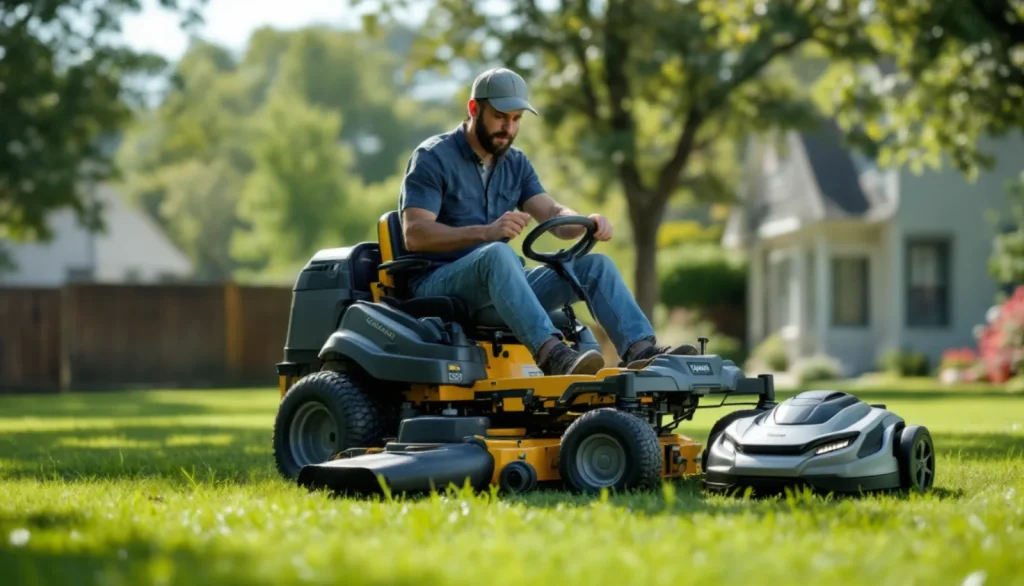
The five mainstream mower types trade off effort, speed, runtime, and price. Push mowers cost least and work hardest. Self-propelled mowers add a drive system so you steer instead of push. Riding mowers and zero-turns cut large lawns two to three times faster than a walk mower. Robotic mowers remove the labor entirely on a set schedule.
- Push mower: you supply the forward power. Best for small, flat lawns and tight budgets. Deck 20 to 22 inches.
- Self-propelled: a drive system pulls the mower; you steer. Front, rear, or all-wheel drive. Best for medium lawns and slopes.
- Lawn tractor or riding mower: front-mount steering wheel, 42 to 54 inch deck. Best for half acre and up with open layout.
- Zero-turn: lever steering, pivots in place, 42 to 54 inches residential. Fastest cut on open acreage without many hills.
- Robotic: a small battery unit that mows daily inside a wire or GPS boundary. Best for set-and-forget owners with yards under about 1.25 acres.
Electric vs gas: which power source fits you?
Battery (electric) mowers win on noise, maintenance, and running cost for most suburban lawns under a half acre; gas wins on unlimited runtime and raw torque for tall, wet, or thick grass and larger properties. Battery models start with a button, produce no exhaust, and skip oil changes, spark plugs, and filters. Gas models cost less upfront but more to own over time.
Running cost separates them clearly. Electricity for a battery mower runs about $10 to $20 per season on an average suburban lawn, while gas runs roughly $30 to $60 per season, before any oil and tune-up costs. Consumer Reports now finds top battery mowers cut as well as or better than their gas counterparts, which was not true a decade ago.
| Factor | Gas | Battery (electric) |
|---|---|---|
| Upfront cost (push) | ~$250 to $400 | ~$250 to $550 |
| Seasonal fuel or power | $30 to $60 | $10 to $20 |
| Maintenance | Oil, plugs, filters, winterizing | Blade and battery only |
| Runtime | Unlimited (refuel) | ~45 to 60 min per charge, swap batteries |
| Best for | Thick, wet, or large lawns | Flat suburban lawns under 1/2 acre |
Are robotic lawn mowers worth it?
A robotic mower is worth it if you would otherwise pay for weekly cuts or do not want to spend weekends mowing, and your lawn fits the model’s coverage range. It mows on its own schedule, charges itself, and runs quietly with no emissions. The trade-off is a higher upfront price ($500 to $2,500 for most consumer units, more for GPS and all-wheel-drive models) and a setup step for boundaries.
Most current robotic mowers handle yards up to about 1.25 acres on one unit, including slopes, edges, and obstacle-heavy layouts. If weekly professional mowing in your market runs more than a few hundred dollars a season, a mid-range robot often pays back within a few seasons. Owners with very large or steeply terraced lawns are still better served by a zero-turn.
How much should I spend on a lawn mower?
Plan to spend $250 to $600 for a good push or self-propelled mower, $1,300 to $4,000 for a lawn tractor or entry rider, and $4,000 or more for a residential zero-turn. Robotic mowers cluster between $500 and $2,500. You do not have to pay top dollar to get a strong cut; spending a little more at the low end usually buys better performance than the absolute cheapest model.
| Mower type | 2026 price range | Typical lifespan |
|---|---|---|
| Push (gas or battery) | $130 to $1,020 | 5 to 10 years |
| Self-propelled | $350 to $2,300 | 5 to 10 years |
| Riding mower / lawn tractor | $1,300 to $4,000 | 10 to 15 years |
| Zero-turn | $4,000 to $6,100+ | 10 to 15 years (1,000 to 1,500 hr) |
| Robotic | $500 to $2,500 | ~10 years |
Lifespan is better measured in operating hours than in calendar years. A well-maintained engine commonly reaches 1,000 to 1,500 hours, which at about an hour of mowing a week through the season works out to roughly 15 to 20 years of service. Skipping oil changes and blade sharpening cuts that short.
Which specs actually matter when comparing models?
Beyond type and power source, four specs decide the cut: deck width, engine size, drive type, and clipping handling. Deck width sets how many passes you make. Engine size (cc on walk mowers, hp on riders) sets how it handles tall or wet grass. Drive type controls hill traction. Clipping handling decides whether you bag, mulch, or side-discharge.
- Deck width: 20 to 22 in for walk mowers; 42 in riders need about 18 hp, 54 in residential zero-turns want 22 to 24 hp.
- Engine size: on gas push mowers, higher cc means more cutting power for heavy or damp grass.
- Drive type: rear-wheel drive for slopes, front-wheel for flat and easy turns, all-wheel for mixed terrain.
- Clipping handling: mulching returns nutrients and reduces raking; bagging keeps the lawn clean and limits weed-seed spread; side-discharge clears tall growth fastest.
Mulching is the default most lawns benefit from, since returned clippings feed the turf. For the fertilization side of that equation, see our NPK fertilizer guide to match feeding to your grass type. Drive type also matters more on warm-season turf that grows dense in summer heat; homeowners in markets like our Phoenix lawn care coverage often run rear-wheel-drive walk mowers on overseeded Bermuda.
When should I repair vs replace my lawn mower?
Replace the mower when the repair quote exceeds 50 percent of a new model’s price, or once the machine passes about half its expected life and needs a major part. Most repairs run $75 to $550, and a tune-up runs $85 to $350, with shop labor at $55 to $135 an hour. A blade sharpening can cost as little as $5; a riding-mower transmission swap can run up to $2,500, which is replacement territory.
Use these triggers to decide quickly:
- Get the written repair estimate, including parts and labor.
- Compare it to the replacement cost of an equivalent new mower.
- If the repair is over 50 percent of replacement, lean toward replacing.
- Replace outright on a cracked or bent deck, a failed engine, or a failed transmission, since those approach new-mower cost.
- Factor age: walk mowers past 10 years and riders past 15 years usually justify replacement on the next big failure.
Routine wear items (blades, belts, spark plugs, air filters, batteries) almost always favor repair. Structural and powertrain failures favor replacement. If the lawn itself is the problem rather than the mower, our guides on diagnosing brown patches in your lawn and the year-round grass maintenance schedule are the better fix.
Can I still buy a new gas lawn mower in 2026?
In most states, yes. In California, no for most newly manufactured gas walk mowers and small equipment. The California Air Resources Board rule under AB 1346 required most new small off-road engines (spark-ignited, 25 hp and under) sold in the state to be zero-emission starting January 1, 2024. It does not ban using gas mowers you already own; it limits new sales of the engines.
This matters for buyers because availability now depends on where you live. California shoppers will find new walk-mower shelves dominated by battery models. Several cities and states (including parts of Colorado such as Denver, plus action in Minnesota, Maryland, and Connecticut jurisdictions) have pursued similar gas-equipment limits, while states like Texas and Georgia have passed laws blocking local governments from banning gas outdoor equipment. Check your state and city rules before assuming a gas model is available, and confirm current program status with the relevant authority, since these rules change by cycle.
Where to buy and what to skip
Big-box retailers (Home Depot, Lowe’s) and outdoor power dealers cover the consumer range; dealers add service and parts that matter most on riders and zero-turns. Buy from a servicing dealer if you choose a riding mower, because tractor and zero-turn repairs need parts support. For walk mowers, a big-box or online purchase is fine, since most repairs are simple wear items.
Skip the extreme bargain models: the cheapest push mowers test worse than units costing slightly more. For the running side of ownership (water, fuel, fertilizer, and service), our 2026 lawn care cost benchmarks show where the mower fits in a full-year budget. HMNDP does not sell equipment; this is an editorial decision guide.
Quick decision recap
- Lawn under 1/2 acre and flat: battery push or self-propelled, $250 to $600.
- Half acre to an acre: lawn tractor or battery rider, 42 to 46 in deck, 14 to 18 hp.
- One to three open acres: zero-turn, 48 to 54 in, 22 to 24 hp.
- Hate mowing, yard under ~1.25 acres: robotic, $500 to $2,500.
- Repair quote over 50 percent of a new mower, or a dead engine, deck, or transmission: replace.
- California or a restricted city: plan on a battery model for new walk mowers.
Last reviewed: June 2026
HMNDP Editorial Team, reviewed by HMNDP turf and horticulture editors.
Frequently asked questions
What lawn mower do I need for my lawn size?
Match the mower to your acreage. Push and self-propelled walk mowers cover lawns up to about a half acre. Lawn tractors and zero-turns handle a half acre and up, with 42 to 54 inch decks. Robotic mowers fit most yards up to roughly 1.25 acres on a single unit, including slopes and obstacles.
How much should I spend on a lawn mower?
Plan on $250 to $600 for a good push or self-propelled mower, $1,300 to $4,000 for a lawn tractor or entry rider, and $4,000 or more for a residential zero-turn. Robotic mowers run $500 to $2,500. Spending slightly more than the cheapest model usually buys a noticeably better cut.
Is a gas or electric lawn mower better?
For flat suburban lawns under a half acre, battery (electric) mowers win on noise, low maintenance, and running cost (about $10 to $20 per season versus $30 to $60 for gas). Gas wins on unlimited runtime and torque for thick, wet, or large lawns. Top battery models now cut as well as gas.
Are robotic lawn mowers worth it?
A robotic mower is worth it if you would otherwise pay for weekly cuts or want your weekends back, and your lawn fits the model’s range (most cover up to about 1.25 acres). It mows on schedule and self-charges. The trade-off is a $500 to $2,500 upfront price and a boundary setup step.
When should I repair vs replace my lawn mower?
Replace when the repair quote tops 50 percent of a new model’s price, or when the mower passes about half its expected life and needs a major part. Most repairs run $75 to $550. Replace outright on a cracked deck, failed engine, or failed transmission, since those approach new-mower cost.
How long does a lawn mower last?
Walk mowers typically last 5 to 10 years and riding mowers 10 to 15 years, but hours matter more than calendar age. A well-maintained engine often reaches 1,000 to 1,500 hours, roughly 15 to 20 years at an hour of mowing a week, if you keep up with oil changes and blade sharpening.
Can I still buy a new gas lawn mower in 2026?
In most states, yes. In California, most newly manufactured gas walk mowers and small equipment must be zero-emission under the CARB rule (AB 1346) that took effect January 1, 2024, so new shelves favor battery models. The rule limits new sales, not the use of gas mowers you already own. Check local rules first.
What lawn mower specs matter most?
Four specs decide the cut: deck width (20 to 22 inches on walk mowers, 42 to 54 inches on riders), engine size (cc on walk mowers, hp on riders), drive type (rear-wheel for slopes, front-wheel for flat lawns, all-wheel for mixed terrain), and clipping handling (mulch, bag, or side-discharge).