
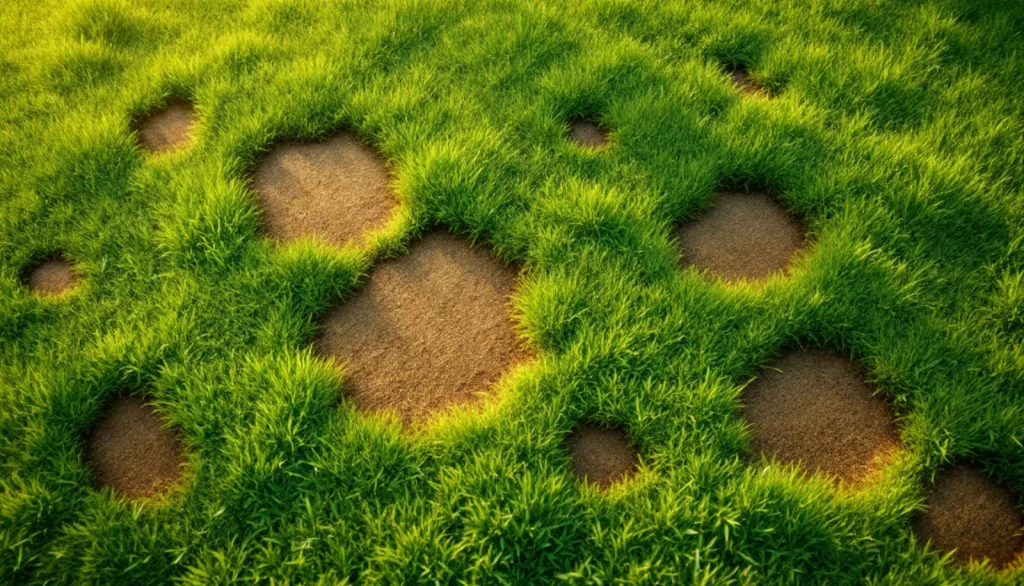
Brown patches in lawn have six common causes: fungal disease (brown patch, dollar spot, summer patch), grub damage, surface insect damage (chinch bug, armyworm), drought stress, dog urine, and chemical burn. Each looks subtly different. Most homeowners treat the wrong cause and watch the patches spread for weeks before getting the right diagnosis.
The short version
- Fungal brown patch: irregular circular patches with darker outer ring, hot humid weather
- Grub damage: lawn lifts up like loose carpet, you can pull it back and see grubs
- Chinch bug: starts in sunny spots, lawn turns straw-yellow then brown
- Drought stress: gradual onset over 2-3 weeks, footprints visible
- Dog urine: small distinct circles with green outer ring (overgrowth from nitrogen)
- Chemical burn: sharp-edged patches, often in the pattern you applied chemical
The diagnostic tree
Use these five questions to narrow the cause in under 5 minutes.
Question 1: Can you pull the dead grass up like a loose carpet? Yes = grub damage. The root system has been eaten by white grubs (Japanese beetle larvae, June bug grubs). No = continue.
Question 2: Are the patches roughly circular with a darker outer ring? Yes = fungal disease, most likely brown patch in summer or dollar spot. No = continue.
Question 3: Are the patches in sunny areas of the lawn first, with no visible insects until you part the grass? Yes = chinch bug or sod webworm. No = continue.
Question 4: Does the patch have sharp clearly-defined edges, especially in patterns matching where you walked while applying fertilizer or herbicide? Yes = chemical burn. No = continue.
Question 5: Is the patch small (under 1 ft diameter) with a darker green ring around the edge? Yes = dog urine. No = drought stress is the remaining likely cause.
Fungal brown patch
Caused by Rhizoctonia solani. Appears in hot humid weather (overnight temperatures above 65F, daytime above 85F, humidity above 60%). Patches are 6 inches to 3 feet in diameter, irregular circular, with a darker “smoke ring” outer edge visible early in the morning when dew is present. Cool-season grasses (tall fescue especially) are most susceptible.
Fix: reduce irrigation frequency, water in the morning only so the lawn is dry by evening. Apply a fungicide containing azoxystrobin (Heritage), propiconazole (Banner Maxx), or chlorothalonil (Daconil). Cost per application: $25-60 for the chemical, on a 5,000 sq ft lawn. Most fungicides need 2 applications 14-21 days apart for complete control. Avoid late-evening watering for the rest of the season.
Grub damage
White grubs (C-shaped larvae of Japanese beetles, masked chafers, June beetles) feed on grass roots from late summer through early fall. The lawn surface looks fine for weeks while the root system is eaten away. Damage shows up when the lawn cannot uptake water and dies in patches. Diagnostic test: pull on the dead grass. If it lifts up easily like a loose carpet, peel back the sod and look for white C-shaped larvae in the top 2 inches of soil. Threshold for treatment: more than 6-10 grubs per square foot.
Fix: apply a grub control product timed for early-season prevention (preventive: imidacloprid or chlorantraniliprole in mid-late spring) or curative if active grubs are present (curative: trichlorfon or carbaryl). Costs: $35-80 per application for chemical. Replace dead patches with seed (tall fescue or KBG in cool-season; Bermuda or Zoysia plug in warm-season). Grub damage in fall recovers fully with seed by next summer.
Chinch bug damage
Chinch bugs feed on St. Augustine, Bermuda, and Zoysia grasses, primarily in southern climates. Damage starts in sunny sections of the lawn (south-facing yard, sunny strip near the driveway). Lawn turns straw-yellow first, then brown. Insects are tiny black-and-white bugs hiding in the thatch layer; you have to part the grass with your hands to see them.
Fix: targeted treatment with bifenthrin, deltamethrin, or carbaryl. One application usually breaks the outbreak. Cost: $20-40 per application. Long-term: reduce thatch (chinch bugs hide in thatch), keep mowing height appropriate for the grass type.
Drought stress
Drought stress appears gradually. The grass turns blue-green first (the early-stress color), then straw-tan. Footprints stay visible 30+ minutes after walking on the lawn (healthy grass springs back; stressed grass stays bent). Patches appear in the highest-stress areas first: south-facing slopes, areas near hardscape that radiates heat, thin-soil zones.
Fix: deep watering (1 inch of water once or twice a week, applied early morning) is better than frequent shallow watering. Most lawns recover from drought stress within 2-3 weeks once consistent irrigation resumes. Cool-season grass that has gone fully dormant (straw color, no green at all) may take 3-4 weeks to green up after watering resumes.
Dog urine spots
Round patches 4-12 inches in diameter with a darker green ring of overgrowth around the edge. Center is brown or yellow. The green ring is the diluted nitrogen at the spot edges acting as a fertilizer, while the center received concentrated nitrogen and salts that burned the grass.
Fix: water the spot heavily within a few hours of the dog urinating to dilute. For established spots: rake out the dead grass, add gypsum (calcium sulfate) at about 1 cup per spot, water in heavily, then reseed with the matching grass type. Yard-wide preventive: water the lawn deeply 2-3 times a week so dog urine dilutes naturally; train the dog to use a designated mulch or gravel area.
Chemical burn
Sharp-edged patches, often appearing 24-72 hours after fertilizer or herbicide application. The pattern usually traces your spreader path or sprayer overlap zones. Most common cause: fast-release nitrogen fertilizer applied during a hot day, or herbicide concentration overdose.
Fix: water the burn site heavily (1-2 inches over 2-3 days) to leach the chemical out of the root zone. Severely burned areas need to be raked out and reseeded. Prevention: read the label, follow the rate, never apply when temperatures are above 85F if the label warns against it, calibrate your spreader. See our spreader calibration guide.
When to call a pro
Three situations where DIY diagnosis fails and a pro lawn care or extension service should look. Patches spreading faster than 12 inches per week. Multiple suspected causes overlapping (fungal + grub damage often look identical until you peel the sod). Damage in a high-value sod or new-seed installation worth protecting at any cost.
Most state university extensions offer free lawn sample identification. Cooperative extension offices in CA, FL, TX, MI, MN, NJ have particularly strong turf programs.
Bottom line
Run the diagnostic tree before you spend money on chemicals. The five-question flow catches 95% of brown patch causes. Match the treatment to the actual cause. If you treat the wrong cause, the patches spread for 3-4 weeks before you realize it. For ongoing lawn care pricing, see our cost guide; for fertilizer rate calculation, see our NPK guide.